The Antikythera Mechanism is a shoebox‑sized bronze device salvaged from a shipwreck near Antikythera in 1900. Modern study reveals a complex system of gears that modeled celestial motions, predicted eclipses, and marked cycles such as the Olympics—technology unexpected for its era. Popular Mechanics editors Andrew Daniels and Jamie Sorcher explore how the mechanism worked, who might have built it, and why the lack of comparable finds keeps its origins controversial.
The Antikythera Mechanism: How a 2,000‑Year‑Old Greek 'Computer' Still Mystifies Scientists
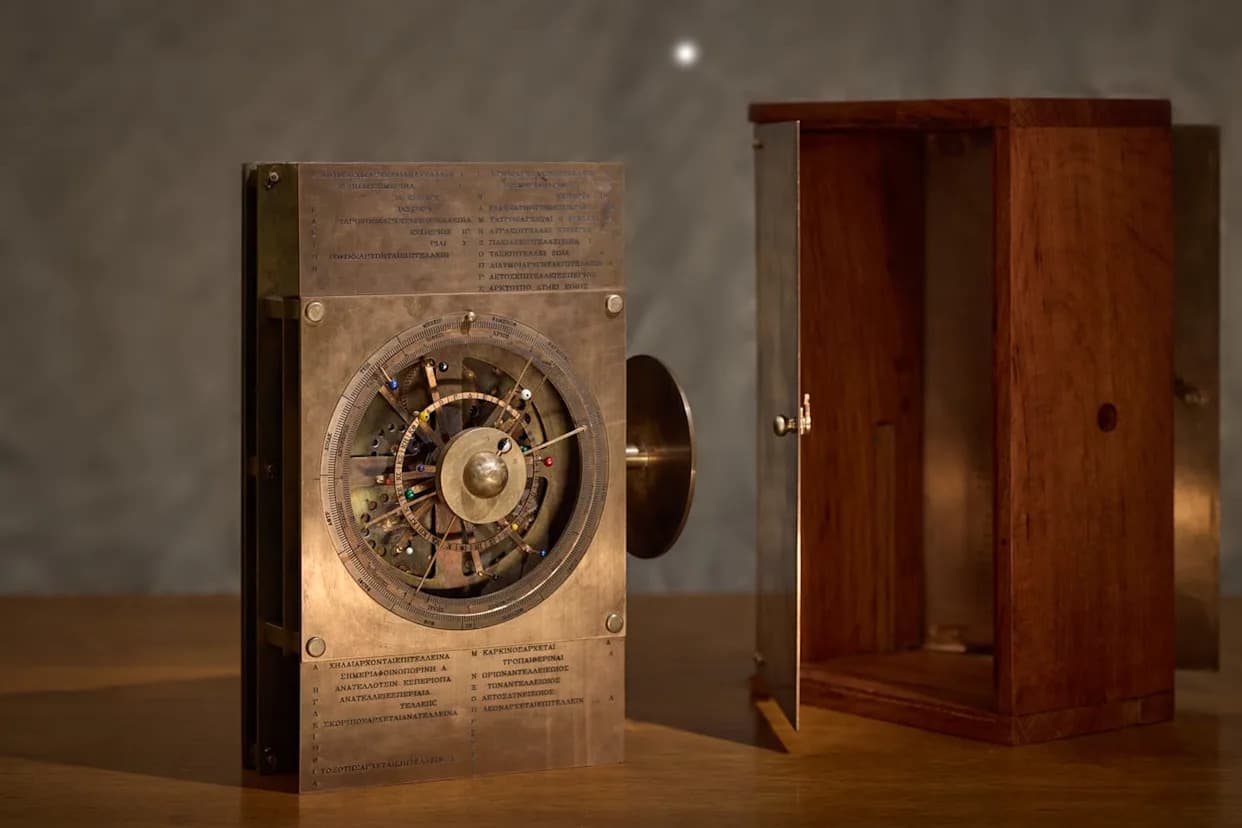
Is This the World’s First Computer?Jessica Wyld
Several millennia ago a Greek ship sank off the island of Antikythera in the Aegean Sea. Among the statues and coins recovered from the wreck in 1900 was a shoebox‑sized, heavily corroded bronze object that would come to be known as the Antikythera Mechanism.
Discovery and Early Recognition
Sponge divers recovered the wreck at the turn of the 20th century and, over decades of study, researchers realized the small artifact was not a simple trinket but a remarkably sophisticated mechanical device. Modern imaging and reconstruction show it contained multiple interlocking gears and finely engraved inscriptions—features unexpected for technology from that period.
What the Device Did
The Antikythera Mechanism is best described as an ancient astronomical calculator. Its known functions include:
- Modeling the motions of the Sun and Moon and, according to some reconstructions, representing planetary cycles.
- Predicting eclipses using an eclipse cycle mechanism related to the Saros period.
- Displaying long cycles such as the 19‑year Metonic cycle and a dial marking the cycle of the Ancient Olympic Games.
Why It Matters
Its gear complexity—fine teeth, compound gear trains and precise inscriptions—appears centuries ahead of when such mechanical sophistication was thought to exist. That has reshaped scholars’ understanding of Hellenistic engineering and astronomy.
Ongoing Mysteries
Only fragments of the mechanism survive, and no comparable intact devices have been found. That scarcity keeps major questions open: Was the mechanism the pinnacle of a lost technical tradition? A unique masterpiece by a few exceptional artisans? Or evidence of broader but now‑vanished mechanical knowledge?
Modern Research
Researchers continue to study the fragments with advanced tools—high‑resolution photography, X‑ray computed tomography, and 3D modeling—to reconstruct the original appearance and functions. Popular Mechanics editors Andrew Daniels and Jamie Sorcher investigate these discoveries and the debate over the device’s origins in their feature.
Bottom line: The Antikythera Mechanism rewrites assumptions about ancient technology and remains one of archaeology’s most intriguing puzzles—both for what it reveals and for the questions it leaves unanswered.
Help us improve.