
Divers have discovered a remarkably preserved 2,000‑year‑old pleasure barge near the submerged island of Antirhodos off Alexandria. The 28 m × 7 m vessel, capable of being rowed by up to 20 oarsmen, matches descriptions in ancient sources and bears Greek inscriptions linking it to Alexandria. Located close to the Temple of Isis, the barge may have served both elite leisure and religious processions. The site will remain protected on the seabed under UNESCO guidelines while researchers study its significance.
Remarkably Preserved 2,000‑Year‑Old Alexandrian Pleasure Barge Discovered Near Antirhodos

Map of the remains of the ship. Image: Franck Goddio/IEASM
Divers from the European Institute of Underwater Archaeology have uncovered the remarkably preserved remains of a 2,000‑year‑old pleasure barge near the now‑submerged island of Antirhodos off the coast of Alexandria, Egypt. The find offers a rare, tangible link to descriptions of elite leisure and ritual life in early Roman Egypt.
Discovery and Historical Context
Antirhodos sank beneath the sea over centuries as earthquakes and rising water levels reshaped the coastline. The island now lies about seven meters underwater beneath a layer of sediment. It was under that silt that researchers located the intact hull.
The Greek geographer Strabo, who visited Antirhodos between 29 and 25 BCE, described similar vessels in his writings:
"These vessels are luxuriously fitted out and are used by the royal court for excursions, and by crowds of revelers who set off from Alexandria across the canal to the public festivals. Day and night, the boats are full of people playing the flute and dancing uninhibitedly and with great abandon."
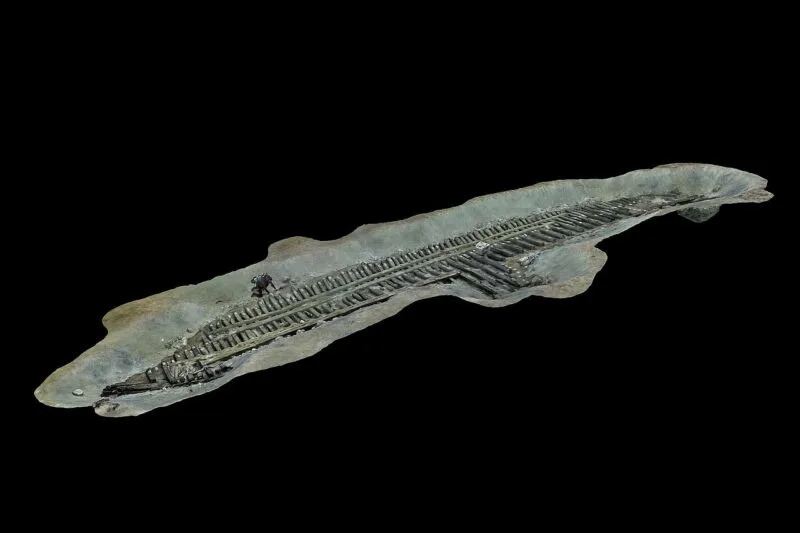
A 3D view of the barge. Image: Christoph Gerigk/Franck Goddio/Hilti Foundation.
What the Wreck Reveals
At first, the visible timbers led the team to suspect two separate ships. Subsequent examination showed all the timbers belonged to a single, unusually complete craft — a boat type previously known only from mosaics and literary descriptions, not from archaeological remains.
The barge measures roughly 28 meters long and 7 meters wide, with a rounded stern and a flat bottom suited to sheltered canals and rivers rather than open sea. Its breadth would have allowed a central pavilion or cabin for elite passengers, and it appears to have been propelled by as many as 20 oarsmen. Greek inscriptions carved into the wood — likely left by craftsmen or crew — point to an Alexandrian origin.
Religious and Social Role
The wreck lies close to the remains of the Temple of Isis. Lead researcher Franck Goddio and his team propose the vessel may have been used not only for private leisure but also in religious processions and festivals associated with the goddess Isis. The dual role would align with ancient accounts of boats serving both pleasure and ceremonial functions.
Conservation and Next Steps
Following UNESCO preservation guidelines, the wreck will remain on the seabed for now, protected in situ. Conservators and archaeologists hope careful study of the hull, its inscriptions and surrounding context will shed new light on daily life, luxury, naval technology and ritual practice in early Roman Alexandria.


