The Hebrew University team deployed an electric field mill in Holon and matched a seven-month record to local air-quality data, using only fair-weather days. They found that NOx spikes during rush hours produce near-instant changes in the near-surface Potential Gradient, while PM2.5 effects lag by about 2.5 hours. Weekend reductions in traffic correlate with weaker electric fields, supporting a causal link driven by pollutants scavenging atmospheric ions. The shifts are small and non-hazardous, and electric field monitoring could help track urban air pollution.
Traffic Patterns Alter Near-Surface Electric Field — Tel Aviv Study Shows Pollution’s Immediate Effect
The researchers linked electric field strength with traffic rush hours. (Yaniv et al.,Atmos. Res., 2025)
Detailed city-level measurements in the Tel Aviv metropolitan area reveal how daily traffic cycles change the electric field measured near Earth's surface.
Study Design
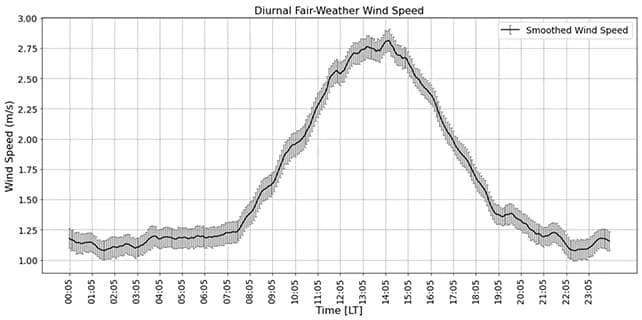
A team from The Hebrew University of Jerusalem deployed an electric field mill in Holon in 2024 and compared its readings with local air-quality observations collected over seven months. To avoid interference from precipitation and storms, the analysis used only measurements taken on fair-weather days. The researchers tracked common traffic-related pollutants, including gaseous emissions and particulate matter from exhaust and tire wear, as well as secondary compounds formed by atmospheric chemistry.
Key Findings
The data show that traffic emissions have a clear, measurable effect on the near-surface atmospheric electric field. Spikes in NOx concentrations and vehicle congestion coincide with morning and evening rush hours and produce an almost instantaneous change in the near-surface Potential Gradient (PG). By contrast, associations between PM2.5 concentrations and the electric field appear after a delay of roughly two-and-a-half hours; the team attributes this lag to differences in particle size, chemical composition and atmospheric lifetime.

Subscribe to ScienceAlert's free fact-checked newsletter
The researchers also observed a distinct weekend effect: when traffic-related pollutant levels drop on weekends, the local electric field weakens correspondingly, reinforcing a causal link between emissions and electrical variability.
"What we observe is a direct physical link between emission peaks and electrical variability,"
— Roy Yaniv, The Hebrew University of Jerusalem
Mechanism And Implications
The proposed mechanism involves atmospheric ions: pollutants scavenge charged ions in the air and thereby reduce atmospheric conductivity. A reduction in conductivity produces a compensatory increase in the measured electric field near the surface. The authors stress that the observed fluctuations are small and not hazardous — they are far too weak to disrupt weather systems or interfere with electronic devices.
Beyond the physics, the study highlights a practical application: near-surface electric field measurements could complement conventional air-quality monitoring and help map traffic-related pollution in dense urban environments, with implications for public-health assessment and urban planning.
The research is published in Atmospheric Research.
Help us improve.