
A Pusan National University lab measured ultrafine-particle emissions from common household appliances and found some devices — notably a pop-up toaster — produced extremely high counts (about 1.73 trillion UFPs per minute when run empty). Particles under 100 nm can evade nasal filtration and reach deep lung tissue, posing greater risks for children. The study also detected heavy metals in the airborne material and identified heating coils and brushed motors as likely sources. Researchers call for appliance redesigns and tighter regulations to reduce indoor exposure.
Everyday Appliances Release Trillions of Ultrafine Particles — Study Urges Design Changes

Toaster with one slice of smoking burned toast
A new laboratory study from Pusan National University (PNU) in South Korea measured airborne ultrafine-particle (UFP) emissions from common household appliances and identified devices that generate especially high counts.
Researchers placed a range of toasters, air fryers and hair dryers inside a controlled test chamber and quantified particles smaller than 100 nanometers — small enough to bypass nasal filters and penetrate deep into the lungs. The single highest source in their tests was a pop-up toaster operated empty, which emitted about 1.73 trillion UFPs per minute.
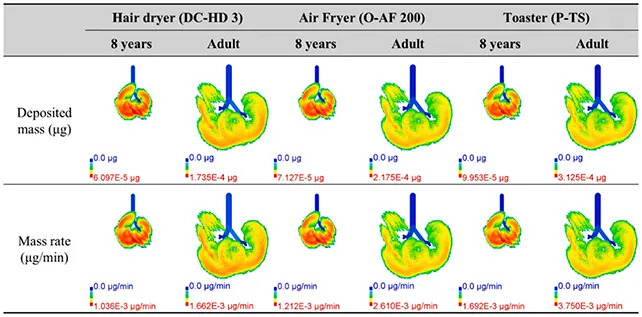
The researchers modeled, in computer simulations, the deposition of ultrafine particles in the lungs of adults and children. (Ryu et al,J. Hazard. Mater., 2025)
What the Study Found
Most tested devices produced substantial numbers of ultrafine particles. The team’s simulations indicated these particles are often too small for the nose to trap effectively and can reach deep lung tissue in both adults and children. Children may be at greater risk because of narrower airways and developing respiratory systems.
Chemical analysis of the airborne material also detected heavy metals — including copper, iron, aluminum, silver and titanium — which the authors say likely originate from wear or erosion of heating coils and motor components.

Subscribe to ScienceAlert's free fact-checked newsletter
"Our study emphasizes the need for emission-aware electric appliance design and age-specific indoor air quality guidelines," said Changhyuk Kim, an environmental engineer at PNU.
Likely Sources And Safer Alternatives
The investigators identified electric heating coils and brushed DC motors as major contributors to UFP generation. In the tests, brushless hair-dryer models emitted roughly 10 to 100 times fewer particles than dryers with brushed motors.
While this experiment did not measure direct health impacts from the appliances themselves, a substantial body of prior research associates inhalation of ultrafine particles with respiratory and cardiovascular effects. The authors urge manufacturers to redesign appliances to limit emissions and recommend that regulators consider tighter standards to accelerate those changes.
Practical Steps For Consumers
Until standards and designs improve, consumers may reduce exposure by ventilating cooking areas, avoiding running appliances empty (for example, heating a toaster with no bread inside), choosing models with brushless motors where possible, and keeping children away from rooms where devices generate visible smoke or odors.
"Understanding the source of the pollutants helps to develop preventive measures and policies for keeping healthy indoor air quality," Kim said.
The full study is published in the Journal of Hazardous Materials.


