
Summary: By the end of 2025 China had intensified military pressure on Taiwan with its largest drills yet, while the U.S. approved roughly $11 billion in arms to strengthen Taipei’s asymmetric defenses. Japan’s remarks linking Taiwan to its own security and repeated South China Sea clashes broadened regional stakes. Most officials say invasion is not the most likely near-term outcome, but sustained coercion, miscalculation and escalation present the main risks heading into 2026.
Taiwan 2025: China’s Largest Drills, $11B U.S. Arms Sale, and Rising Risks of Regional Escalation

As 2025 draws to a close, tensions between China and Taiwan are higher — and more overt — than at any point in recent years.
As 2025 ended, tensions across the Taiwan Strait reached heights not seen in recent years. Beijing escalated pressure on Taiwan through larger and more frequent military drills, increased air and naval activity near the island, and pointed political rhetoric. Washington and regional partners responded with sharper deterrence measures that China described as foreign interference, producing a more volatile balance where the risk of miscalculation has risen.
Year in Review: Military Posturing and Drills
Beijing closed out the year with what it called its largest Taiwan-focused military exercises to date. The December drills included live-fire elements and simulated encirclement operations that many analysts interpreted as practice for coercive scenarios below the threshold of all-out war — notably blockade or quarantine options intended to isolate Taiwan economically and politically.
Throughout 2025, People’s Liberation Army aircraft and ships operated nearer to Taiwan with greater frequency, testing Taipei’s responses and reinforcing Beijing’s sovereignty claims. Observers noted the drills increasingly emphasized joint operations, rapid mobilization and the ability to isolate the island.
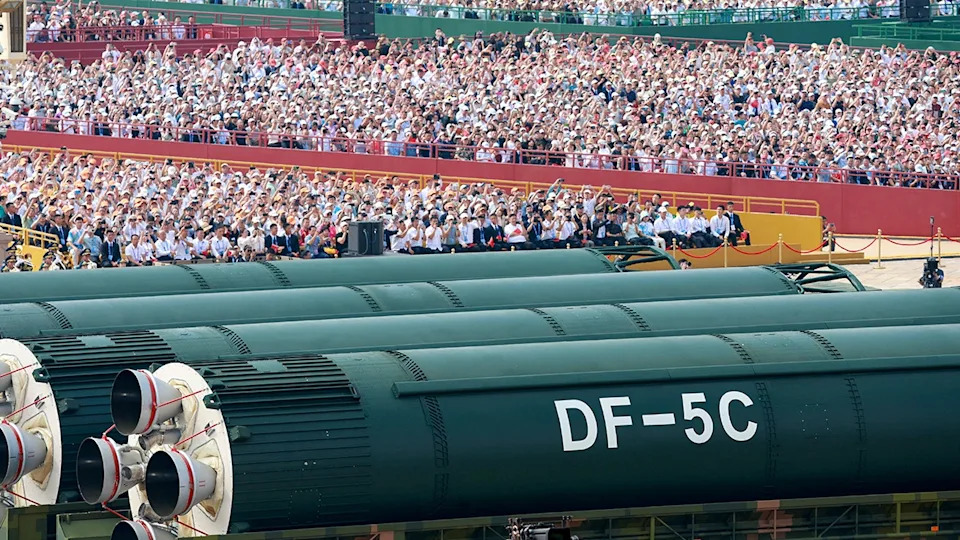
China shows off DF-5C intercontinental strategic nuclear missiles are showcased at a military parade to mark the 80th anniversary of the end of World War Two, in Beijing.
U.S. Response and Regional Reactions
In December the United States approved an arms package to Taiwan valued at roughly $11 billion — described by U.S. officials as one of the largest recent sales. The package focused on asymmetric capabilities such as missiles, drones and systems designed to complicate any coercive Chinese campaign rather than match Beijing weapon-for-weapon. U.S. leaders reiterated that peace and stability in the Taiwan Strait are vital U.S. interests while maintaining long-standing strategic ambiguity about direct defense commitments.
China’s Taiwan Affairs Office: "Any external forces that attempt to intervene in the Taiwan issue or interfere in China's internal affairs will surely smash their heads bloody against the iron walls of the Chinese People's Liberation Army."
Tokyo also shifted the regional calculus. In November, Japanese Prime Minister Sanae Takaichi made unusually direct remarks linking a Taiwan contingency to Japan’s own security, suggesting that an attack on Taiwan could trigger collective self-defense considerations under Japanese law. China protested, accusing Japan of abandoning post-war restraint and aligning with efforts to contain Beijing.
Meanwhile, repeated clashes between Chinese and Philippine vessels in the South China Sea over the year heightened concerns about a potential multi-front crisis implicating U.S. treaty commitments in the region.
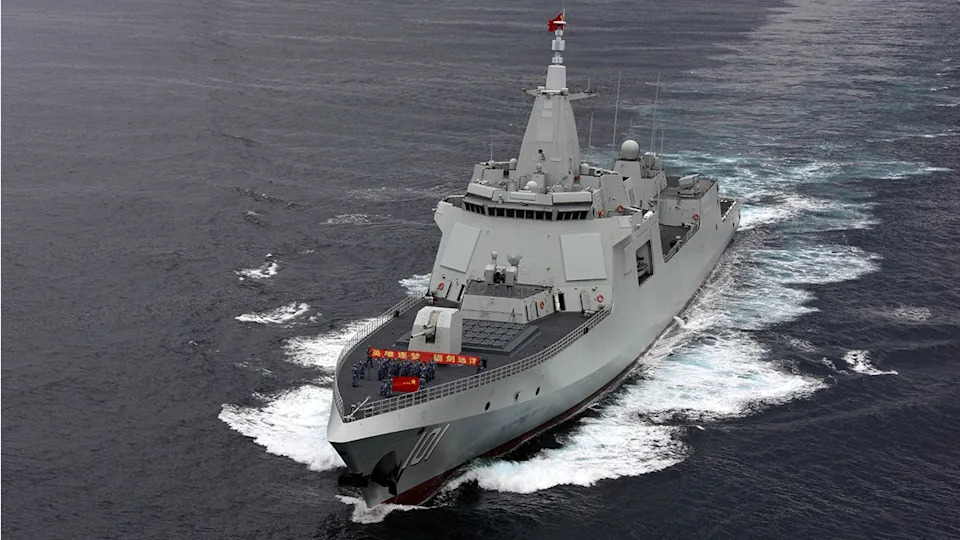
China's type 055 guided-missile destroyer Nanchang sails during a naval exercise.
Assessing the Risk: Invasion, Gray-Zone Tactics, and Miscalculation
The question facing policymakers is whether Beijing is approaching the point of launching a full-scale invasion. The evidence is mixed. The Pentagon’s 2025 report reiterated that U.S. defense assessments see China developing capabilities that could allow it to fight and win a war over Taiwan by 2027 — a benchmark shaping allied planning. At the same time, an amphibious invasion would be extraordinarily complex and risky, and many analysts believe China has incentives to continue applying pressure through gray-zone tools such as cyber operations, economic coercion, legal measures and military intimidation.
The December drills reinforced concerns that Beijing is rehearsing blockade-style coercion rather than an immediate large-scale invasion. For U.S. and regional officials, the most likely near-term danger is prolonged pressure, miscalculation and crisis escalation — particularly as more actors, from Japan to the Philippines, become directly implicated.
Outlook
As 2026 begins, the Taiwan Strait remains a prominent flashpoint. While most U.S. and regional officials judge a full-scale invasion is not the most likely near-term outcome, the rising tempo of operations, sharper rhetoric and deeper allied coordination have narrowed the margin for error. The coming year will test deterrence, crisis management and the ability of all parties to avoid unintended escalation.
Key Facts
- December 2025: China conducted its largest Taiwan-focused exercises, including live-fire and encirclement simulations.
- U.S. approved ~ $11 billion in arms for Taiwan focused on asymmetric defensive capabilities.
- Japan’s leader publicly linked a Taiwan contingency to Japan’s self-defense framework, raising regional stakes.
- Pentagon 2025 assessment highlighted a 2027 benchmark for Chinese capabilities relevant to Taiwan.
- Analysts warn gray-zone tactics and blockade scenarios pose a higher near-term risk than an immediate invasion.
Help us improve.





















