
NASA's SPHEREx telescope has released the first full-sky, three-dimensional infrared map, visualizing cosmic dust, hydrogen gas and millions of stars in dozens of colors. By measuring 102 infrared wavelengths and using redshift, SPHEREx enables distance estimates to hundreds of millions of galaxies and maps their distribution across nearly 14 billion years. Orbiting about 400 miles above Earth, SPHEREx will complete four full-sky scans over its two-year mission, cataloging more than 450 million galaxies and over 100 million Milky Way stars.
NASA’s SPHEREx Unveils Breathtaking Full-Sky 3D Infrared Map of the Universe

NASA's SPHEREx mapped the entire sky in 102 infrared colors to reveal the different features of the cosmos. Blue stars and hydrogen gas, green and white stars and red cosmic dust are seen in this panoramic view. (Credit: NASA/JPL-Caltech)
NASA has unveiled a breathtaking full-sky, three-dimensional map of the cosmos created by the SPHEREx space telescope. The map reproduces the telescope’s infrared view, rendering burnt-red cosmic dust, electric-blue hydrogen gas and stars in white, blue and green tones.
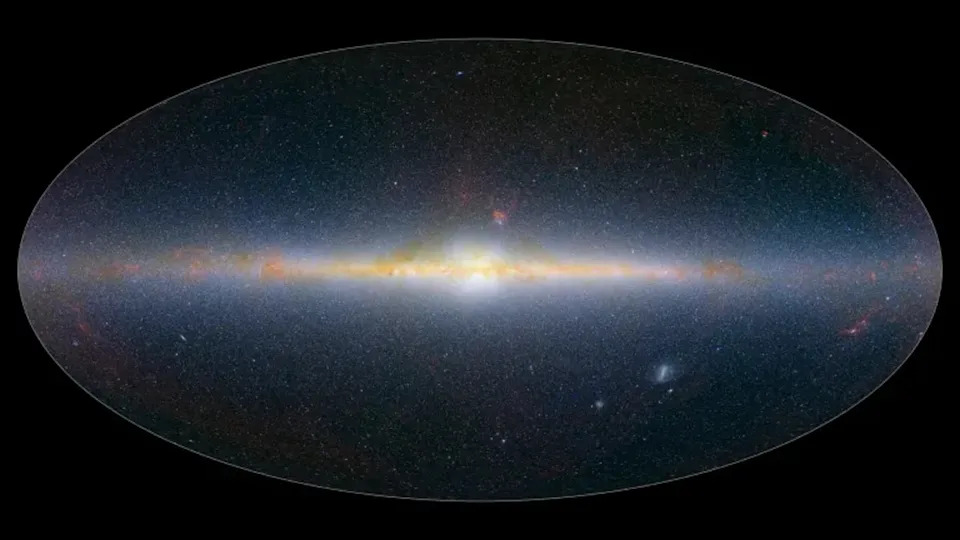
This SPHEREx image shows a selection of the infrared colors primarily emitted by stars and galaxies (Credit: NASA/JPL-Caltech)
What the Map Shows
Unlike visible-light images, SPHEREx observes 102 distinct infrared wavelengths, allowing it to capture dozens of colors that reveal physical properties and distances of celestial objects. By measuring how light stretches as the universe expands (a phenomenon called redshift), astronomers can estimate distances to hundreds of millions of galaxies and map their three-dimensional distribution across cosmic time.
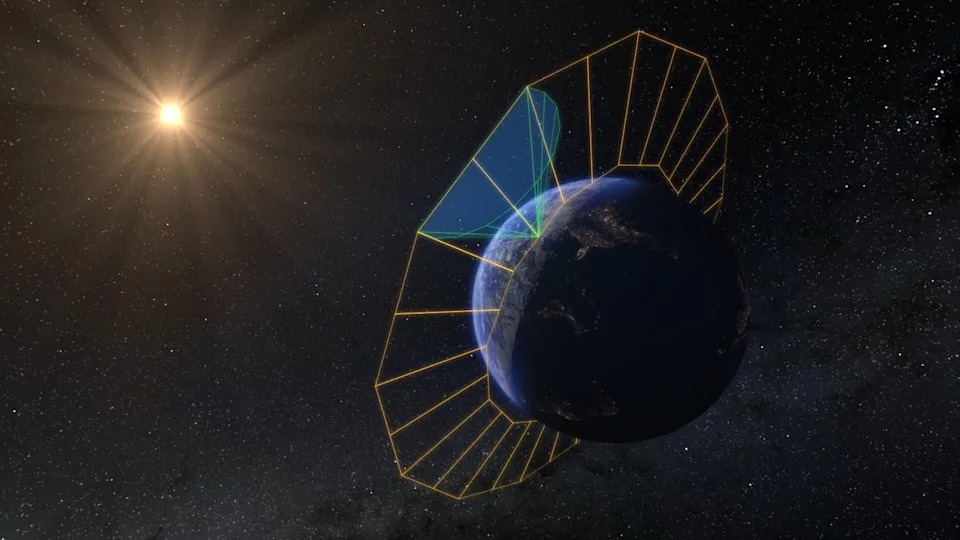
An artist's conceptual image shows NASA's SPHEREx telescope orbiting in space (Credits: NASA/JPL-Caltech)
Mission Details
Launched into low-Earth orbit in March, SPHEREx now orbits roughly 400 miles above Earth and completes about 14.5 circuits per day. Along each circular strip of sky it captures roughly 3,600 images, continuously shifting to build a complete 360-degree panorama. Over its two-year primary mission it will perform three additional full-sky scans, collecting data on more than 450 million galaxies and over 100 million stars within the Milky Way.
Why It Matters
Scientists will use this unprecedented dataset to study galaxy evolution over nearly 14 billion years and to investigate how the chemical ingredients for life formed in our galaxy. The survey also provides a way to probe fundamental events that occurred in the earliest moments after the Big Bang and how they influenced the large-scale structure of the universe.
While the James Webb Space Telescope also observes infrared light, its field of view is much smaller; SPHEREx's wide-area mapping complements Webb's deep, targeted observations by identifying compelling targets for follow-up study.
SPHEREx is a mid-sized astrophysics mission delivering big science. It’s a phenomenal example of how we turn bold ideas into reality, and in doing so, unlock enormous potential for discovery.


