The national museum in Tripoli has reopened after a 14-year closure following the 2011 uprising, returning ancient artifacts to public view. Staff secretly safeguarded the collection until a six-year rehabilitation — funded in part by the Tripoli government and supported by the French archaeological mission and the ALIPH Foundation — modernised the galleries with digital displays and interactive tools. The reopening is widely seen as a restoration of a national symbol and a step toward cultural education and reconciliation.
Tripoli's National Museum Reopens — Libya Reclaims a Shared Heritage
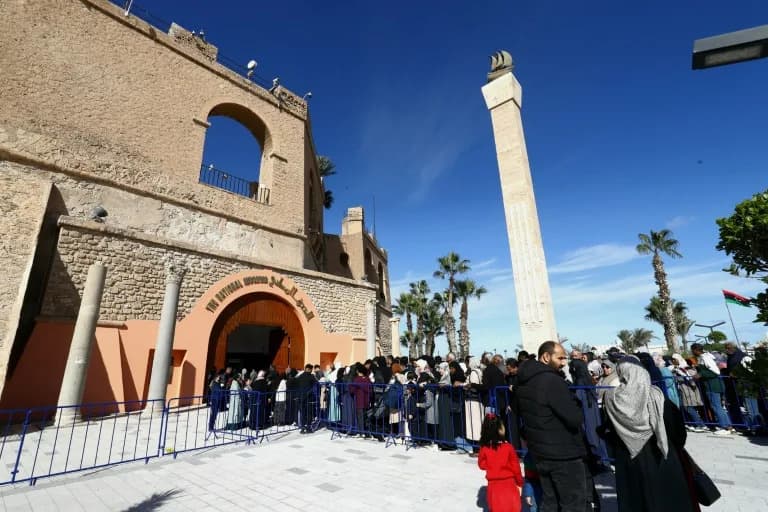
Libyans are rediscovering a heritage that transcends political divides at their national museum which reopened this month after a 2011 uprising (Mahmud Turkia)(Mahmud Turkia/AFP/AFP)
The national museum in central Tripoli has reopened this month, welcoming Libyans back into galleries of ancient statues, Greek and Roman antiquities, Ottoman-era weaponry and jewellery, and natural-history exhibits that together trace the country’s long and diverse past.
A Carefully Preserved Collection
For 14 years, curators and staff moved the museum’s treasures into secret, sealed rooms to protect them from looting and damage after the 2011 uprising that toppled Moamer Kadhafi. Mohamed Fakroun, head of international cooperation at the antiquities department, said the removal and protection of objects was essential during a "dark period" of instability.
"We worked to preserve a historic and cultural heritage that belongs to all Libyans," said curator Fathiya Abdallah Ahmad, one of the few staff members who knew the locations of the secret storerooms.
Modern Presentation, Deep Roots
The restored museum — located in the waterfront building known locally as the Red Citadel — reopened after a six-year renovation. The refreshed galleries feature digital projections, interactive screens, audio guides, videos and QR codes so visitors can explore context and provenance in depth. One gallery is devoted to the Roman emperor Septimius Severus, who was born in nearby Leptis Magna, a UNESCO World Heritage site.
Another room showcases artifacts that were stolen during the years of unrest and later repatriated, including items returned from institutions in the United States and the United Kingdom.
Investment, Cooperation and Hope
The Tripoli government invested more than $5 million in the museum and its surrounding area despite ongoing economic challenges. The six-year restoration was carried out in cooperation with the French archaeological mission and the ALIPH Foundation (International Alliance for the Protection of Heritage).
Locals described the reopening as the "return of a national symbol" and a step toward reconciliation. Students, teachers and families have been visiting in large numbers: architecture student Nirmine Miladi, 22, said she felt transported by the galleries, while her sister Aya, 26, praised the lighting and interactive tools for making the collection accessible to a new generation.
Teacher Fatima al-Faqi, 48, brought high-school pupils to help them "discover Libya's history and nourish their sense of patriotism," and visitor Sarah al-Motamid, 34, said she came with her six-year-old daughter so the child would "understand that we are not without a past or civilisation." Officials hope the museum will offer a unifying story of Libya’s identity to many visitors who were not born when it last opened before 2011.
Help us improve.