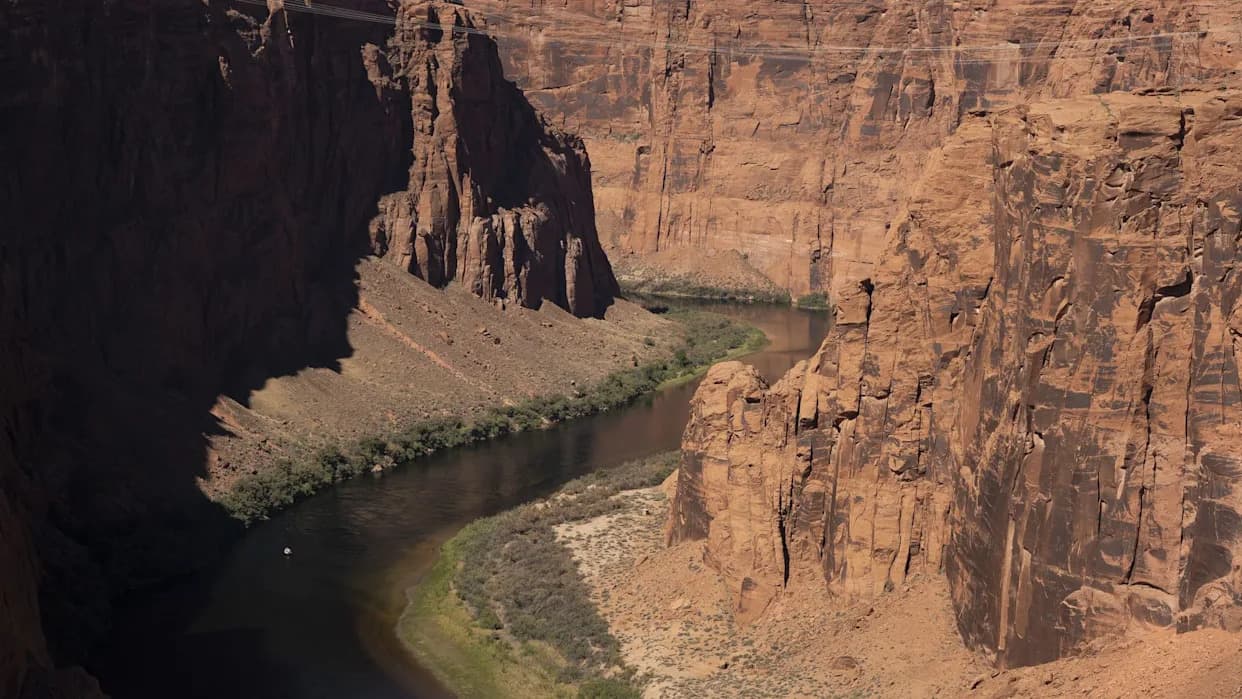
Kansas grasslands are being overtaken by eastern red cedar, a process called woody encroachment that converts prairie to dense tree cover and increases wildfire risk. A March fire in Yates Center burned 130 acres and destroyed a nursing home, underscoring the danger posed by cedar stands. Scientists link cedar spread to rising CO2 and past changes in land management; conservationists and ranchers promote prescribed burning and regenerative grazing to restore resilient prairie and protect ranching livelihoods.
Kansas Grasslands Under Siege: Ranchers Turn to Fire and Regenerative Grazing to Fight Cedar Invasion
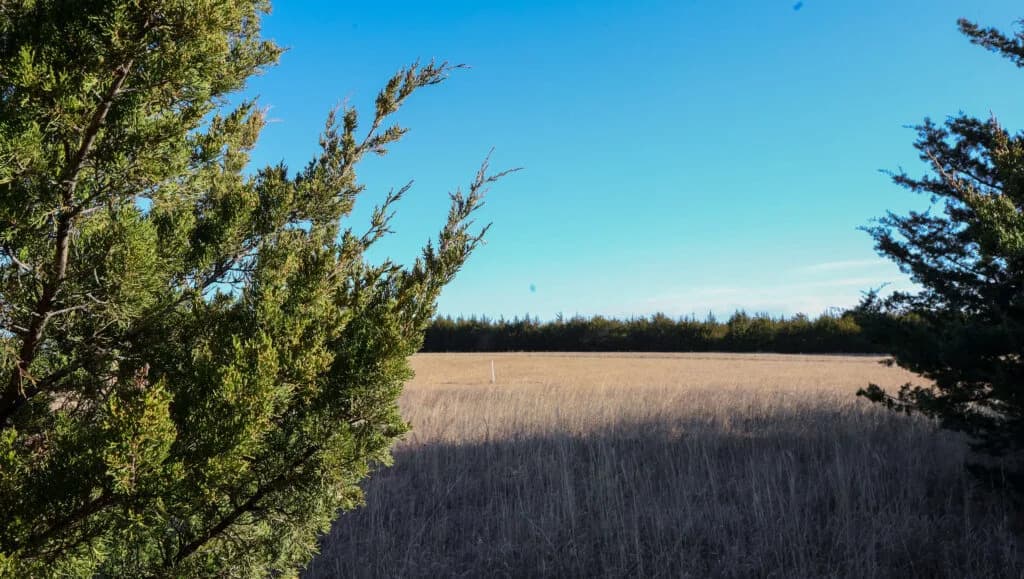
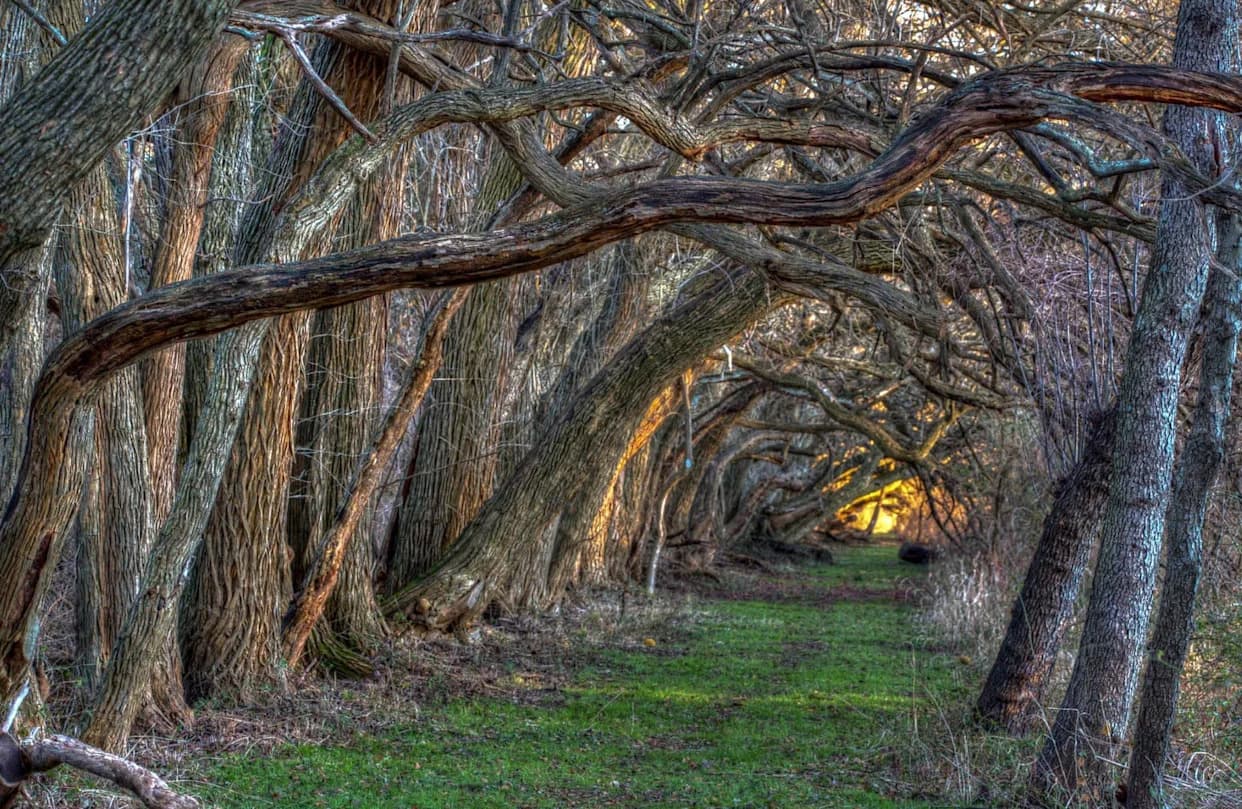
Eastern red cedars surround the Rockefeller Prairie from all sides at the University of Kansas field station north of Lawrence, where researchers have studied the effects of both fire and grazing on grassland ecosystems.
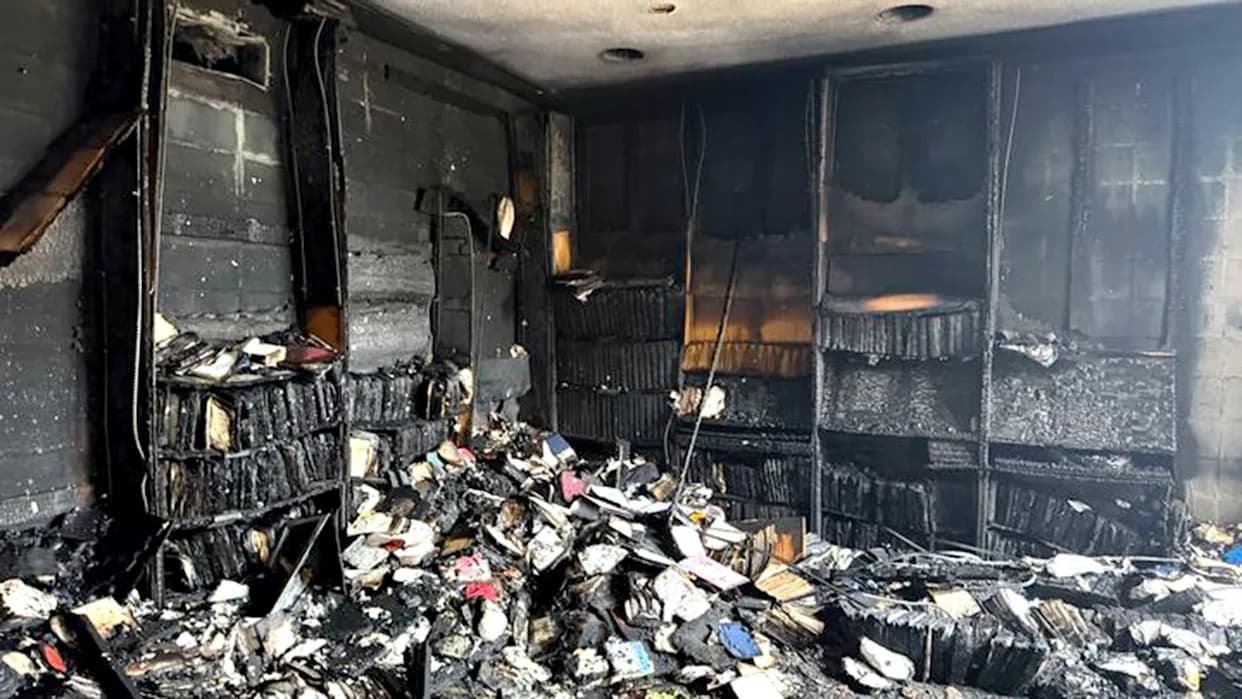
LAWRENCE, Kan. — A wind-driven wildfire this March tore through 130 acres in Yates Center, destroying the Yates Center Health and Rehabilitation Center and causing nearly $5 million in damage. Dense stands of eastern red cedar that had encroached near the building provided abundant kindling and helped the blaze spread.
“The fire jumped the road and got into the cedars,” Yates Center Fire Chief Brandon Gaulding told KOAM News. “It went through the cedars so fast that by the time we got to the nursing home… the wind was too much.”
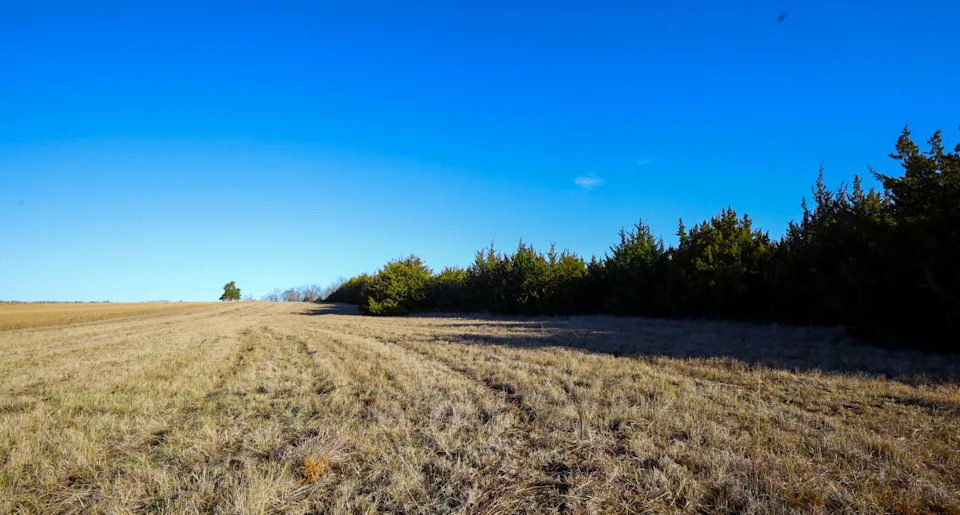
Rockefeller Prairie, at the University of Kansas field station north of Lawrence, is surrounded by encroaching eastern red cedar trees. The university has conducted land management experiments involving both fire and grazing for five decades. (Photo by Erin Socha for Kansas Reflector)
What Is Woody Encroachment?
Woody encroachment is the expansion of trees and shrubs into native grasslands. In Kansas and across the Great Plains, eastern red cedar has rapidly invaded prairies, transforming open grassland into dense tree stands. Scientists say this shift now converts more grassland than row-crop agriculture in some areas.
Why It Matters
Researchers warn that the spread of cedar and other woody species threatens biodiversity, water availability, ranching livelihoods and public safety. Jesse Nippert, a distinguished biology professor at Kansas State University, calls the phenomenon “the single greatest conservation threat of what will be my lifetime.” He and others point to several drivers:
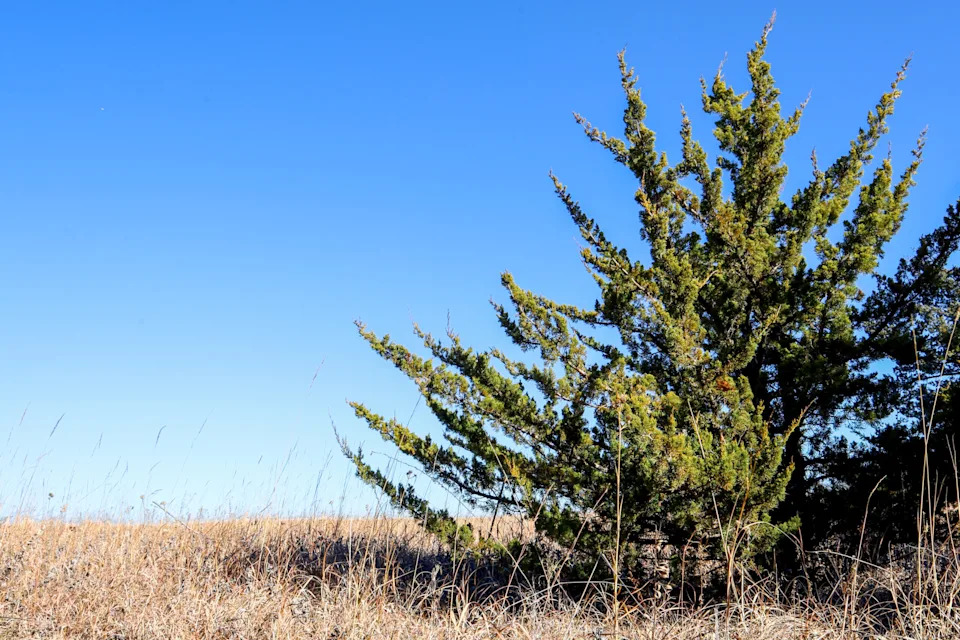
An eastern red cedar tree establishes a foothold on Rockefeller Prairie, an experimental site at the University of Kansas field station north of Lawrence where researchers have studied burning and grazing as tools for land management. (Photo by Erin Socha for Kansas Reflector)
- Rising atmospheric CO2: Higher carbon dioxide helps trees like eastern red cedar survive in drier environments, expanding the range where they can grow.
- Land-use and land-management changes: Reduced fire frequency and different grazing patterns allow trees to establish and spread.
- Hydrology impacts: Woody species consume more than twice the water of native grasses and increase soil porosity, contributing to lower groundwater and drier soils.
Consequences include shrinking rangeland for cattle, increased wildfire risk (as seen in Yates Center), more tick-borne disease, and long-term ecosystem shifts down to bedrock and soil structure.
Ranchers, Conservationists and Solutions
Kansas has roughly 15 million acres of grassland that support cattle ranching, the state's largest agricultural industry. Many ranchers are now on the front lines of efforts to stem cedar invasion using a mix of traditional and innovative practices.

Phillip Simmonds, regenerative livestock manager for the Iowa Tribe of Kansas and Nebraska, says large grazing animals were fundamental to prairie’s evolution. (Photo by Erin Socha for Kansas Reflector)
Regenerative grazing — combining planned rotation of livestock with other practices such as prescribed burning — is a key strategy promoted by conservation groups. Rob Manes, co-director of regenerative grazing lands strategy for The Nature Conservancy, explains that leaving enough residual grass fuels hotter, more effective prescribed fires that can kill young cedar trees. The result: increased forage, greater drought resilience and habitat recovery for species such as the lesser prairie-chicken.
“If we can establish a grazing regime that leaves enough residual grass to create a hot enough fire to kill cedar trees, then we increase forage for cattle, we increase drought resiliency, and we bring back lesser prairie chickens,” said Manes.
Ranchers and tribal managers also emphasize that grazing — when managed to avoid overgrazing — can mimic the historic effects of large herbivores like bison. Phillip Simmonds of the Iowa Tribe of Kansas and Nebraska notes that grazing is how the prairie evolved; Justin Roemer of Smoky Valley Ranch reports similar grazing behavior between cattle and bison when animals are managed for resilience.
On-the-Ground Tools
- Prescribed fire: Controlled burns remove woody seedlings and maintain open prairie structure.
- Targeted tree removal: Mechanical cutting or chemical treatments eradicate mature cedar stands in priority areas.
- Adaptive grazing: Rotational systems that leave adequate residual cover support hotter burns and healthier soils.
- Community and landscape-scale planning: Coordinated efforts between ranchers, tribes, conservation groups and agencies deliver bigger conservation wins than isolated actions.
Takeaways
Woody encroachment presents ecological, economic and public-safety challenges for Kansas and grasslands worldwide. While rising CO2 and past management decisions have enabled cedar expansion, land managers and ranchers are using prescribed fire and regenerative grazing to restore resilient prairie and protect both habitat and livelihoods.
Economy and ecology converge: Healthy grazing systems can increase forage, reduce cedar cover and support ranching communities — but success requires coordination, resources and ongoing management.
Help us improve.