
The Northern Hemisphere experiences its shortest day on the winter solstice, while the Southern Hemisphere has its longest day and the start of summer. "Solstice"—from Latin—marks the sun’s lowest or highest annual arc; after the winter solstice daylight lengthens each day. Equinoxes bring nearly equal day and night, and meteorological seasons follow fixed three-month blocks (Mar 1, Jun 1, Sept 1, Dec 1).
Winter Solstice Arrives: Shortest Day in the Northern Hemisphere — What to Know

FILE - People celebrate the Winter Solstice sunrise celebrations at Stonehenge, England, Saturday, Dec. 21, 2024. (AP Photo/Anthony Upton, file)(ASSOCIATED PRESS)
Yes — the darkest day of the year has arrived for people north of the equator, but it also marks the moment daylight will slowly begin to return. The winter solstice brings the shortest day and longest night to the Northern Hemisphere while the Southern Hemisphere enjoys its longest day and the start of summer.
The term solstice comes from the Latin words sol (sun) and stitium (a pause or stop). The solstice marks the point at which the sun ends its annual shift higher or lower in the sky. At the winter solstice the sun traces its lowest, briefest arc across the sky; after this point the sun begins to climb higher each day and daylight gradually increases until the June solstice.
People have observed and celebrated solstices for millennia, often with rituals or monuments aligned to the sun’s path — Stonehenge being a famous example. To understand why solstices and equinoxes occur, it helps to look at Earth’s tilt and orbit.
What Is the Solstice?
Earth orbits the sun with its axis tilted about 23.5 degrees. That tilt causes sunlight to fall unevenly on the Northern and Southern Hemispheres through the year. Solstices occur when Earth’s axial tilt is at its maximum toward or away from the sun, producing the greatest difference in day length between the hemispheres.
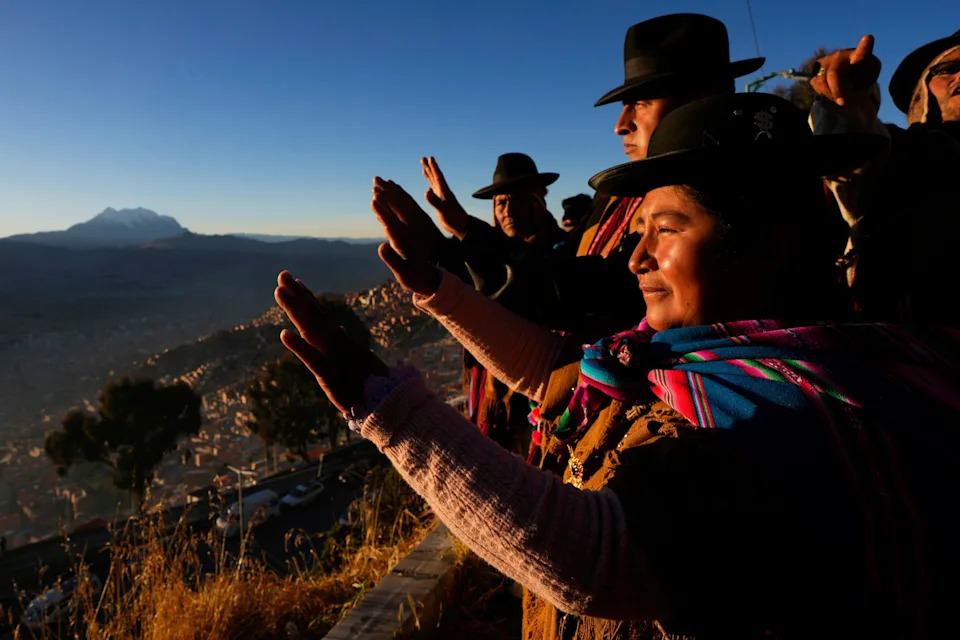
Aymara Indigenous people hold up their hands to receive the first rays of sunlight in celebration of the Andean New Year 5533, marking the Southern Hemisphere's winter solstice, in El Alto, Bolivia, June 21, 2025. (AP Photo/Juan Karita, File)(ASSOCIATED PRESS)
At the Northern Hemisphere’s winter solstice, the North Pole is tilted farthest away from the sun, producing the shortest day and longest night of the year. Winter solstices can occur between Dec. 20 and Dec. 23; this year it falls on Dec. 21. The opposite occurs at the Northern Hemisphere’s summer solstice (usually June 20–22), when the North is tilted toward the sun and days are longest.
What Is the Equinox?
Equinoxes happen when Earth’s axis is oriented so both hemispheres receive roughly equal sunlight. The word "equinox" comes from Latin words meaning "equal" and "night." On an equinox, day and night are nearly the same length around the globe, though local differences (and atmospheric refraction plus the sun’s apparent size) mean daylight and night are not exactly equal.
The Northern Hemisphere’s autumnal equinox typically occurs between Sept. 21 and 24; the vernal (spring) equinox usually falls between March 19 and 21.
Meteorological vs. Astronomical Seasons
Astronomical seasons are determined by Earth’s position in orbit (solstices and equinoxes). Meteorological seasons are based on the annual temperature cycle and are defined as fixed three-month periods for easier climate statistics: spring begins March 1, summer June 1, autumn Sept. 1 and winter Dec. 1.
Quick Notes on Observing
Day length changes most noticeably at higher latitudes. Near the poles, the sun can remain below or above the horizon for long stretches. On the equinoxes and solstices, many cultures hold festivals or mark the occasion with monuments aligned to the sun’s rising or setting points.
The Associated Press Health and Science Department receives support from the Howard Hughes Medical Institute’s Department of Science Education and the Robert Wood Johnson Foundation. The AP is solely responsible for all content.


