
The SNO+ experiment at SNOLAB has, for the first time, directly observed solar neutrinos converting carbon‑13 into nitrogen‑13. Researchers analyzed 231 days of data (4 May 2022–29 June 2023), finding 60 candidate delayed‑coincidence events and estimating 5.6 genuine neutrino‑driven transmutations versus 4.7 expected. The observation provides the first direct low‑energy cross‑section measurement for this reaction and offers a new benchmark for nuclear physics.
Neutrino Alchemy: Solar 'Ghost' Particles Caught Turning Carbon‑13 Into Nitrogen‑13

Neutrino Alchemy: Sun's Ghost Particles Finally Caught Transforming Atoms
Deep beneath Earth's surface at SNOLAB in Canada, researchers operating the SNO+ detector have for the first time observed solar neutrinos directly converting carbon‑13 nuclei into nitrogen‑13. This rare, neutrino‑mediated nuclear reaction confirms theoretical expectations and provides a new low‑energy benchmark for nuclear physics.
Neutrinos—nearly massless, uncharged particles produced in vast numbers by the Sun's fusion reactions—pass through ordinary matter almost unhindered. Every second, hundreds of billions stream through our bodies, which is why they are often called "ghost particles." Only occasionally does a neutrino interact with a nucleus, producing a faint flash of light that large, shielded detectors can register.
YouTube Thumbnail
SNO+ sits about 2 kilometers (roughly 1.24 miles) underground, where the surrounding rock shields the detector from cosmic rays and ambient radioactivity. A large volume of liquid scintillator inside the detector amplifies tiny flashes of light produced when particles interact, while arrays of photodetectors record the resulting signals.
How the reaction works
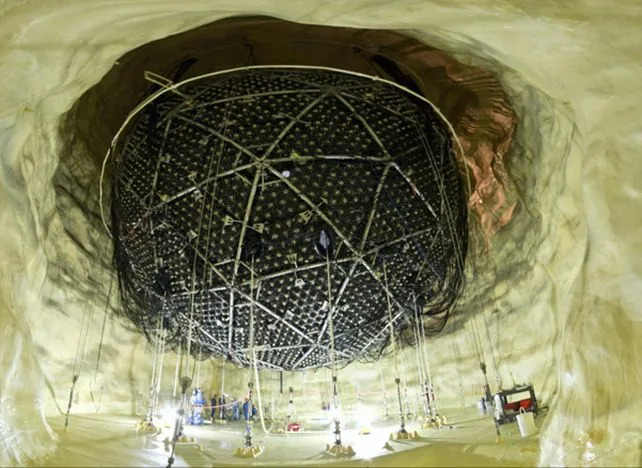
The outside of the SNO+ detector vessel. (SNOLAB)
When a solar electron neutrino (νe) hits a carbon‑13 nucleus (13C), the weak force converts one neutron into a proton and emits an electron, producing nitrogen‑13 (13N):
13C + νe → 13N + e−
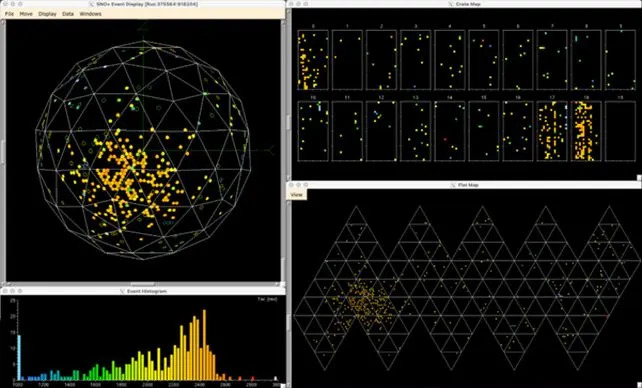
The event display in the SNOLAB control room. (SNOLAB)
Because 13N is radioactive with a half‑life of about 10 minutes, it subsequently decays and emits a positron (an anti‑electron). This sequence produces a distinctive "delayed coincidence" signature: an initial electron signal followed about 10 minutes later by a positron signal.
Data and results

Subscribe to ScienceAlert's free fact-checked newsletter
The analysis, led by Gulliver Milton of the University of Oxford, examined SNO+ data recorded between 4 May 2022 and 29 June 2023 (231 days of live observation). From that dataset the team identified 60 candidate delayed‑coincidence events. Using their statistical model, they estimate that 5.6 of those events are genuine neutrino‑driven 13C→13N transmutations, close to the 4.7 events predicted by theory.
"This discovery uses the natural abundance of carbon‑13 within the experiment's liquid scintillator to measure a specific, rare interaction," says physicist Christine Kraus of SNOLAB. "To our knowledge, these results represent the lowest energy observation of neutrino interactions on carbon‑13 nuclei to date and provide the first direct cross‑section measurement for this specific nuclear reaction to the ground state of the resulting nitrogen‑13 nucleus."
Physicist Milton added: "Capturing this interaction is an extraordinary achievement. Despite the rarity of the carbon isotope, we were able to observe its interaction with neutrinos, which were born in the Sun's core and travelled vast distances to reach our detector."
Steven Biller of the University of Oxford highlighted the broader context: "Solar neutrinos were central to discoveries recognized by the Nobel Prize for SNO in 2015. It is remarkable that we can now use solar neutrinos as a 'test beam' to study other rare nuclear reactions."
Why it matters
The measurement gives the first direct cross‑section for this low‑energy reaction to the ground state of 13N and represents the lowest‑energy observation of neutrino interactions on carbon‑13 so far. That direct experimental input helps refine nuclear models and will support future neutrino and nuclear physics studies that rely on precise reaction probabilities.
The team's results have been published in Physical Review Letters.


