
Researchers have described a new Ice Age species, Speleotherium logani, from well-preserved fossils recovered in Muskox Cave, Carlsbad Caverns. The specimens—excavated in 1976–1977 and housed at the Smithsonian for more than 40 years—include a near-complete skull and skeleton and were reexamined in 2023. Comparative analysis found matching bones at sites in New Mexico, Mexico and Belize, showing a wider distribution during the Late Pleistocene. The species is closely related to the modern muskox of the Arctic.
Ice Age Muskox Relative, Speleotherium logani, Identified From Carlsbad Caverns Fossils

Researchers identify Ice Age mammal found in Carlsbad Caverns
A team of paleontologists has described a previously unrecognized Ice Age relative of the muskox from fossils recovered in Carlsbad Caverns National Park. The new species, Speleotherium logani, is described in a paper led by Gary Morgan, paleontology curator at the New Mexico Museum of Natural History & Science, with coauthors Richard White, Jim Mead and Sandy Swift of the Mammoth Site in Hot Springs, South Dakota.
Speleotherium logani is named in honor of Lloyd Logan, the paleontologist who led the fieldwork that uncovered the material in 1976 and 1977. The Muskox Cave collection includes a nearly complete skull and much of the animal’s skeleton, providing unusually well-preserved anatomical evidence for describing a new species.
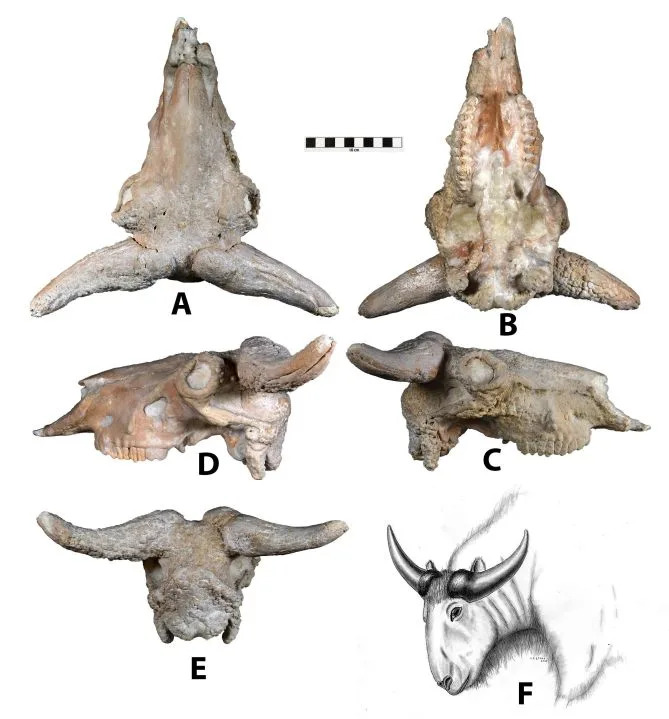
Fossils from the Ice Age muskox relative Speleotherium logani found in Muskox Cave, Carlsbad Caverns National Park. (A) dorsal, (B) ventral, (C) right lateral, (D) left lateral, (E) posterior, and (F) reconstructed view. Drawn by Lloyd E. Logan (Usage: Courtesy of NMMNHS | Credit: Lloyd Logan)
After excavation, the fossils were curated in the Smithsonian’s National Museum of Natural History for more than four decades. The research team resumed study of the material in 2023 and recognized anatomical features that distinguish the specimens from known species of muskox relatives.
Broader Distribution and Age
Using the Muskox Cave specimens as a reference, researchers identified matching bones at four additional sites: U-Bar Cave in the Bootheel region of southwestern New Mexico, two caves in Mexico and one cave in Belize. These records indicate that Speleotherium had a broader geographic range across parts of North and Central America during the Ice Age.
Speleotherium lived during the Late Pleistocene — the epoch that ended less than 12,000 years ago — and is closely related to the modern muskox that inhabits Arctic regions of Alaska, Canada and Greenland. "New Mexico is known as a hotbed for dinosaur fossils, but discoveries like this remind us that our state's fossil record extends long after the Cretaceous extinction," said Dr. Anthony Fiorillo, executive director of the New Mexico Museum of Natural History & Science. "The discovery of Speleotherium in Muskox Cave and U-Bar Cave attests to the extraordinarily rich fossil record of Ice Age mammals in New Mexico," Morgan added.
Note: The fossils were discovered in fieldwork carried out in 1976–1977, curated for decades at the Smithsonian, and formally studied and described by the current team beginning in 2023.


