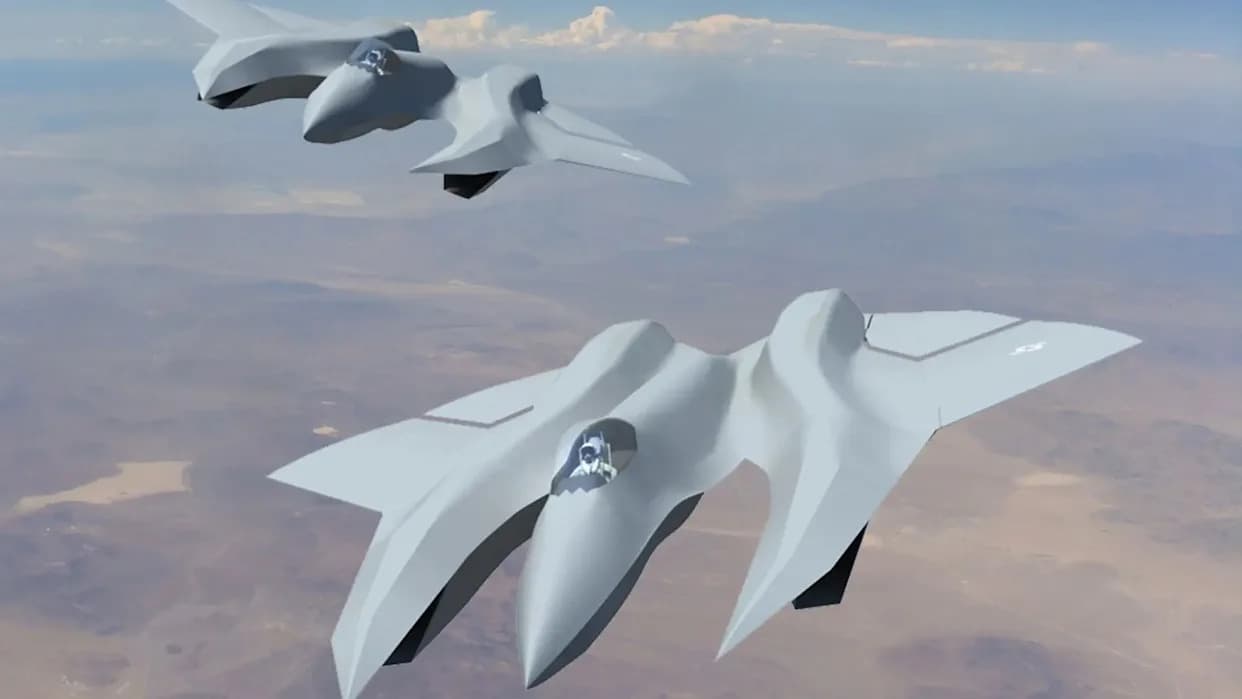
Northrop Grumman and Scaled Composites unveiled Project Talon, a new CCA demonstrator designed for lower cost and faster production. Developed over roughly 15 months with a targeted first flight in about nine months, Talon emphasizes reduced parts count, lighter weight and rapid manufacturability while retaining stealthy shaping and modular mission adaptability. The aircraft uses Northrop’s Prism autonomy suite and extensive digital design methods; officials describe the program as both a new airframe and an experiment in faster, more scalable engineering and production approaches.
Northrop Grumman Reveals Project Talon: A Lean, Stealthy CCA Demonstrator

Northrop Grumman and its Scaled Composites subsidiary publicly revealed Project Talon, a new Collaborative Combat Aircraft (CCA) demonstrator, at Mojave Air and Space Port. Company representatives say Talon has been under development for about 15 months and is targeting a first flight in roughly nine months.
Engineered as a lower-cost, rapidly producible alternative to previous designs, Talon was developed using lessons from the U.S. Air Force’s Increment One CCA competition. Northrop frames the demonstrator as “cheaper and better” in several respects, trading some extremes of peak performance for reduced complexity, lower weight, and faster manufacture.
Design and onboard systems
Observers describe Talon as a familiar unmanned combat airframe profile with a lambda wing, V-tail, a dorsal trapezoidal inlet and a shovel-shaped nose with a prominent chine line. Sawtooth-edged and trapezoidal access panels appear across the airframe, and a semi-recessed, circular exhaust sits between the tails. The shaping emphasizes low observability, particularly from forward aspects.
The demonstrator carries Northrop’s Prism autonomy suite for onboard command-and-control — software already tested on the company’s Beacon demonstrator. The aircraft in its current flight-test configuration is not fully missionized but is designed to be adaptable to multiple roles based on customer requirements.
Key engineering choices and performance targets
- Approximately 50% fewer parts versus Northrop’s earlier Increment One concept.
- Roughly 1,000 pounds lighter and about 30% faster to produce, company officials say.
- Extensive use of digital design tools and modern composite construction to speed development.
Northrop and Scaled said landing gear for Talon is sourced from an existing design (the origin was not disclosed), a typical cost-and-schedule control measure. FAA registration lists the demonstrator as N444LX and Model 444, consistent with Scaled Composites’ historical model numbering.
Visible features and test instrumentation
On the prototype, three air-data probes protrude from the nose, and several small domed antennas are visible on the forward fuselage and atop the intake. The underside features a large sawtooth-edged panel observers suspect conceals a weapons bay, though Northrop did not confirm that detail. The main landing gear are single-tire units that retract inward beneath widely spaced wing positions, and a small aperture under the nose likely houses a test camera or sensor.
Program intent and organizational lessons
Northrop executives described Project Talon as an experiment in methodology as much as an airframe. The program aimed to show how digital tools, design trade-offs, and simplified architectures can yield high-performing systems that are faster and less expensive to produce at scale.
"This was an experiment on a new methodology for designing aircraft faster that would enable us to scale manufacturing faster," said Tom Jones, President of Northrop Grumman’s Aeronautics Systems sector. "The outcome was an aircraft — but the outcome we were shooting for was the process."
Greg Morris, President of Scaled Composites, noted that while Talon does not have a complete "digital twin," digital environments were used extensively alongside physical testing to optimize development and speed delivery.
Northrop also highlighted its sizeable internal research-and-development investment, saying recent independent R&D spending is near $1 billion and roughly 40% higher than some public peers. Company leaders framed that spending as part of a broader push to change engineering culture and scale production more rapidly when required.
Market context
The public reveal places Northrop squarely back in the CCA conversation, alongside other entrants such as General Atomics, Anduril, Boeing and Lockheed Martin, all of which have active efforts or demonstrators in the collaborative combat/drone support space. Northrop says Talon is already attracting interest from U.S. services and foreign customers, though the company has not positioned this demonstrator exclusively for the Air Force’s upcoming Increment Two competition.
More technical details and formal performance figures were not released at the event. Reported by Joseph Trevithick.
Help us improve.