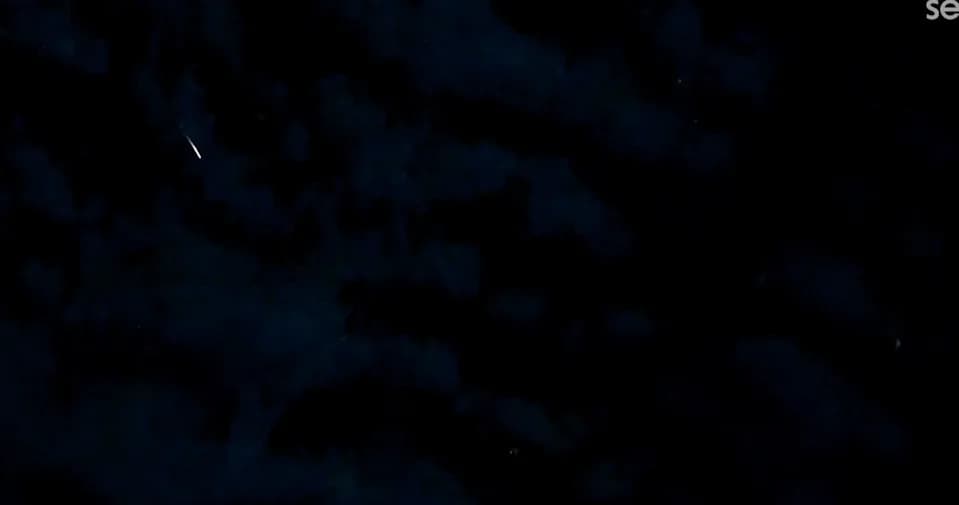
The Cincinnati Observatory posted video of a bright fireball seen on Nov. 28 and later announced it had recovered multiple micrometeorites after a September visit from hobbyist Dusty Segretto. About 50 eyewitness reports to the American Meteor Society place the meteor’s path over western Kentucky near Owensboro. Ryle noted micrometeorites fall constantly but are easiest to find in long-uncleared debris (like gutters or roofs). The Geminid meteor shower peaks Dec. 13–14 and can produce many meteors from a dark site.
Thanksgiving Fireball Over Cincinnati — Observatory Posts Video and Confirms First Micrometeorites

While many were finishing Thanksgiving leftovers and preparing for an approaching snowstorm, a bright fireball lit up the skies over Cincinnati on the night of Nov. 28. The city’s observatory shared video of the event and later announced it had recovered its first confirmed micrometeorites.
Fireball witnessed across several states
Cincinnati Observatory astronomer Wes Ryle was driving home around 11 p.m. on Nov. 28 when he saw a brilliant streak cross the sky and break into fragments. "I knew what it was right off the bat," Ryle said, though he does not know whether any fragments reached the ground.
Ryle texted former students; one had captured the event on video. Observers across Alabama, Georgia, Indiana, Kentucky, Ohio, Tennessee and West Virginia also reported the sighting to the American Meteor Society. Based on about 50 submissions, the society’s analysis places the meteor’s trajectory over western Kentucky near Owensboro.
Observatory recovers micrometeorites
On Nov. 30, the Cincinnati Observatory announced that staff had identified multiple micrometeorites in debris swept from the observatory roof. The discovery followed a September visit by hobbyist Dusty Segretto, who demonstrated how to locate and extract tiny extraterrestrial particles.
Segretto — who documents his work on Instagram under the account "supertinyuniverse" — examined the sweepings and found several micrometeorites. Each specimen is only a fraction of a millimeter, requiring careful magnification and handling to confirm.
Ryle explained that micrometeorites fall to Earth continuously but are difficult to find in wooded or heavily urban areas. Surfaces that collect debris over long periods, such as gutters or roofs that haven’t been cleared, improve the chances of recovery. In this case, years of accumulated debris on the observatory roof made the find possible.
Terminology: meteoroid, meteor, meteorite
Ryle clarified the common terms used for space debris: a meteoroid is the rock while it travels through space; a meteor is the same object glowing as it passes through Earth’s atmosphere (often seen as a streak of light); and a meteorite is any fragment that survives atmospheric entry and lands on Earth.
"The thing we saw can be described as a meteor," Ryle said, "and it was definitely bright enough to be called a fireball."
Viewing tips and the upcoming Geminid shower
Meteors occur frequently, but they can be hard to spot. Under dark skies, with no moon and away from city lights, an observer might see three to four meteors per hour; during a strong shower, that number can be far higher.
Ryle pointed to the Geminid meteor shower as a particularly good opportunity: according to NASA, the 2025 Geminids are active Dec. 1–21 and are expected to peak the night of Dec. 13 into the morning of Dec. 14. From a dark location with eyes adjusted to the dark, viewers could see many meteors — as many as 100 per hour at peak conditions. He also advised against using binoculars or a telescope when watching a shower, since those instruments narrow your field of view and make it easy to miss meteors streaking across the sky.
Help us improve.