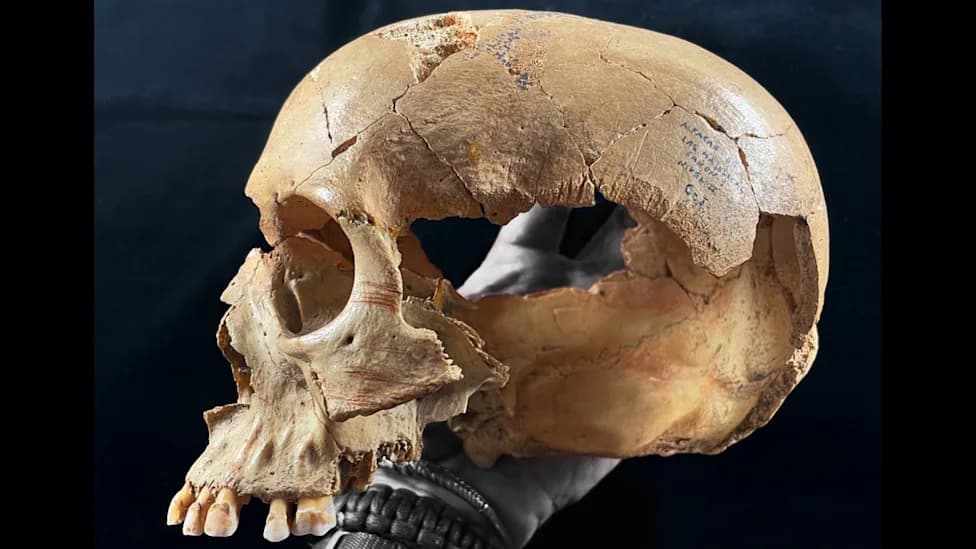
Research at the late Neolithic Shimao site (3,800–4,300 years ago) shows human sacrifice was gendered: large male mass burials concentrated at the East Gate likely served public rituals, while female victims were buried with elites. DNA analysis of 169 individuals links Shimao people to earlier local groups and to southern rice-farming communities. The patterns point to patrilineal descent and deliberately organised, sex-specific sacrificial roles, underscoring Shimao's social complexity and prompting calls for further study.
Ancient Shimao: DNA Reveals Gendered Human Sacrifice 3,800–4,300 Years Ago

New archaeological and genetic research at the stone-walled Shimao settlement in northern Shaanxi Province indicates that human sacrifice there, roughly 3,800–4,300 years ago, was highly gendered and organised for different ritual purposes.
Researchers from the Chinese Academy of Sciences analyzed DNA from 169 individuals recovered at Shimao and compared them with remains from seven nearby sites. Their findings, published in Nature, show that the Shimao community was largely descended from local groups who occupied the region about 1,000 years earlier, and that they also had genetic ties to southern rice-farming populations — evidence of broad interaction among prehistoric farming and pastoral societies.
Two distinct sacrificial systems appear to have operated at Shimao. The team documented large, male-dominated mass burials concentrated at the East Gate, which likely served public or communal ritual functions. By contrast, victims found in high-status cemeteries were overwhelmingly female and appear to have been interred as attendants or companions with elite individuals. Genetic and spatial patterns therefore suggest deliberately organised, sex-specific ritual roles tied to different places and purposes.
“These findings reveal a predominantly patrilineal descent structure across Shimao communities and possibly sex-specific sacrificial rituals,”
The genetic evidence overturns earlier assumptions about the East Gate burials, where scholars had suspected most victims were female; the new data show nine out of ten individuals from that context were male. The presence of female sacrificial companions alongside elites — a practice elsewhere in China only millennia later during the early Iron Age (770–221 BC) — points to complex social hierarchies and gendered institutions already present at Shimao.
Archaeological features of the settlement — covering roughly 4 sq km (1.5 sq miles) and including distinct functional zones, craft-production areas, and large fortifications — together with these ritual patterns, strengthen the interpretation of Shimao as a highly organised, possibly proto-state society.
While the study provides clear new evidence for gendered sacrificial practices, the authors emphasize the need for additional regional research and more ancient DNA sampling to refine our understanding of social structure, ritual practice, and the pathways to early state formation in East Asia.
Help us improve.