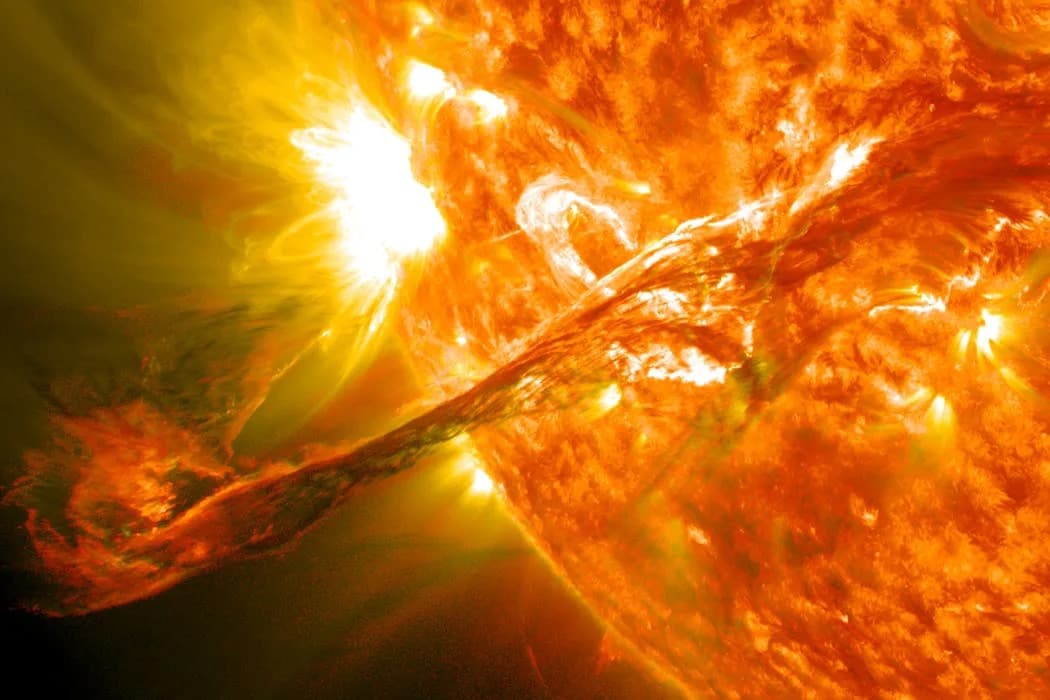
The Sun unleashed an X1.9-class flare on Nov. 30 (peaking at 9:49 a.m. EST), causing a brief R3 radio blackout across the sunlit side of Earth that affected Australia and parts of Southeast Asia. SOHO imagery showed a partial-halo CME that is not Earth-directed. A larger, magnetically complex sunspot region (AR4294) is rotating toward Earth, and NOAA warns of likely M-class flares with a small chance of additional X-class events through Dec. 1–3. Minor (G1) geomagnetic storming is possible around Dec. 3 due to a coronal hole stream.
Powerful X1.9 Solar Flare Briefly Knocks Out Radio Across Australia as Large Sunspot Turns Toward Earth

The Sun began December with a strong X1.9-class solar flare that briefly disrupted high-frequency radio communications across Australia and parts of Southeast Asia.
What happened
The eruption peaked at about 9:49 a.m. EST on Nov. 30 (0249 GMT Dec. 1). It originated from an emerging sunspot region identified as AR429 as it rotated into view on the Sun's northeastern limb. At the time of the event the flare produced a strong (R3) radio blackout across the sunlit side of Earth, temporarily degrading communications and navigation signals in affected areas.
Coronal mass ejection and trajectory
Coronagraph images from the SOHO spacecraft showed a rapid partial-halo coronal mass ejection (CME) — a fast release of plasma and magnetic field — streaming away from the Sun's northeast limb. Modeling indicates this CME is not Earth-directed and therefore unlikely to pose an immediate geomagnetic threat.
The larger concern: a growing sunspot complex
Following the flare, a much larger and magnetically complex sunspot cluster, designated AR4294, is rotating toward Earth. NOAA analysts have split this sprawling region into three groups because of its size and magnetic complexity. The same area produced multiple X-class flares last month and has continued to grow, increasing the chance of further strong eruptions.
Forecast and what to watch
NOAA space-weather forecasters expect M-class flare activity to remain likely and warn of a small chance for additional X-class flares between Dec. 1–3. While no Earth-directed CMEs have been detected so far, heightened activity from AR4294 could change that in the coming days, so observers and satellite operators should stay alert.
Geomagnetic conditions are predicted to be mostly quiet until Dec. 3, when a negative-polarity coronal hole stream could produce minor (G1) geomagnetic storming. Such conditions can increase the likelihood of aurora at high latitudes and may affect sensitive satellite and radio systems.
Sources: NOAA Space Weather Prediction Center, SOHO coronagraph imagery.
Help us improve.