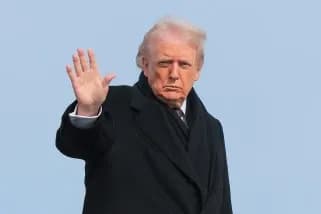
As President Trump nears the end of his first year back in office, a growing number of Republican lawmakers are publicly distancing themselves from key parts of his agenda. Major areas of dissent include his diplomatic approach to Ukraine and Venezuela, a proposal to use tariff revenue for $2,000 payments, rapid federal AI expansion, redistricting efforts ahead of 2026, and proposals to eliminate Senate traditions like the filibuster and blue slips. High-profile Republicans have voiced concerns that reflect tensions between party loyalty, institutional norms and electoral strategy.
Five Ways Republicans Are Breaking With Trump as GOP Splits Over Policy and Procedure
President Trump is encountering growing resistance from fellow Republicans in Congress as he approaches the end of his first year back in the White House. Although he remains a dominant figure in the GOP and aides warn that dissenters risk primary challenges or losing presidential support, an increasing number of lawmakers have openly criticized his actions or refused to follow parts of his agenda.
1. Foreign policy and peace talks
Trump has spent much of the year pursuing diplomatic deals to resolve foreign conflicts, but his approach has split Republican opinion. The White House has pointed to progress on a proposed peace agreement to end the war in Ukraine, yet top Senate Republicans — including Sen. Mitch McConnell (R-Ky.), Sen. Lindsey Graham (R-S.C.) and Sen. Roger Wicker (R-Miss.) — warned the initial plan was too deferential to Russia and unlikely to deliver a lasting peace. McConnell said if advisers are focused on appeasing Vladimir Putin rather than securing real peace, the president should find new advisors.
Divisions have also emerged over U.S. military support for Israel amid the war with Hamas. Rep. Marjorie Taylor Greene (R-Ga.), once among Trump’s strongest supporters, has publicly criticized Republican leadership and signaled she will resign from Congress in January as tensions with the White House grew.
Trump’s tougher posture toward Venezuela has raised further concern. The Pentagon repositioned assets near Venezuela, prompting warnings from Sen. Rand Paul (R-Ky.) that an invasion or additional funding for Ukraine could fracture Trump’s movement. The House Armed Services Committee announced a probe after reports that Defense Secretary Pete Hegseth ordered "no survivors" in an initial strike; committee leaders said they were taking bipartisan action to gather a full accounting of the operation.
2. Tariff-funded payments
The president proposed using tariff revenue to send $2,000 checks to millions of Americans to ease rising living costs. While the idea responds to public frustration over inflation, it would require congressional approval — and many Republicans oppose it. Sen. Ron Johnson (R-Wis.) said the government cannot afford such payments, and deficit hawks argue that tariff proceeds should go toward repaying the national debt, which exceeds $38 trillion. Senate Majority Leader John Thune (R-S.D.) suggested tariff revenue would be better used to retire debt. Earlier proposals, such as a so-called "DOGE Dividend" using savings from a Department of Government Efficiency, likewise failed to gain traction.
3. Artificial intelligence
The administration has pushed to expand federal use of artificial intelligence, including an executive order establishing the "Genesis Mission" to combine federal datasets, computing power and AI tools to accelerate scientific research. The White House also circulated a draft order to create a task force to challenge state AI rules and has withheld broadband funding from states that impose certain AI regulations.
Some conservatives, however, worry the rollout is too fast. Sen. Josh Hawley (R-Mo.) has called for repealing legal protections that shield tech platforms from liability (commonly associated with Section 230) and criticized how companies use copyrighted works to train AI. Steve Bannon, a former Trump adviser, warned that AI could be "the most dangerous technology in the history of mankind" if left unguided, even while acknowledging its upside if properly regulated.
4. Redistricting fights
The White House has urged Republican-led states to redraw congressional maps ahead of the 2026 midterms to add safe GOP seats and help retain a House majority. Texas and Missouri complied, but other states resisted. Indiana lawmakers signaled hesitation, saying each chamber would decide by early December whether to pursue redistricting. Trump publicly warned opponents on his platform that he would support primary challengers and mobilize grassroots activists against those who block his plan.
At the national level, some Republicans threatened by mid-decade map changes pushed back. Rep. Kevin Kiley (R-Calif.) introduced legislation to ban all mid-decade redistricting efforts, arguing such shifts destabilize representation and invite partisan gamesmanship.
5. Senate rules: the filibuster and blue slips
Trump has pressed senators to eliminate the filibuster and the Senate's "blue slip" tradition, contending those rules obstruct his agenda. During a prolonged government shutdown, he urged repeal of the filibuster — which generally requires 60 votes to advance major legislation — and raised the issue in person with senators at a White House breakfast.
Many Republicans remain opposed. Senate leaders such as John Thune have said their positions are unchanged, Sen. John Curtis (R-Utah) called himself a "firm no," and Speaker Mike Johnson (R-La.) warned that removing the filibuster would be regrettable if the roles were reversed. Senate Judiciary Chairman Sen. Chuck Grassley (R-Iowa) pushed back against changing the blue-slip norm, saying nominees without returned blue slips generally lack the votes needed for confirmation.
Conclusion: These five flashpoints — foreign policy, tariff-funded payments, AI policy, redistricting and Senate rules — illustrate growing tensions within the Republican Party. Prominent figures from Mitch McConnell and Lindsey Graham to Rand Paul and Kevin Kiley have publicly criticized or resisted the White House. The rifts underscore a GOP balancing loyalty to Trump against institutional norms, fiscal conservatism and electoral self-preservation.
Help us improve.