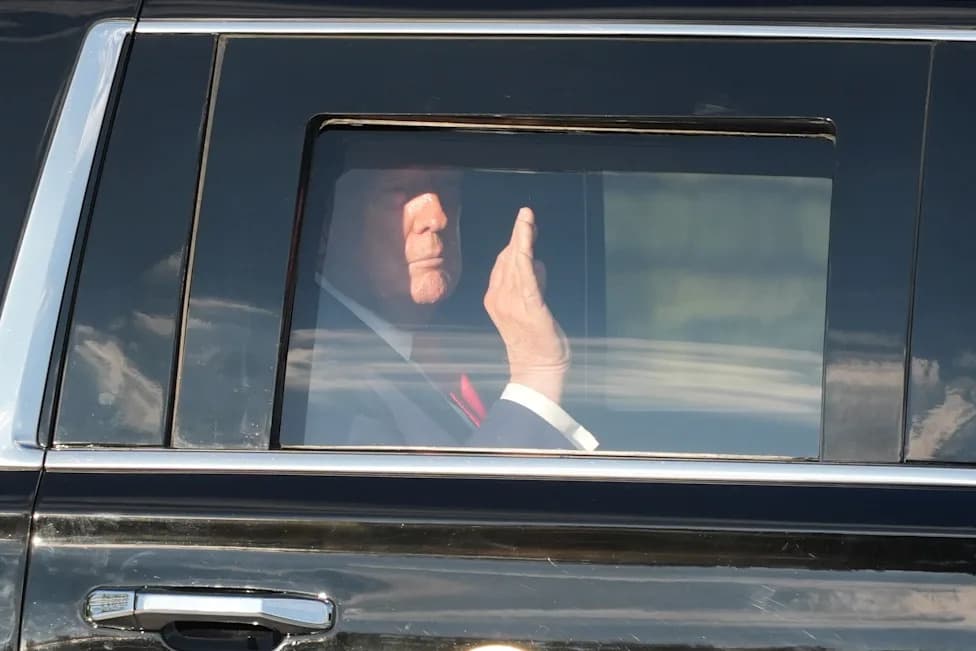
President Trump announced plans to "very soon" extend operations against alleged Venezuelan drug traffickers to land routes after recent strikes in the Caribbean. The U.S. has repositioned the USS Gerald R. Ford and increased forces in the U.S. Southern Command area to improve detection and disruption of illicit activity, Pentagon spokesperson Sean Parnell said. The strikes have prompted concern after reports that some people killed were not linked to trafficking, and Colombian President Gustavo Petro suggested oil interests may be a motivating factor. U.S. data from 2020 indicate Venezuela is not a major fentanyl producer, and some reporting found no cocaine aboard the vessels struck.
Trump Signals 'Very Soon' Shift to Land Operations Against Alleged Venezuelan Drug Traffickers
President Donald Trump told U.S. service members on Thanksgiving that the United States will "very soon" expand operations to stop alleged Venezuelan drug traffickers on land, following a series of strikes at sea in the Caribbean.
Speaking to military personnel, Trump said recent measures have curtailed maritime shipments: "Of course, there aren't too many coming in by sea anymore. You probably noticed that people aren't wanting to be delivering by sea, and we'll be starting to stop them by land also." He added, "The land is easier, but that's going to start very soon. We warn them: Stop sending poison to our country."
Increased U.S. Military Presence
Earlier this month, U.S. forces repositioned the aircraft carrier USS Gerald R. Ford to the region. Chief Pentagon spokesperson Sean Parnell said the enhanced presence in U.S. Southern Command's area of responsibility is intended to "bolster U.S. capacity to detect, monitor, and disrupt illicit actors and activities that compromise the safety and prosperity of the United States homeland and our security in the Western Hemisphere."
Parnell added that these forces are meant to "enhance and augment existing capabilities to disrupt narcotics trafficking and degrade and dismantle Transnational Criminal Organizations." The administration says its objective is to prevent illegal narcotics from being smuggled into the United States.
Concerns and Regional Reactions
U.S. strikes on vessels in the Caribbean have raised concern among foreign leaders and some lawmakers. Reports allege that some people killed during these operations were not involved in trafficking, prompting questions about the intelligence underpinning the strikes and the rules of engagement used.
Venezuelan President Nicolás Maduro denies links to drug-trafficking networks. President Trump has called Maduro an "illegitimate leader" and has associated him with regional trafficking operations.
Colombian President Gustavo Petro told CNN he believes oil dynamics are central to the matter, suggesting U.S. actions may be influenced by negotiations over energy rather than solely by efforts to promote democracy or combat narcotics. Petro said, in effect, that oil lies at the heart of the dispute.
Data on Trafficking Routes
U.S. government data from 2020 indicate Venezuela is not a major producer of fentanyl. The Drug Enforcement Administration estimated that roughly 74% of the cocaine entering the United States moves through the Pacific, and the State Department assessed that much of the cocaine produced in or transiting Venezuela was destined for Europe or Brazil.
Recent reporting has also indicated that U.S. military officers confirmed no cocaine was found aboard the ships struck by U.S. forces in the Caribbean. Those findings have contributed to international scrutiny of the recent operations.
The U.S. administration frames the recent deployments and potential land actions as measures to protect the homeland by disrupting illicit drug flows. Observers and regional leaders, however, continue to press for clarity on legal authority, intelligence standards, and the humanitarian consequences of such operations.
Help us improve.