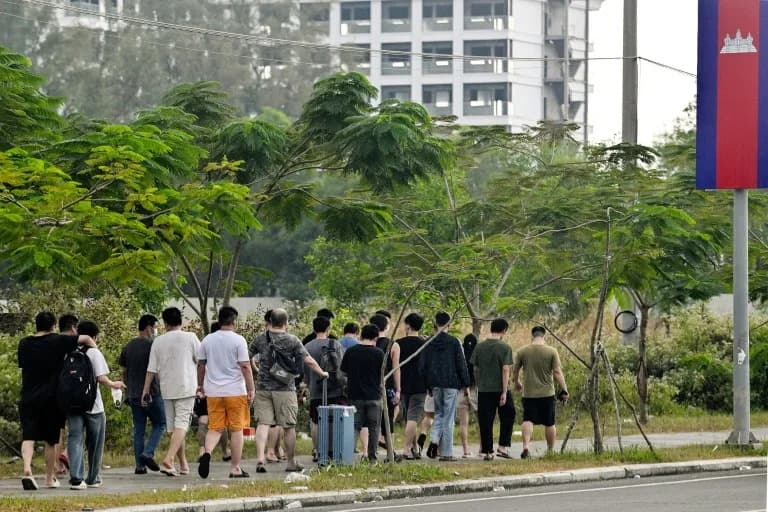
South Korea has imposed record sanctions on 15 individuals and 132 entities linked to cross-border online scams and human trafficking, including groups tied to Cambodia's Prince Group. The measures — Seoul's first independent sanctions against transnational crime — include asset freezes, limits on domestic financial transactions and entry bans. Authorities also named the Huione Group, identified suspects connected to the August death of a Korean student, and strengthened cooperation with Cambodian police and China.
Seoul Targets Cambodia-Linked Scam Networks with Record Sanctions

South Korea announced a sweeping sanctions package targeting cross-border online fraud and human trafficking networks in Southeast Asia, designating 15 individuals and 132 entities tied to scam operations, including those linked to Cambodia's Prince Group, the Ministry of Foreign Affairs said.
"This measure represents South Korea's first independent sanctions against transnational crime and the largest single sanction to date," the ministry said. "It demonstrates the government's firm commitment to proactively addressing online organized crime in Southeast Asia, which is causing significant damage both domestically and internationally."
The designated entities include the Prince Group, accused of operating large scam compounds — notably the Prince Complex and Mango Complex in Cambodia — where numerous South Korean nationals were reportedly detained and forced to work. The Prince Group was previously sanctioned by the United States and the United Kingdom in October.
Also named is the Huione Group and its subsidiaries, which Seoul says have laundered funds for transnational criminal organizations, including the Prince Group. In May the U.S. Treasury labeled Huione a "primary money laundering concern." The sanctions list also identifies leaders of scam operations in Cambodia's Bohai region and a principal suspect in the August torture and death of a South Korean university student who had been detained by a criminal group in Cambodia.
That case prompted public outrage in South Korea and led Seoul to issue a "code-black" travel warning — the country's highest alert — for parts of Cambodia. In response to the broader problem, Seoul established a joint task force with Cambodian police focused on crimes affecting Korean nationals. South Korea's National Intelligence Service said this joint effort recently led to the arrest of 17 Koreans in Sihanoukville during an operation targeting so-called "no-show" fraud schemes.
Separately, South Korea and China signed a memorandum of understanding earlier this month to strengthen cooperation against voice-phishing and online fraud during talks between President Lee Jae-myung and Chinese President Xi Jinping. Authorities say many scam operations in the region have links to Chinese nationals or are run by companies under Chinese control.
Under the new measures, designated individuals and entities will face asset freezes, restrictions on domestic financial transactions in South Korea, and entry bans for sanctioned persons. The Foreign Ministry said Seoul will continue whole-of-government efforts and international cooperation to disrupt overseas criminal networks and prevent South Korea from becoming a haven or laundering hub for illicit proceeds.
"We will continue to mobilize whole-of-government cooperation and work closely with the international community to counter transnational crime, disrupt overseas criminal networks and prevent South Korea from being used as a hiding place or laundering hub for criminal proceeds," the ministry said.
Help us improve.