
Chen Zhi, 38, founder of Prince Group, was arrested in Cambodia, had his Cambodian citizenship revoked, and was extradited to China after a months-long probe. U.S. prosecutors accuse him of running a transnational criminal network that used forced labor and crypto scams, alleging daily takings up to $30 million and a linked $15 billion cryptocurrency forfeiture. Experts say extradition to China makes near-term U.S. prosecution unlikely amid geopolitical tensions.
Chen Zhi Extradited To China After Cambodia Arrest; U.S. Probes $15B Crypto Seizure

Footage broadcast by Chinese state television CCTV shows billionaire businessman Chen Zhi during his extradition from Cambodia to China on January 7, 2026. - EyePress News/Shutterstock
Chen Zhi, 38, the founder and chairman of Cambodia-based Prince Group, was arrested in Cambodia and extradited to China after a months-long, joint investigation, Cambodian and Chinese authorities said. Cambodian officials revoked Chen's Cambodian citizenship and said the operation was conducted at China’s request. He was detained alongside two other Chinese nationals.
Allegations and U.S. Case
U.S. federal prosecutors have accused Chen of heading one of Asia’s largest transnational criminal networks that used forced labor and large-scale cryptocurrency scams to defraud victims worldwide. Prosecutors allege the schemes at one point generated as much as $30 million per day. In October, the U.S. Treasury and the U.K. Foreign Office sanctioned Prince Group and dozens of affiliated entities, designating them transnational criminal organizations.

Vehicles drive past the Prince International Plaza in Phnom Penh, Cambodia, on October 15, 2025. - Tang Chhin Sothy/AFP/Getty Images
Chen was indicted in absentia in New York on charges including money laundering conspiracy and wire fraud conspiracy. The Justice Department said investigators seized roughly $15 billion in cryptocurrency linked to the network — a forfeiture the DOJ described as the largest in its history. Authorities in Singapore, Thailand, Hong Kong and Taiwan have also announced seizures or asset freezes tied to Chen and his affiliates.
Chinese Authorities' Response
Chinese state media released footage showing a hooded, handcuffed Chen being escorted off an airplane by Chinese security forces. China’s Ministry of Public Security said Chen "has been placed under compulsory criminal measures in accordance with the law" and described him as "the ringleader of a major cross-border online gambling and fraud criminal syndicate." Officials said they will issue wanted notices for key members of the network and seek to apprehend fugitives linked to the alleged syndicate.
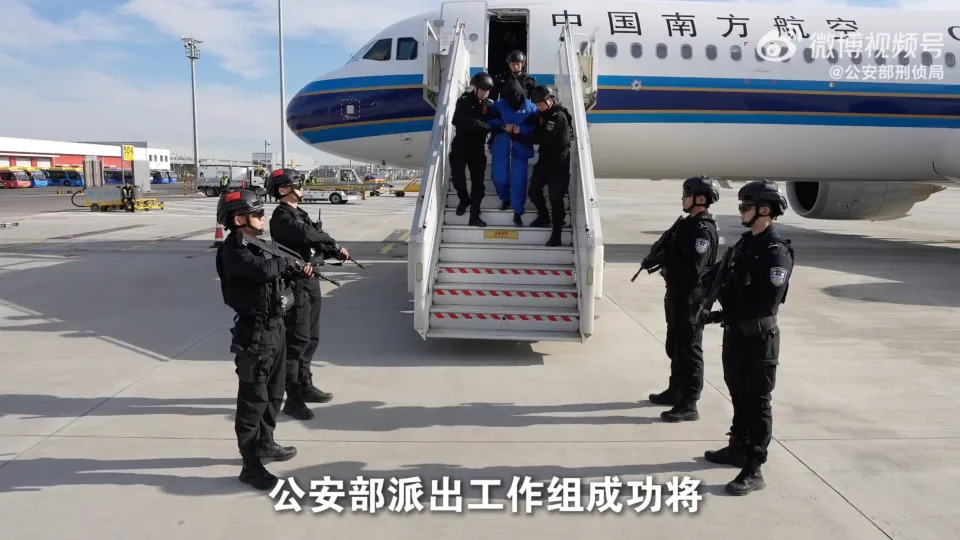
Alleged cybercrime kingpin Chen Zhi is extradited from Cambodia to China. - The Ministry of Public Security/Weibo
Scope Of The Alleged Network
According to U.S. authorities, the Prince Group empire served as an umbrella for more than 100 shell companies used to move illicit proceeds across at least a dozen countries and territories, from Singapore to St Kitts and Nevis. Prosecutors allege the stolen funds were used to buy art, private jets and high-end properties in London, and to pay bribes to public officials.
U.S. prosecutors also allege Chen and associates ran at least 10 forced-labor camps across Cambodia since 2015, where trafficked or coerced workers were forced to run cryptocurrency and investment scams under threat of violence. The global scam industry, much of it centered in Southeast Asia, is estimated at $50 billion to $70 billion; U.S. victims reportedly lost at least $10 billion in 2023 alone.

Chen Zhi in custody of Chinese police upon arrival in China. - The Ministry of Public Security/Weibo
Diplomatic And Legal Implications
Analysts say Chen’s extradition to China makes near-term prosecution in the United States unlikely: China and the U.S. have no extradition treaty, and the two countries are engaged in heightened geopolitical tensions. Observers note Beijing has incentives to handle politically sensitive cases internally, especially given reported ties between some business figures and government officials.
"This arrest reflects sustained international pressure reaching a point where continued inaction became untenable for Phnom Penh," said Jacob Sims, a visiting fellow at Harvard University’s Asia Center and an expert on transnational crime.
CNN contacted lawyers for Prince Group for comment. Prince Group has previously denied illegal activity, calling the allegations "baseless" and asserting that past asset seizures were unlawful. Chinese authorities said the related cases remain under further investigation.
Help us improve.


