Archaeologists in Lamonzie-Saint-Martin, southwestern France, have unearthed a richly furnished Roman cremation tomb (a bustum) dating to the 1st–3rd centuries CE. The grave contained silver coins, nearly two dozen gold objects, a probable bulla, and a heat-deformed gold ring that matches a rock-crystal intaglio inscribed in Greek: ΑΛΛΑΛΛΗ (Allallé). Researchers will analyze bone fragments to determine the individual's sex and age and continue excavations to explore nearby graves or settlements that might explain the tomb's wealth and possible Greek links.
Greek-Inscribed Gold Ring Points to Lavish 2,000-Year-Old Roman Cremation Tomb in France

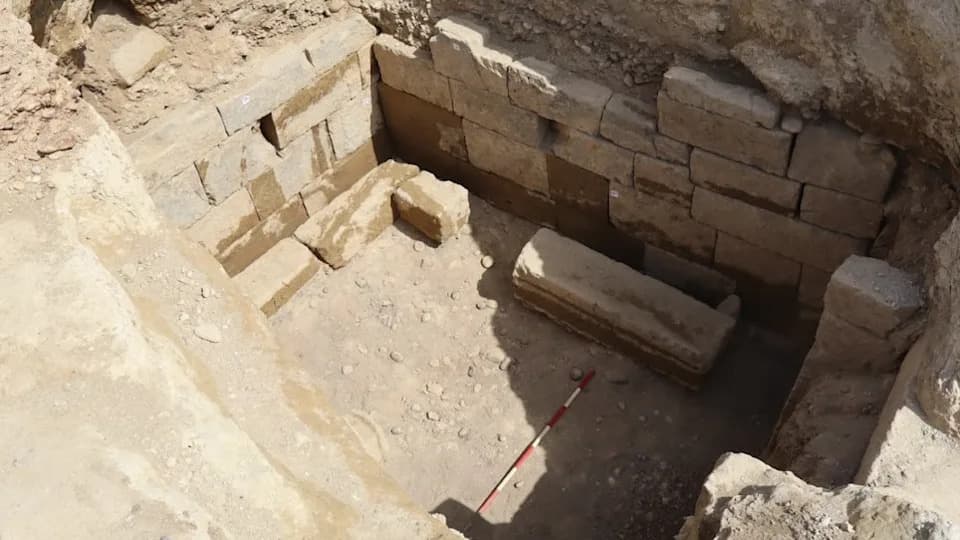
Archaeologists excavating beneath medieval silo remains in Lamonzie-Saint-Martin, southwestern France, have uncovered a richly furnished Roman-period cremation tomb that sheds light on elite funerary practices and cultural connections in the region.
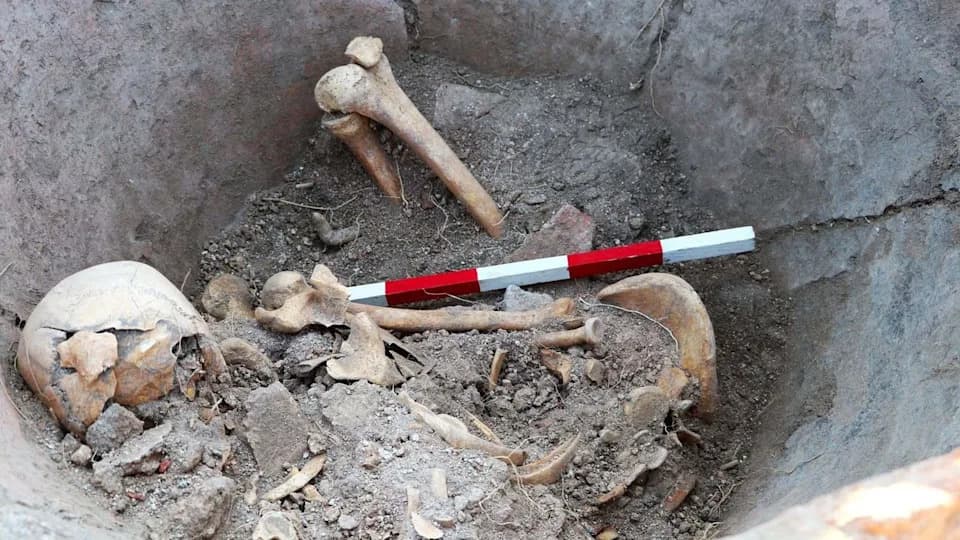
The burial is a rectangular bustum — a Roman funerary pit where the deceased was cremated directly over the grave and the ashes and remains were then buried. The pit measures roughly 7.2 by 3.4 feet (2.2 by 1.05 meters) and contained clothing, personal items and a wide range of votive offerings.
Key finds
Among the discoveries were a ceramic beaker and a clear glass vial, a cluster of 10 silver and bronze coins, and small gold sheets that likely decorated a purse or coin case. A string of lozenge-shaped crystals appears to be the degraded remnants of a bejeweled leather accessory, and a long, corroded iron object may be part of a horse bit once attached to a bridle.
The burial yielded nearly two dozen small gold objects. Notably, archaeologists recovered what they identify as a probable bulla — a protective amulet typically given to Roman boys — and the remains of a gold ring deformed by cremation heat. That ring appears to match a small inscribed rock-crystal intaglio found in the grave.
The intaglio carries a Greek inscription, ΑΛΛΑΛΛΗ (transliterated as Allallé), which may represent a personal or family name and suggests possible Greek cultural connections for the individual buried here. Stylistic evidence, the pottery and the coins date the grave to between the 1st and 3rd centuries CE.
What researchers will do next
Specialists will analyze surviving bone fragments to estimate the individual's age, sex and health, and carry out further material studies to clarify the origin and date of the objects. Additional excavation in the surrounding area will seek nearby graves or habitation remains that might explain why this unusually rich burial — including an item with a Greek inscription — occurred at this site in southwestern France.
The tomb was reported by the French National Institute for Preventive Archaeological Research (INRAP), and the finds add an intriguing piece to the picture of cultural interactions and social identity in Roman Gaul.
Help us improve.