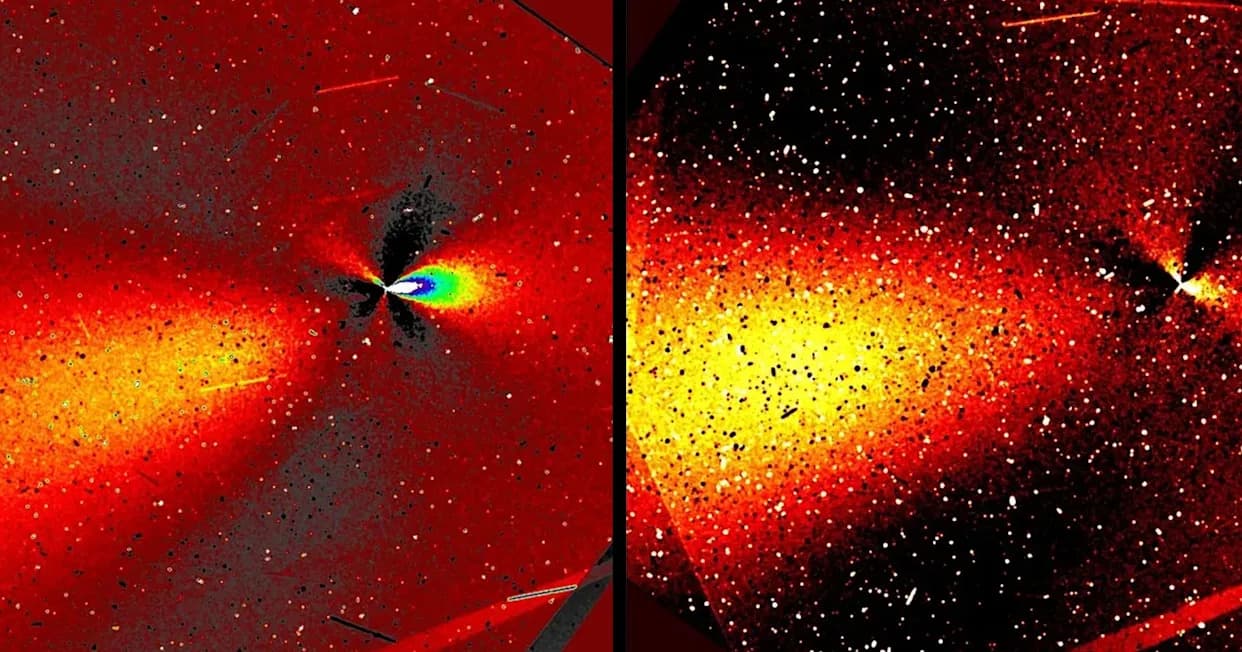
NASA released HiRISE images of interstellar visitor 3I/ATLAS showing a bright coma captured from about 19 million miles away at roughly 19 miles per pixel. Harvard astronomer Avi Loeb notes that jets in the new image appear to align with the object’s motion rather than toward the Sun, a pattern he says is difficult to explain with standard comet physics. NASA cautions that current evidence favors a natural, though unusual, comet. Observations planned around 3I/ATLAS's close approach to Earth on December 19 should allow measurements of jet composition, speed and mass loading to resolve the debate.
New HiRISE Image of Interstellar Visitor 3I/ATLAS Shows Unusual Jet Orientation — Scientists Debate Cause

NASA this week released HiRISE images of the interstellar visitor 3I/ATLAS taken by the Mars Reconnaissance Orbiter as the object passed near Mars in early October. The closest image in the set was captured from roughly 19 million miles away, with a resolution of about 19 miles per pixel. It shows a bright, fuzzy coma — a cloud of dust and ice — illuminated by sunlight.
NASA associate administrator Amit Kshatriya described the target as a "fuzzy white ball" and emphasized that the agency's preliminary assessment favors a natural, if unusual, comet. A full, peer-reviewed analysis of the HiRISE data has not yet been released.
Harvard astronomer Avi Loeb, who has previously suggested a nonnatural origin for 3I/ATLAS, flagged an odd feature in the new HiRISE image: jets appearing to align with the object’s direction of motion rather than pointing away from or toward the Sun, as is commonly expected for cometary jets. That orientation contrasts with features identified in earlier Hubble Space Telescope observations.
"It is easy to explain a plume of gas and dust extended towards the Sun as a result of the illumination of pockets of ice by sunlight or away from the Sun as a result of radiation pressure or the solar wind," Loeb wrote in a blog post. "It is also possible to explain a trailing stream that the object leaves behind as the drag on the solar wind slows it down relative to the object."
Loeb adds that a plume extending perpendicular to the Sun's direction and appearing ahead of the object is more difficult to reconcile with those standard explanations. He has speculated whether such a feature could conceivably be a technological signature, for example an attempt to illuminate or clear micrometeorites away from a hypothetical vehicle. NASA officials have urged caution and note that the weight of current evidence points to natural origins.
What scientists will look for next
3I/ATLAS will make its closest approach to Earth on December 19, offering a fresh opportunity for ground- and space-based telescopes to gather higher-quality data. Researchers plan to characterize the object’s jets by measuring their composition, velocity and mass-loading rate. Those measurements will help determine whether the observed jets are produced by sublimating pockets of ice responding to sunlight, by interactions with the solar wind and radiation pressure, or by another process entirely.
Ultimately, more detailed spectroscopic and time-series observations around the December encounter should settle whether 3I/ATLAS behaves like a natural comet from another star system or displays anomalies that require alternate explanations. Until the full HiRISE data are analyzed and the December observations are completed, the object's origin remains an open question.
Key facts: image distance ~19 million miles; resolution ~19 miles/pixel; next close approach to Earth on December 19. Sources cited include NASA officials and astronomer Avi Loeb.
Help us improve.