The United States and 15 partner countries will announce the "Kyoto Vision for a Golden Age of Science," urging the integration of AI—called "super intelligence"—into research to accelerate discovery. Led by OSTP director Michael Kratsios, the declaration emphasizes AI-driven laboratories, metascience, and experimentation with funding models. Supporters say this could democratize research; critics warn proposed federal budget cuts undermine public trust and the capacity to deliver on these promises.
Kyoto Vision: 16 Nations Back 'Super Intelligence' to Usher a Golden Age of Science

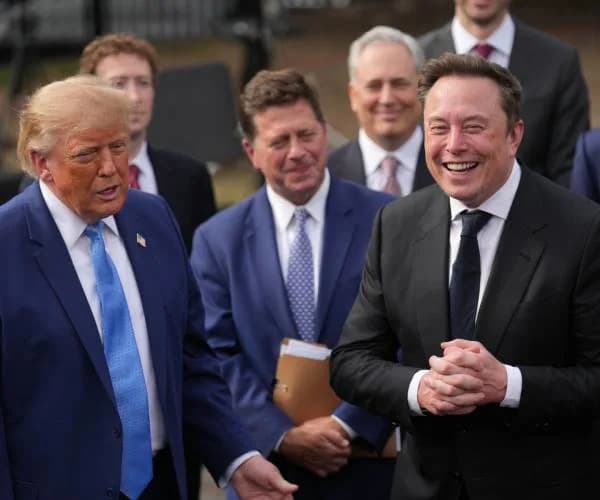
President Donald Trump speaks in the East Room of the White House on Sept. 29 during a lunch meeting with top executives of AI firms, as NVIDIA CEO Jensen Huang, left, and Elon Musk listen. (Jacquelyn Martin / AP)
The United States and 15 partner countries will unveil the "Kyoto Vision for a Golden Age of Science," a joint declaration encouraging the integration of advanced artificial intelligence—termed "super intelligence" in the statement—into the scientific enterprise. The declaration is scheduled for release at the Science and Technology in Society Forum in Kyoto, Japan, an annual meeting of policymakers and experts that began in 2004.
What the Vision Proposes
Led by Michael Kratsios, director of the White House Office of Science and Technology Policy (OSTP), the statement emphasizes the potential of AI-driven systems and automation to accelerate discovery. It highlights robotic and AI-assisted laboratories that can design experiments, iterate rapidly, and analyze results at speeds beyond human capability.
"Super Intelligence and new ways of organizing research are opening entirely new frontiers of discovery. We recognize the opportunity to take advantage of these changes."
Metascience and Funding
The declaration explicitly endorses metascience—the study of how science is conducted—and calls for experimentation with funding mechanisms to improve research outcomes. The National Science Foundation recently announced plans to create an Office of Metascience to pilot new approaches, measure what works, and scale successful methods.
International Support
Technology ministers and delegates from countries including Japan, South Korea, the United Kingdom and the United Arab Emirates are among the endorsers. Major AI firms such as Anthropic and OpenAI have already begun initiatives to connect biomedical laboratories with powerful AI systems, and several companies have long sought to automate laboratory workflows.
Criticism and Context
The statement appears amid controversy over proposed federal budget cuts. The administration's proposed fiscal year 2027 budget would, for example, reduce National Science Foundation funding substantially. Critics—such as Gretchen Goldman of the Union of Concerned Scientists—say that recent policy choices and proposed cuts have eroded public trust in government support for science. Goldman warned that promises about transparency and trust ring hollow when accompanied by steep funding reductions to agencies like the NIH.
What's Next
Kratsios has also promoted broader reforms to how the U.S. funds and incentivizes research, submitting recommendations to the President and planning a summit in Washington, D.C., with scientific and business leaders. He is leading the Genesis Mission, a national effort to accelerate AI-enabled innovation and discovery. The Kyoto declaration follows recent White House outreach to tech companies that produced the voluntary "White House Accord on Super Intelligence," a framework asking firms to adopt safety practices for AI development.
The Science and Technology in Society Forum will include panels on AI's effects on education, public trust in research, personalized medicine, and ethical and safety implications of advanced AI. Observers say the declaration signals growing international interest in combining AI, metascience, and new funding strategies to speed scientific progress—while also raising questions about governance, transparency, and equitable investment.
Help us improve.