The study published in Science Advances found that adults who ate the same carbohydrate meal with a close companion experienced smaller blood-glucose spikes and faster return to baseline than when they ate alone. Researchers tested 108 participants using just over 100 g of white-wheat bread and recorded glycemic responses for two hours. Parallel experiments (116 people for cold exposure; 115 adults and 56 mother–infant pairs for stress) showed improved temperature regulation and reduced physiological arousal when another person was present. Authors propose a "social physiology" framework, but caution that long-term implications require further study.
Eating With Someone Lowers Your Blood Sugar Spike, Study Finds

(urbazon/E+/Getty Images)
Dining alone may affect more than your mood: a new set of controlled experiments indicates that who you eat with can change how your body manages blood sugar.
Researchers publishing in Science Advances tested 108 adults who each ate just over 100 grams of white-wheat bread. Investigators continuously monitored participants' blood-glucose responses for two hours after the meal. Each participant completed two conditions: eating the same bread alone, and eating the same bread in the presence of a close companion.
When people ate with a close companion, their blood glucose rose less sharply and returned to baseline faster than when they ate by themselves. Across the two-hour monitoring period, overall glucose exposure was lower in the social condition (Masalha et al., Science Advances, 2026).
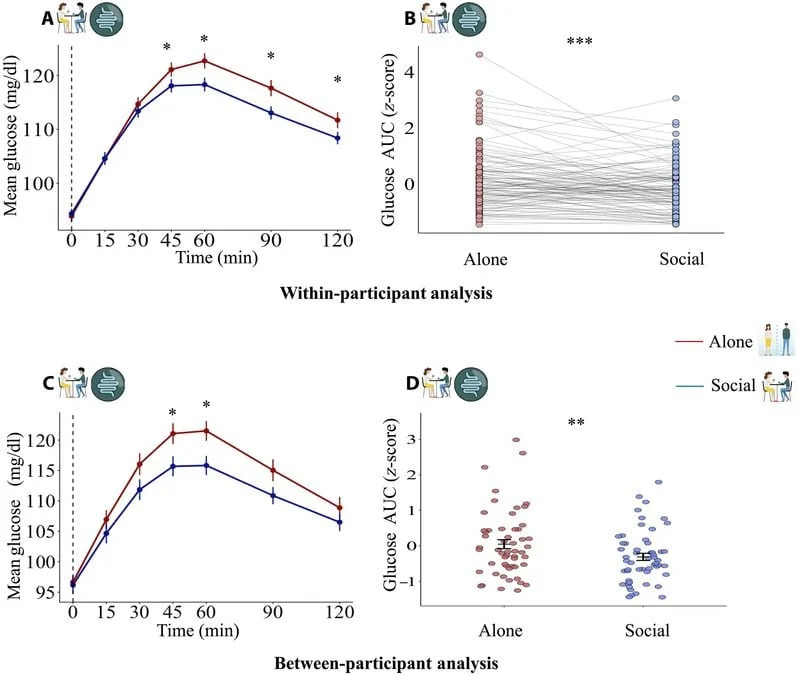
After the same carbohydrate meal, participants' blood sugar rose less when they ate with a close companion (blue) than when they ate alone (red). The top graphs compare the same people in both settings; the bottom graphs compare separate groups. The plots on the right show the total blood sugar response over two hours. (Masalha et al.,Science Advances, 2026)
Broader Tests of Social Proximity
The authors also ran parallel laboratory protocols to test other regulatory systems. In a cold-exposure experiment (116 participants), temperature regulation was more efficient when a partner was present, with the strongest benefit when partners touched—though non-contact presence still showed measurable effects. In stress-challenge trials (115 adults and 56 mother–infant pairs), physiological arousal (for example, sweating) was smaller when another person was nearby and returned to baseline faster in the social condition, even without skin-to-skin contact.
What the Authors Propose
Lead author Shir Atzil and colleagues frame these findings as proof of concept for a framework they call "social physiology," which posits that internal bodily regulation and external social environments are interlinked. They argue that social proximity can reduce the energetic cost of physiological regulation, offering an immediate metabolic advantage to being near trusted others and a possible evolutionary incentive for social bonding.
"Blood sugar regulation is not just about what we eat, but who we eat with," says Atzil. "Our relationships have an active biological role in our physical well-being."
Context and Caveats
Animal studies in social species—from fruit flies and rodents to pigs and non-human primates—have shown that isolation can shorten lifespans, weaken immune responses, or amplify stress reactivity. In mice, social isolation alters insulin signaling and impairs metabolic function. Observational human research also links loneliness with poorer glycemic control and a higher risk of type 2 diabetes.
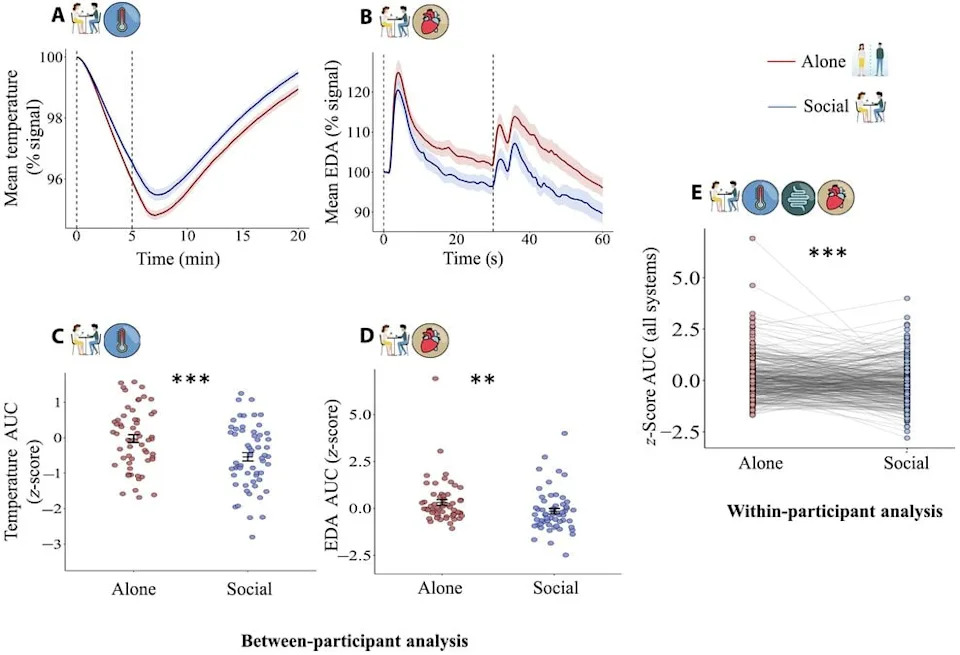
During cold exposure and a stress test, participants showed smaller physiological responses when a companion was present (blue) than when they were alone (red). (Masalha et al.,Science Advances, 2026)
However, the experimental effects reported are acute and measured in controlled settings. Long-term health implications remain uncertain: repeated small physiological advantages could plausibly accumulate, but further research is needed to confirm generalizability across ages, cultures, meal types, and real-world social situations. The study's sample sizes are moderate and laboratory conditions differ from everyday life, so replication and mechanistic work are important next steps.
Bottom line: These findings add experimental support to the idea that social context affects physiological regulation—eating with a trusted companion produced smaller glucose spikes and faster recovery than eating alone, and similar benefits were seen for temperature control and stress recovery in related tests.
The research was published in Science Advances.
Help us improve.