Frederick Douglass developed a principled constitutional method that sought to redeem the U.S. Constitution from slavery rather than reject it outright. Initially aligned with William Lloyd Garrison's denunciation of the founding, Douglass ultimately argued — on textual, historical, and natural-rights grounds — that the Constitution, properly read, opposed slavery. His choices during Reconstruction show the recurring tension between moral theory and political strategy.
Frederick Douglass: Redeeming the Constitution From Slavery
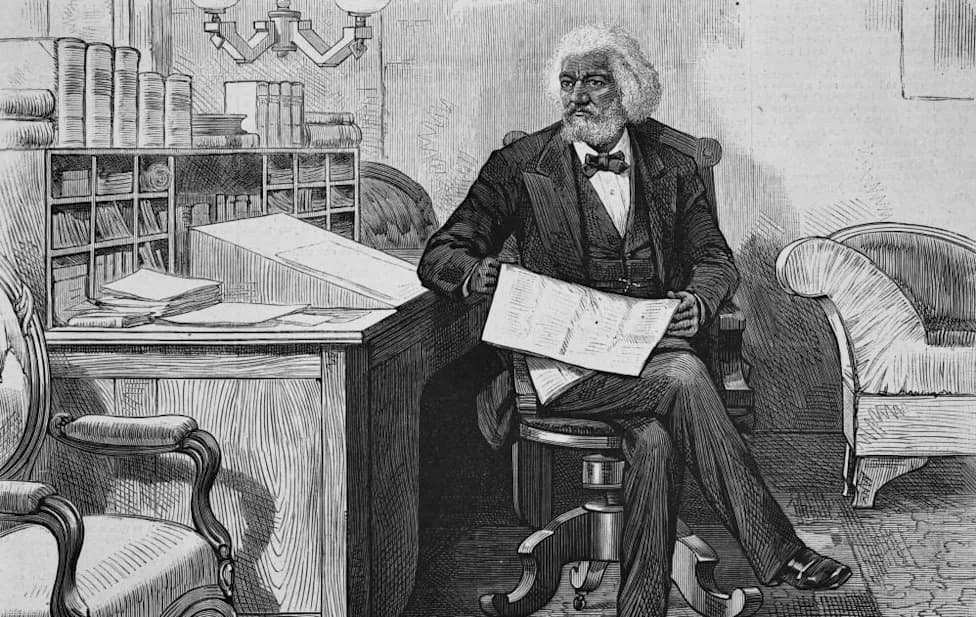
Today's constitutional debates echo arguments from the nineteenth century. At their center stood Frederick Douglass, whose interpretation of the Constitution challenged both defenders of slavery and those who thought America irredeemable. (Graphic House / Archive Photos / Getty Images)
Debates over whether the U.S. Constitution defends or denounces slavery have long shaped American political and legal thought. Since the rise of originalism in the 1980s and the more recent reframing of U.S. history around slavery and white supremacy, arguments about the founders' intentions and the moral force of the Constitution have become central to public discourse.
Two Competing Narratives
One narrative portrays the founding as committed to liberty and equality; the other views it as designed to entrench slavery and white dominance. These opposing accounts echo antebellum controversies in which proslavery and antislavery advocates each appealed to text, history, and principle to claim fidelity to the Constitution.
Frederick Douglass's Intellectual Journey
Frederick Douglass — born into slavery, escaped to freedom, and became a leading abolitionist, orator, and statesman — offers a distinctive and instructive response to this debate. Early in his career Douglass allied with William Lloyd Garrison, who denounced the Constitution as "a covenant with death, and an agreement with hell" and urged disunion as the only moral option. Douglass initially echoed that critique, fiercely condemning the framers and their compromise with slavery.
But Douglass's reading of the founding evolved. Through careful study of the Constitution, the Declaration of Independence, and founding history (including James Madison's Notes on the Federal Convention), he developed a different method: a natural-rights approach that read the Constitution through the moral principles articulated in the Declaration. He came to argue that the Constitution, properly interpreted, could be and ought to be a force against slavery.
Method: Natural Rights and Constitutional Interpretation
Douglass combined textual, historical, and moral arguments. He insisted that the Constitution should not be interpreted in isolation from the nation's professed commitments to natural rights. Where other abolitionists accepted slavery as an ineradicable constitutional stain, Douglass proposed that those founding principles could redeem the document: by reading the text in light of natural-law ideals, slavery could be excised from its operative meaning.
Douglass described his mission as using "voice and pen . . . to stand for the freedom of people of all colors, until in our land the last yoke was broken and the last bondsman was set free."
Rhetoric Versus Method: The Fourth of July Address
Douglass's famous speech "What to the Slave Is the Fourth of July?" contains both searing denunciation of American hypocrisy and the provocative claim that the Constitution was a "Glorious Liberty Document." Critics on both sides often seize fragments of that speech to affirm their positions, but that approach misses Douglass's methodological point: his praise for the Constitution was not naive veneration but a claim about how the text should be read and what principles should govern interpretation.
Reconstruction, Prudence, and Political Strategy
Douglass's theory informed his political choices but did not always determine them. During Reconstruction he pressed for universal suffrage — for both African Americans and women — as the realization of constitutional equality. When political realities made simultaneous expansion impossible, he prioritized African American male suffrage as the most viable step to protect freed people and advance justice. After the Fifteenth Amendment passed, Douglass renewed his efforts for women's suffrage. His decisions illustrate the tension between moral principle and political prudence.
Legacy and Lessons
Douglass offers a model of constitutional fidelity that is both critical and constructive: he refused blind loyalty but insisted the Constitution could be an instrument of liberation when interpreted through its deeper principles. His intellectual evolution — from Garrisonian rejection to a purposive, rights-focused reading of the Constitution — shaped antebellum and Reconstruction debates and continues to inform contemporary arguments about originalism, historical memory, and moral allegiance to founding documents.
Studying Douglass teaches modern readers how to confront a fraught past with clarity and hope, how to translate moral commitments into legal argument, and how to balance principled aims with political strategy to achieve lasting reform.
Help us improve.