The DOE launched the $215 million Quantum Genesis Q Competition to push private teams toward a fault-tolerant, scientifically useful quantum computer, offering milestone awards and large prize pools for demonstrations of ~100, 150 and 200 logical qubits. A companion SCAC report identifies seven grand challenges—two directly tied to energy: fusion materials and next-generation batteries and superconductors—with milestones through 2028 and ambitions into the 2030s. DOE frames the contest as the start of a multi-decade effort; practical materials and energy payoffs are expected on a 2030-plus timeline.
DOE’s $215M Quantum Genesis Q Competition: What It Could Mean for Fusion and Battery Materials
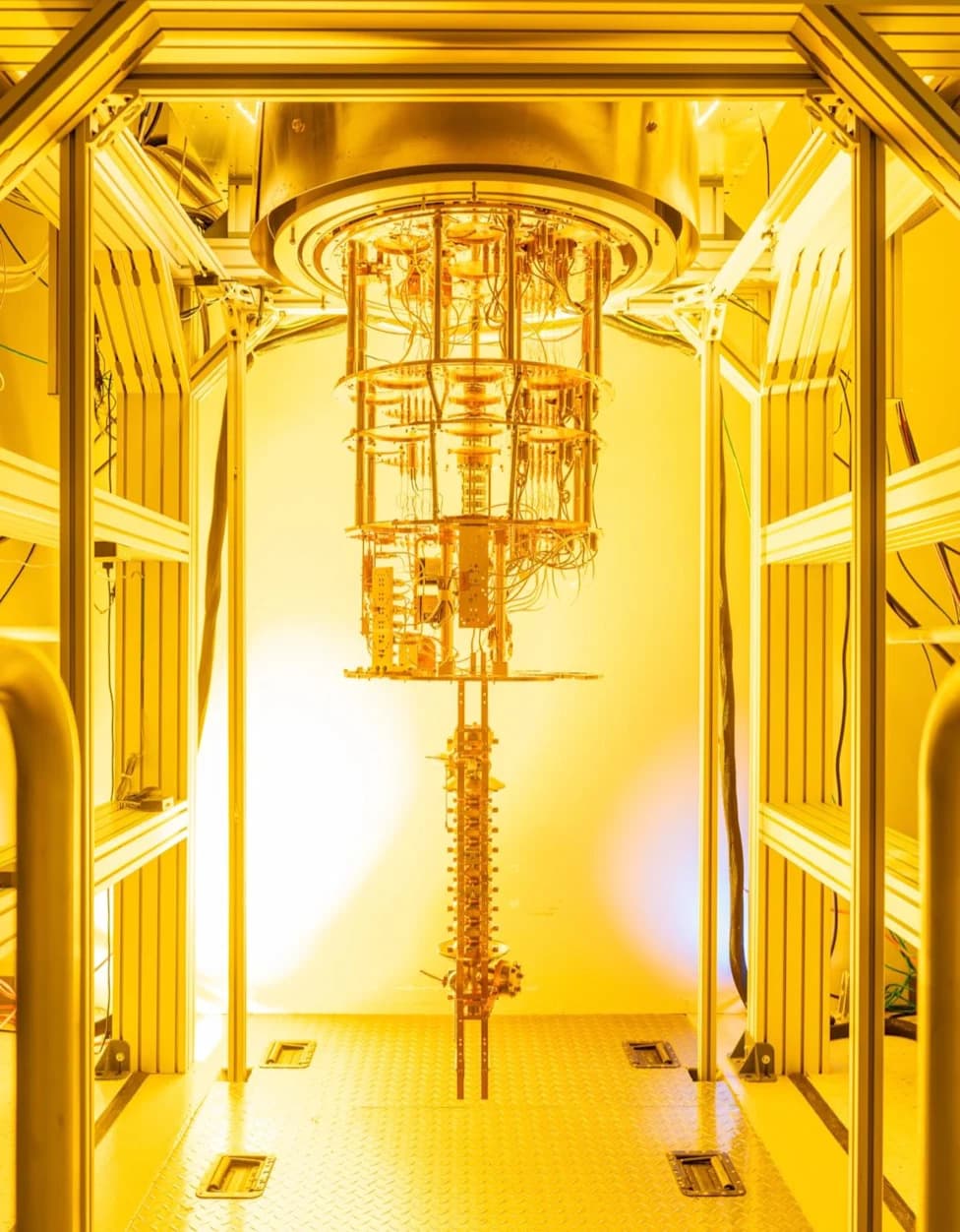
A dilution refrigerator cools a quantum processor to near absolute zero at Fermi National Accelerator Laboratory. DOE's new Quantum Genesis Q Competition aims to fund a fault-tolerant version of this hardware by 2028. Courtesy: Ryan Postel/Fermilab
The U.S. Department of Energy on Sept. 17 launched the Quantum Genesis Q Competition, a $215 million milestone-driven program to accelerate private-sector efforts to build the first fault-tolerant, scientifically relevant quantum computer. The contest will award early fixed payments up to $1.5 million per team for near-term technical milestones, and distribute a $100 million prize pool plus two $50 million bonus pools among teams that demonstrate machines with roughly 100, 150 and 200 logical qubits.
How the Competition Works
Applications from private-sector teams are open now and are due Oct. 19. Rather than a traditional grant program, the initiative pays set amounts for validated milestones and concentrates large prize pools on major hardware achievements. DOE officials emphasize the program is intended as the start of a long-term national effort, not a single final selection of a winning architecture.
Why Energy Sector Observers Are Watching
A companion report from the Office of Science Advisory Committee's Quantum Subcommittee (SCAC) lays out seven grand scientific challenges that quantum computing could address. Two challenges are especially relevant to the power sector: fusion energy materials, and next-generation batteries and superconductors. If successful, these advances could shorten development cycles and enable materials design that is impractical with classical computing alone.
Fusion Materials
The SCAC roadmap sets milestones spanning the late 2020s into the 2030s. Near-term objectives for 2026–2027 include quantum calculations of tritium binding, plasma-response modeling, and material transport properties—chemical and physics problems that strain today's classical supercomputers. By 2028 the committee expects validated predictions of key quantities that currently limit fusion design. On a 2030-and-beyond horizon, the report envisions integrated simulations covering tritium production and recovery, plasma-facing materials, and reactor interior conditions—capabilities that could accelerate reliable, commercial fusion development.
The roadmap cites an early real-world demonstration: a June 2026 preprint from Oak Ridge National Laboratory, the Cleveland Clinic and IBM describing what the authors call the first quantum computation of fusion-blanket molten salts, showing the approach can address materials questions relevant to fusion development.
Next-Generation Materials and Superconductors
For batteries and superconductors the SCAC sets modest near-term targets—matching simple material models to experiments in 2026 and extending to more complex correlated materials by 2027, with a validated correlated-material prediction by 2028. The long-term vision is to predict and design superconductors and energy-storage materials before fabrication, dramatically compressing a discovery process that today takes years of synthesis and testing.
Timing, Odds, and Expectations
DOE Under Secretary for Science Dr. Darío Gil acknowledged the uncertainty in hitting near-term hardware targets. He estimated roughly a 50% probability of achieving the 2028 milestone of a ~100-logical-qubit machine capable of hundreds of millions of fault-tolerant operations, rising to 75% a year later and into the high 90s two years after that. Those odds apply to hardware; the materials and energy payoffs the SCAC describes are explicitly placed on a 2030-plus timeline.
DOE also stressed that the competition will not automatically determine the architecture for any future national quantum user facility. Officials expect multiple architectures to cycle over decades, much as high-performance computing has evolved.
What This Means For The Energy Sector
For fusion developers and battery researchers, the announcement is an important federal bet on long-horizon technology. The potential to transform materials discovery is real, but tangible payoffs for fusion and next-generation energy materials are likely a decade away if they materialize at all. The Q Competition is best read as an opening salvo in a multi-decade investment, not an immediate shortcut to commercial fusion or radically improved batteries.
—Aaron Larson, POWER's Executive Editor
Help us improve.