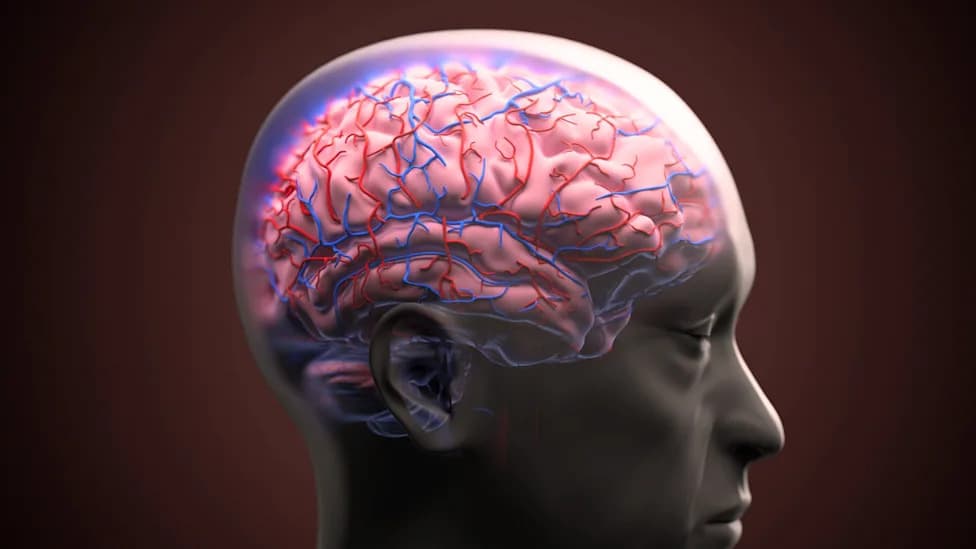
The Institute of Basic Science study suggests misdirected expression of the receptor ERBB4 in excitatory neurons may link early cellular changes to memory loss in Alzheimer’s. In mouse models, removing ERBB4 from hippocampal excitatory neurons reduced hyperactivity, calmed reactive astrocytes and microglia, lowered amyloid plaque accumulation and improved cognition. Activating ERBB4 in a few healthy neurons caused hyperactivity and cognitive decline, and analysis of nearly 450 human brain samples showed elevated ERBB4 in affected excitatory neurons. The authors propose ERBB4 as a potential early therapeutic target.
Misplaced ERBB4 Receptor May Kickstart Early Alzheimer’s Changes, Study Finds

Potential root cause of Alzheimer’s may have just been discovered
A subtle shift in where a receptor protein appears in the brain may help explain how Alzheimer’s disease progresses from abnormal neural connections to memory loss, according to a new study from the Institute of Basic Science in South Korea.
Background
Previous research has implicated abnormal protein deposits — amyloid plaques and tau tangles — as hallmarks of Alzheimer’s disease. These aggregates occur alongside a broader circuit breakdown: some neurons become hyperactive, synaptic connections are lost, and support cells (glia) become reactive. How those cellular changes translate into cognitive decline has been unclear.

An old person suffering from Alzheimer's (AFP via Getty Images)
Key Findings
The researchers identify the receptor protein ERBB4 as a potential early driver of disease-related changes. Using single-nucleus gene profiling, they found that ERBB4 — normally enriched in inhibitory neurons that dampen brain activity — was aberrantly expressed in a subset of excitatory neurons in Alzheimer’s model mice. That misexpression appeared early in the disease process.
In Alzheimer’s-model mice, astrocytes and microglia increasingly removed healthy synapses from excitatory neurons, and glial signaling shifted toward boosting rather than restraining neural activity. This imbalance can precede measurable cognitive symptoms.
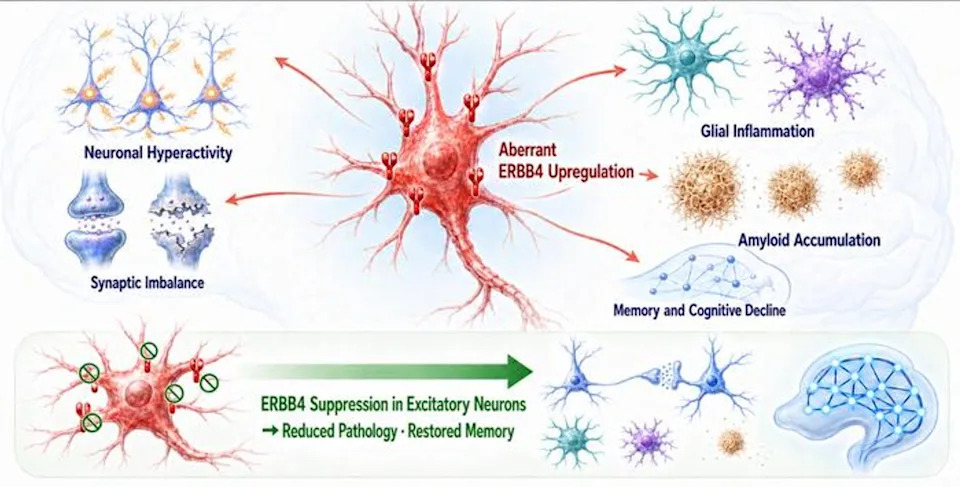
Schematic illustration of the proposed disease mechanism (Institute for Basic Science)
Intervention And Validation
Using gene-editing to remove ERBB4 specifically from excitatory neurons in the hippocampus — the brain region crucial for memory — the team reduced neuronal hyperactivity and reversed several downstream abnormalities. After ERBB4 removal, astrocytes and microglia were less reactive, amyloid plaque accumulation decreased, and mice performed better on memory and spatial cognition tests.
Conversely, activating ERBB4 in a small number of excitatory neurons in otherwise healthy mice produced heightened neural activity and measurable cognitive impairment, supporting a causal role for mislocalized ERBB4 expression.
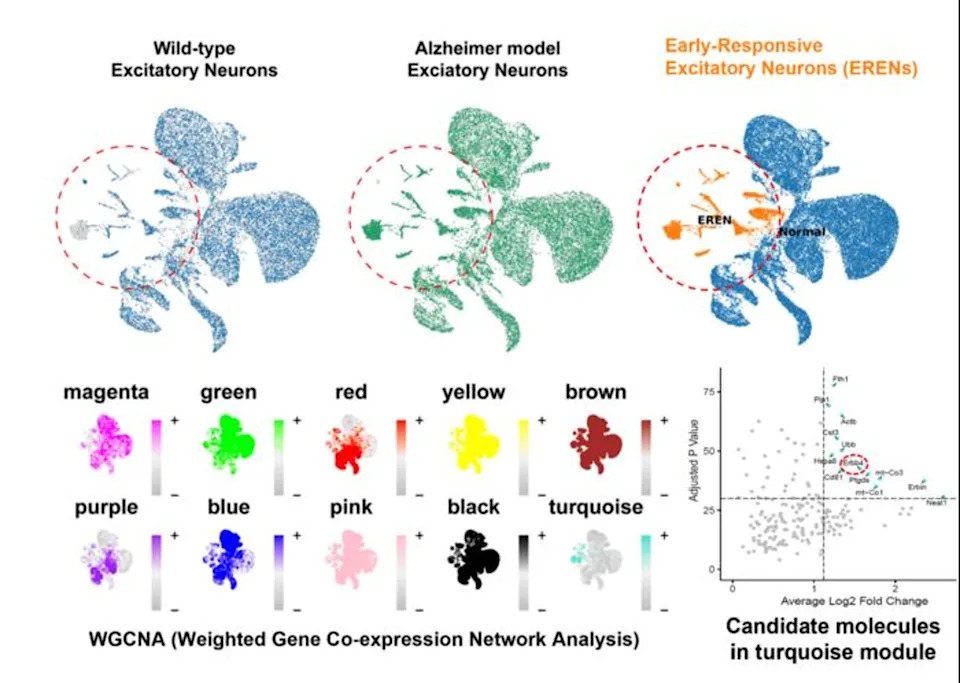
Distinct population of early responsive excitatory neurons that was selectively enriched in the Alzheimer's disease model (Institute for Basic Science)
Human Relevance
To assess relevance to people, researchers examined post-mortem brain tissue from nearly 450 individuals and observed elevated ERBB4 expression in excitatory neurons affected by Alzheimer’s disease, consistent with the animal-model findings.
“These findings identify aberrant ERBB4 expression in excitatory neurons as an early driver of AD pathophysiology and a potential therapeutic target across neurodegenerative diseases,” the authors write.
Implications
The study suggests that Alzheimer’s may not only destroy neurons but also push some into an aberrant state that destabilizes circuit balance. Targeting misdirected ERBB4 expression or its downstream effects might offer a new early-intervention strategy, though translation to human therapies will require further validation and safety testing.
Help us improve.