WMO Bulletin: The Antarctic ozone hole is now significantly smaller than the 1990–2020 average but is not fully recovered. Scientists warn that recovery is slower than many models projected and that seasonal variability makes single-year gains hard to interpret. An unusually early minimum in September 2025 and a wide area of below-average ozone linked to a strong Arctic winter vortex highlight how climate-driven extreme weather could hinder future recovery.
Ozone Hole Showing Signs Of Recovery — But Extreme Weather Could Slow Healing
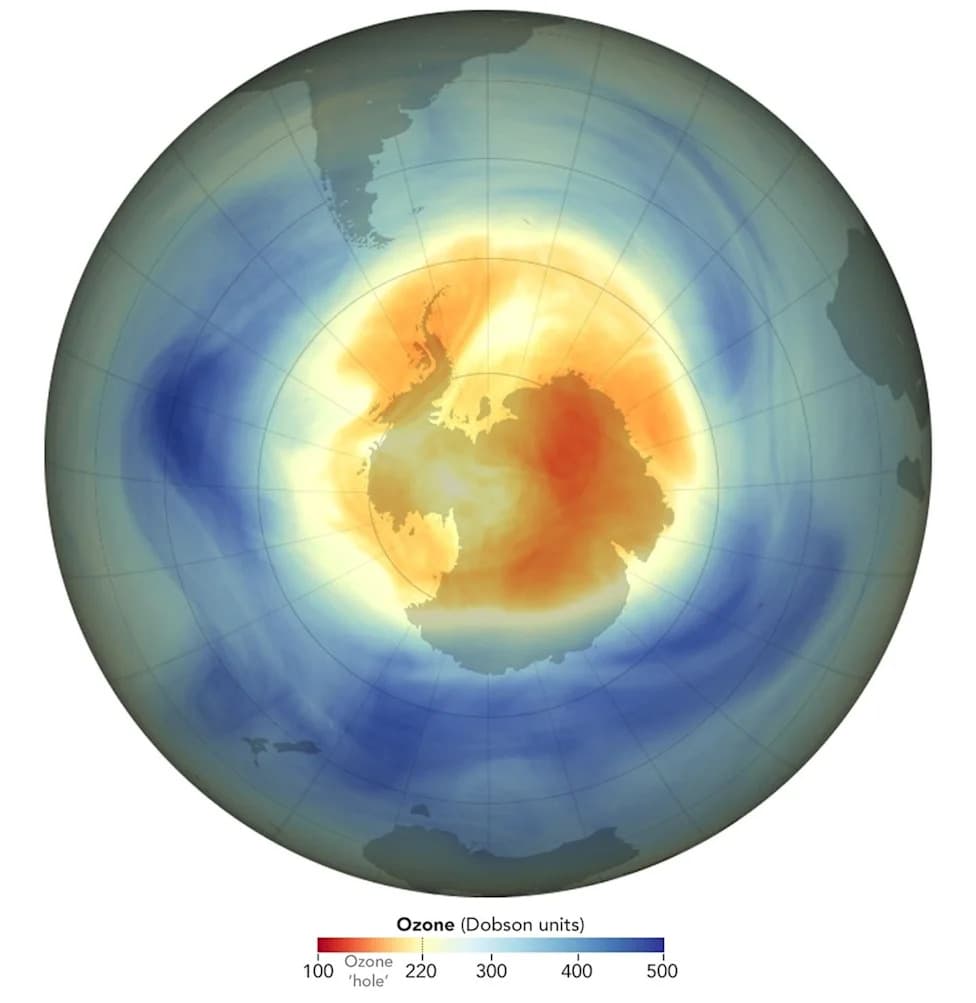
A map shows the size and shape of the ozone hole over the South Pole on the day of its maximum extent in 2025. Moderate ozone losses (orange) are visible amid areas of more potent ozone losses (red). Scientists describe the ozone “hole” as the area in which ozone concentrations drop below the historical threshold of 220 Dobson units.
The World Meteorological Organization's (WMO) latest Ozone and UV bulletin finds the Antarctic ozone hole is now significantly smaller than its 1990–2020 average, but it remains far from fully healed. Scientists welcome the improvement while urging caution: natural variability and extreme weather events may be slowing the pace of recovery.
Researchers first identified the ozone hole in the 1980s and traced its cause to human-made chlorofluorocarbons (CFCs), which break down ozone molecules. The ozone layer, which begins roughly nine miles (about 14 km) above Earth’s surface, absorbs harmful ultraviolet (UV) radiation that can increase skin cancer and other health risks. International action under the 1987 Montreal Protocol phased out many ozone-depleting substances and is widely seen as a rare environmental success story.
Still, the WMO bulletin and independent scientists caution that recovery is progressing more slowly than some models predicted. Suzanne Paulson, an atmospheric scientist at UCLA, notes that year-to-year swings are normal and a single-season improvement does not guarantee a sustained trend:
"It does go up and down every year, so any one year doesn't really tell you a whole lot. It certainly hasn't gotten worse in recent years, but for the most part, we haven't really seen major improvements."
This is the second consecutive year the WMO recorded a net positive change in the ozone hole’s area. However, the bulletin highlights several warning signs. Ozone concentrations usually reach their annual minimum in October; in 2025 the minimum occurred unusually early, in September. Laurence Rouil, director of the Copernicus Atmospheric Monitoring Service (CAMS), observed that while the hole’s area expanded rapidly in early September, "other indicators remain close to historical averages," underscoring the need to monitor interactions between human-caused disturbances and natural variability.
The report also documents a broad region of below-average ozone stretching from Greenland and Europe across Central Asia to Japan and Russia’s Kamchatka Peninsula. Scientists attribute that anomaly to a particularly strong Arctic winter vortex in January and February 2025—an example of extreme weather that researchers say is becoming more frequent as the climate warms.
Experts warn that as climate change increases the frequency and intensity of unusual atmospheric events, ozone anomalies may become more common and could complicate the recovery timeline. Continued global monitoring, emissions controls, and climate action remain essential to ensure the ozone layer’s long-term healing.
Help us improve.