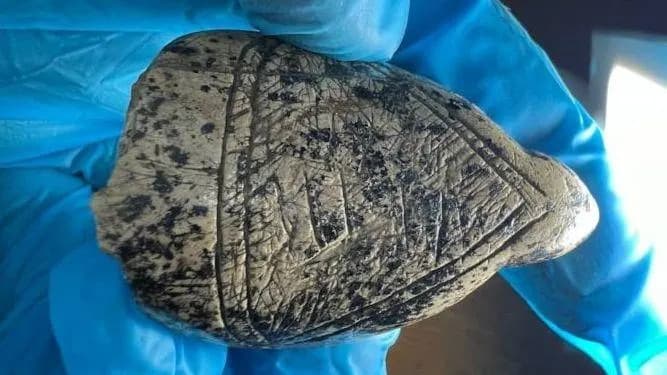
Two firefighters discovered a carved human face on a granite outcrop in Sandyktau, northern Kazakhstan, in 2024. The modest bas-relief (about 10.5 x 8 inches) was found near a stone stele with a deer petroglyph and other ritual features. Akmola heritage officials proposed a 6th–9th century date for the face (October 2025), while a December 2025 study argued that only the stele can be dated—by analogy—to the second millennium BCE. The site was placed under state protection in July 2024 and is slated for conservation and further research.
Firefighters Discover Carved Ancient Face on Kazakh Granite, Sparking a Dating Debate

Fire Patrol Finds Ancient Face Carving in BoulderColors Hunter - Chasseur de Couleurs - Getty Images
During a routine 2024 patrol in the Sandyktau region of northern Kazakhstan, two district firefighters unexpectedly discovered a carved human face on a granite outcrop—an unusual find that has prompted archaeological investigation and spirited debate over its age and context.
Employees of the local fire service, Nursultan Ashkenov and Akhmet Zaripov, came across the austere bas-relief while patrolling roughly 200 miles northwest of the capital, Astana. The department alerted the national Ministry for Emergency Situations and the local museum, and specialists were quickly invited to assess the find.
The carved face is modest in size—about 10.5 inches (27 cm) long and roughly 8 inches (20 cm) wide—and shows pronounced features: large eyes, a long straight nose and protruding lips. The relief sits on a granite outcrop located near a separate stone stele decorated with a deer petroglyph. Regional authorities have described the area as a multi-component sacred complex that also includes burial mounds, a menhir, a stone wall and a nearby quarry.
“The face is clearly visible,” said Sergey Yarygin of the Alkey Margulan Institute of Archaeology. “It has large eyes, a long straight nose and protruding lips. Kazakh archaeology not only enriches the scientific world with its remarkable discoveries but also reveals the main stages of the ancient and medieval development of Kazakhstan society.”
Dating the carved face has proved contentious. Yarygin and others have noted stylistic parallels with carvings from a wide range of periods and regions—Bronze Age sites across Central Asia and Western Europe, Iron Age southern Siberia, and medieval Turkic art—making a secure attribution difficult without clear stratigraphic context.
Different teams have reached contrasting conclusions. In October 2025, Akmola regional heritage authorities reported results that favored a sixth- to ninth-century CE date for the bas-relief. A December 2025 article in the journal Archaeology of Eurasian Steppes treated the location as two distinct objects—the deer-stele and the granite outcrop with the face—and argued that only the stele could reasonably be dated by analogy to the second millennium BCE. Because the stele and the face may represent separate episodes of use, their relationship (and the face's true age) remains unresolved.
Local authorities moved quickly to protect the site. In July 2024, Akmola heritage officials took the monument under state protection as an identified heritage object while its final status was considered. As of October 2025, officials were discussing conservation measures, further study, and options for bringing the monument into broader scientific and cultural circulation.
The Sandyktau discovery highlights the challenges archaeologists face when interpreting isolated carved stones: without secure context or datable materials, stylistic comparisons can point to many possible eras. Nonetheless, the find is important for understanding long-term site reuse and cultural layering in Kazakhstan and has already attracted international interest.
Help us improve.