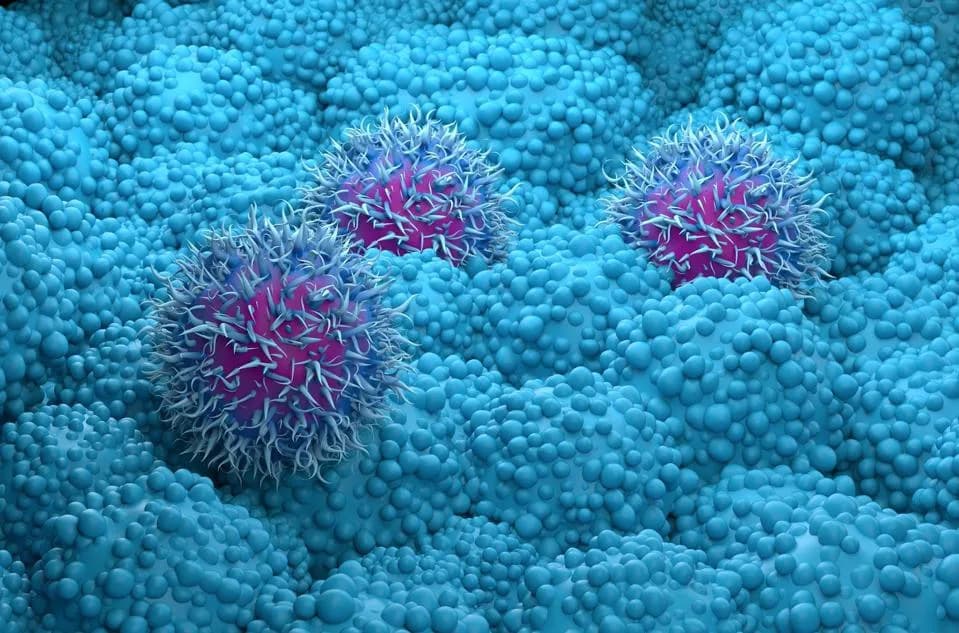
Revolution Medicines' Rasonque approval signaled that KRAS-driven cancers can be effectively targeted, though side effects persist. Second‑generation candidates aim to address limitations of first‑generation agents by focusing on specific mutations such as KRAS G12D and G12C. Zoldonrasib (Revolution), setidegrasib (Astellas) and divarasib (Genentech) have reported encouraging early results — including notable response rates and survival estimates — and are now advancing in phase 3 trials. Upcoming readouts will determine whether these drugs expand treatment options for pancreatic, lung and other solid tumors.
Three KRAS Drugs to Watch As Next-Gen Therapies Aim To Expand Options For Pancreatic, Lung And Other Cancers

Revolution Medicines, Astellas and Genentech are advancing investigational drugs targeting KRAS mutations in pancreatic and lung cancers.
Revolution Medicines' FDA approval this summer of Rasonque marked a major advance for a lethal form of pancreatic cancer and underscored that RAS-family mutations — including KRAS, which appear in roughly 30% of cancers — can be targeted effectively. Rasonque's RAS(ON) inhibitor nearly doubled median overall survival versus chemotherapy, but treatment-related side effects such as rash, diarrhea and oral inflammation highlight ongoing tolerability challenges.
Drugmakers are now advancing a wave of second-generation KRAS candidates designed to address gaps left by first-generation agents like Amgen's Lumakras and Bristol Myers Squibb's Krazati. Many of these follow-on programs focus on specific KRAS variants — notably G12D, common in pancreatic and colorectal cancers — with the aim of overcoming resistance and treating tumor types where earlier drugs were less effective.
Revolution Medicines — zoldonrasib
Revolution is building on Rasonque's success with zoldonrasib, an investigational therapy that targets the challenging KRAS G12D subtype. Approximately 90% of pancreatic cancers carry RAS mutations, and roughly 40% of pancreatic tumors harbor KRAS G12D, a variant associated with poorer outcomes. Zoldonrasib is being evaluated as monotherapy and in combination with other agents, including Rasonque, across non-small cell lung cancer (NSCLC), pancreatic cancer and other solid tumors.
Early data are encouraging. In a phase 1 NSCLC trial, 52% of 27 previously treated patients with KRAS G12D-mutated disease experienced tumor shrinkage, and the estimated 12‑month overall survival was 73%. In a phase 1/2 pancreatic study, zoldonrasib combinations produced objective response rates of 82% with modified FOLFIRINOX and 61% with gemcitabine plus nab‑paclitaxel among previously untreated patients. Ongoing phase 3 trials in pancreatic and lung cancer will determine whether these outcomes translate into durable benefits.
Astellas Pharma — setidegrasib
Astellas' setidegrasib targets KRAS G12D via a different strategy: it is a first‑in‑class protein degrader that leverages the cell's own disposal machinery to eliminate the mutant protein rather than simply inhibiting it. The drug is in phase 3 studies for pancreatic cancer and non-small cell lung cancer.
Phase 1 results signaled antitumor activity with a low rate of discontinuation for adverse events. At the recommended phase 2 dose, the estimated one‑year survival was 59% among 45 previously treated lung cancer patients. In a smaller cohort of 21 previously treated pancreatic cancer patients, 24% had objective responses and median overall survival was 10.3 months. The degrader approach could offer a complementary mechanism to direct inhibitors if larger trials confirm efficacy and tolerability.
Genentech — divarasib
Genentech's divarasib is a next‑generation KRAS G12C inhibitor that has shown promise in a phase 3, head‑to‑head study in previously treated NSCLC. KRAS G12C appears in approximately 14% of non‑small cell lung cancers. In the trial, divarasib met its primary and key secondary endpoints, improving both progression‑free survival and overall survival compared with approved G12C inhibitors (Lumakras or Krazati).
If these results are confirmed and replicated, divarasib could become a new standard of care for previously treated patients with KRAS G12C–mutant NSCLC; it is also advancing in phase 3 trials as a first‑line therapy and in settings for patients who have already received surgery, chemotherapy and immunotherapy.
What To Watch Next
The early commercial uptake of first‑generation KRAS drugs has been modest, and safety profiles remain an important consideration. The coming phase 3 readouts for zoldonrasib, setidegrasib and divarasib will be pivotal: positive results could broaden treatment options for patients with pancreatic, lung and other solid tumors and establish new standards of care in KRAS‑mutant disease.
Help us improve.