The reanalysis of eye-tracking data from 50 children (28 with combined-type ADHD, 22 controls) suggests unmedicated children with ADHD show ~23% greater trial-to-trial pupil variability but reduced within-trial fluctuation. A subset of 17 children tested on and off methylphenidate showed medication-linked changes in pupil responses, though drug physiology may explain some effects. The findings are preliminary, from a small lab study, and not suitable for clinical diagnosis; larger, real-world studies are needed.
Tiny Pupil Rhythms May Reveal Subtle Attention Differences in Children With ADHD

(Valeriia Kuznetsova/iStock/Getty Images)
Researchers are investigating whether tiny, rapid fluctuations in pupil size carry a detectable signature of how attention shifts over time. A new reanalysis of existing eye-tracking data suggests these subtle pupil rhythms may differ in some children with attention deficit hyperactivity disorder (ADHD), but the findings are preliminary and require replication.
What the Study Did
The team from the Indraprastha Institute of Information Technology Delhi reexamined eye-tracking records from 50 children in Chile (ages 10–12): 28 with combined-type ADHD and 22 without a neurodevelopmental diagnosis. Each child completed 160 memory trials while an eye tracker sampled pupil diameter at 1,000 Hz (1,000 measurements per second).

The technique can't yet diagnose ADHD, but it could point towards new ways to detect the condition. (megaflopp/Getty Images)
Key Findings
After adjusting for age, IQ, and task difficulty, a statistical model estimated about 23% greater trial-to-trial variability in pupil responses among unmedicated children with ADHD compared with controls. Paradoxically, the ADHD group showed reduced within-trial fluctuation (less variability during each single trial). The two measurements appear to reflect distinct aspects of pupil dynamics and attention.
"Looking at how pupil responses vary from trial to trial may provide information that is missed when we only look at average pupil size or behavioral performance," said first author Saumya Yadav.
Medication Effects and Caveats
A subset of 17 children with ADHD completed the task twice: once after pausing methylphenidate for 24 hours and once while taking their usual medication. When medicated, these children showed stronger task-related pupil responses and reduced variability between sessions, and their pupil-response shapes more closely resembled the control group.
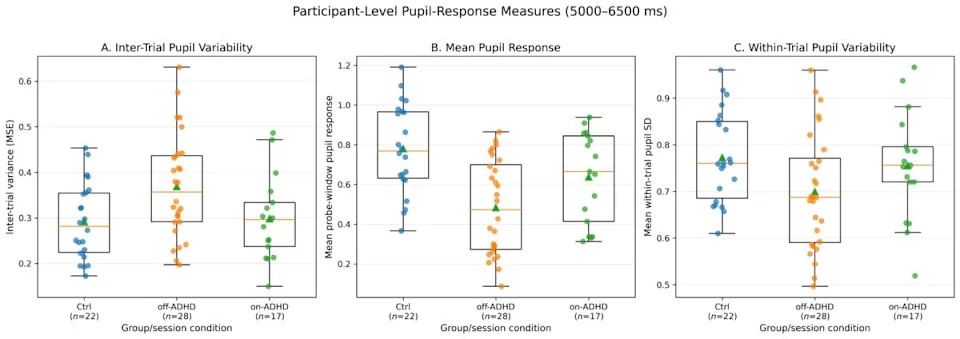
Trial-to-trial variability was higher in the unmedicated ADHD group, while within-trial variability was lower. (Yadav, S et al.,Scientific Reports, 2026)
However, the authors caution against interpreting this as clear evidence that medication "normalizes" attention. Stimulant drugs like methylphenidate can directly affect physiological systems that alter pupil size, so observed changes could reflect pharmacological effects, improved cognitive performance, or both. The researchers did not know each child's dose or formulation, and the two test sessions were separated by an average of about six months, leaving room for maturation, practice effects, or other influences.
Limitations and What Comes Next
The study reused a small dataset collected in a controlled laboratory task. Although a model using thousands of trials detected greater variability, direct comparisons between individual participants narrowly missed statistical significance after correction for multiple tests. The link between pupil variability and lower task accuracy in the unmedicated ADHD group was not significantly stronger than that pattern in controls.

Subscribe to ScienceAlert's free fact-checked newsletter
Because pupil diameter is influenced by many factors (light, arousal, effort, fatigue and medication effects), it remains an indirect signal of attention. The authors conclude that pupil measures are not ready for clinical diagnosis. Larger, independent, and longer-term studies in more naturalistic settings (for example classrooms) are needed to assess whether pupil dynamics reliably generalize across people and everyday environments.
Implications
If validated, high-resolution eye tracking could become a useful complement to clinical interviews and behavioral assessment by charting how an individual's attention fluctuates over time or responds to treatment. For now, the eyes reveal intriguing clues but cannot diagnose ADHD.
Publication: Scientific Reports.
Help us improve.