A new theoretical study in PNAS challenges the idea that evolution drifts randomly among equally fit forms. Using mathematical models and simulations, researchers at the Technion show a consistent "directional drift" toward the flattest, most mutation‑tolerant regions of a fitness plateau. This bias—emerging from population variability and landscape geometry—can produce robustness without direct selection and has implications for interpreting neutrality in evolution and parallels with deep learning.
New Study Suggests Evolutionary Change May Be Predictable — Populations Drift Toward Flatter, More Mutation‑Tolerant Regions

(Stanley45/E+/Getty Images)
The standard picture of evolution imagines populations climbing peaks on a fitness "landscape": forms that are better adapted to their environment rise to the tops while less fit variants disappear. But what happens when different forms share the same level of fitness? A new theoretical study from researchers at the Technion Israel Institute of Technology, published in PNAS, challenges the long‑held assumption that evolution then wanders randomly among those equivalent states.
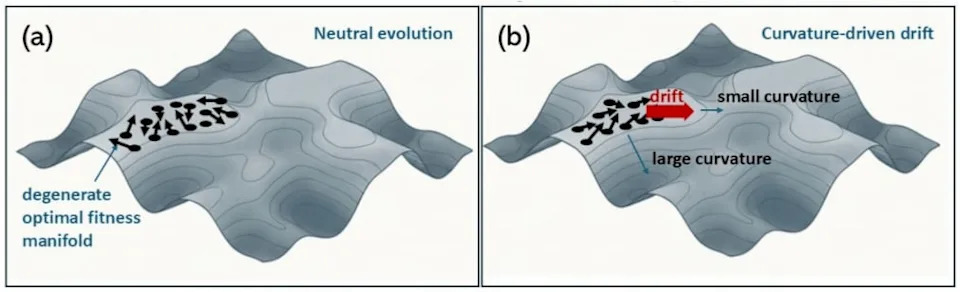
An illustration of a fitness peak 'plateau' and what happens next. (Fachareldeen & Brenner,PNAS, 2026)
The authors—Fachareldeen and Naama Brenner—use a simplified mathematical model and extensive computer simulations to follow populations on flat, degenerate regions of fitness landscapes. In evolutionary biology, "degeneracy" refers to the situation where distinct genotypes or phenotypes have roughly equal fitness despite arising by different routes.

YouTube Thumbnail
"On smooth manifolds of equal fitness, an implicit bias appears, directing evolving populations deterministically toward flatter regions," the researchers write, arguing that this bias emerges from the interaction between population variability and landscape geometry.
The key finding is a consistent "directional drift": once populations reach maximal fitness, they do not simply diffuse randomly across a plateau. Instead, they tend to move toward the flattest parts of the plateau—the regions where traits are more robust to mutation and environmental perturbations. In other words, the population gravitates to mutation‑tolerant, more "forgiving" neighborhoods even when there is no immediate fitness advantage.

Subscribe to ScienceAlert's free fact-checked newsletter
This effect arises from basic processes included in the model—selection, mutation, and the geometry of the fitness space—rather than from an explicit selective pressure for robustness. As a result, robustness and resilience can emerge as by‑products of how populations explore degenerate landscapes.
Implications and Next Steps
The study has several important implications: it suggests researchers should be cautious when labeling observed evolutionary changes as "neutral," since directional drift can produce nonrandom outcomes on neutral plateaus; it predicts that small biological differences may reveal features of historical evolutionary trajectories; and it highlights parallels with machine learning, where neural networks similarly prefer flatter regions of loss landscapes.
The authors emphasize that their results come from simplified, high‑level models and simulations. They call for future work to extend these models to more complex organisms, ecological interactions, and empirical data from natural populations to test how directional drift plays out in the wild.
Reference: Fachareldeen & Brenner, Proceedings of the National Academy of Sciences (PNAS), 2026. Study conducted at the Technion Israel Institute of Technology.
Help us improve.