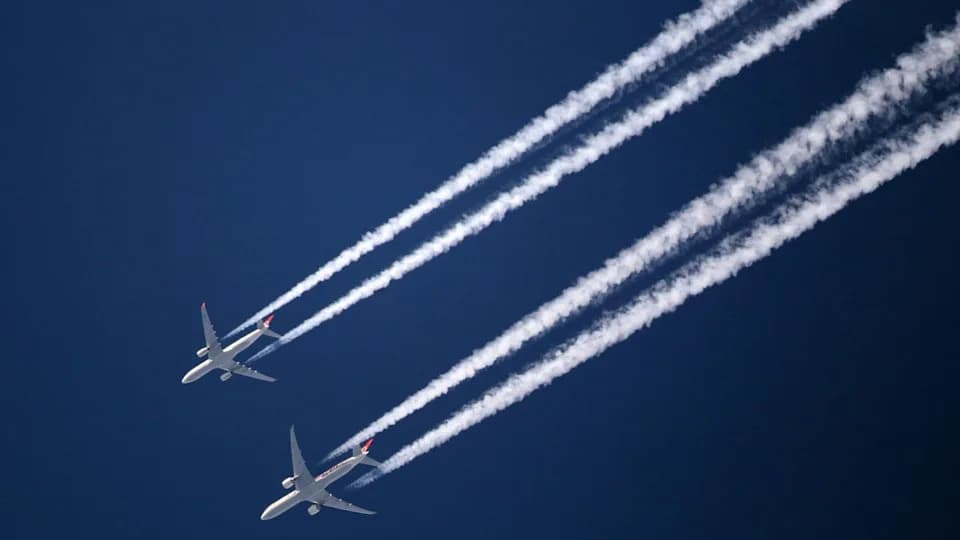
Contrails — the white lines behind some aircraft — are clouds of ice crystals formed when exhaust meets cold, humid air, and are not evidence of secret chemical spraying. A 1996 U.S. Air Force paper helped fuel the chemtrails conspiracy, but it described hypothetical possibilities rather than proving active programs. Scientists estimate contrails account for about half of aviation’s climate impact (roughly 1% of human-caused warming). Researchers are exploring mitigation measures such as rerouting flights, while real weather-modification tests continue and carry potential risks.
Contrails, Not Chemtrails: How a 1996 Air Force Paper Fueled a Persistent Myth
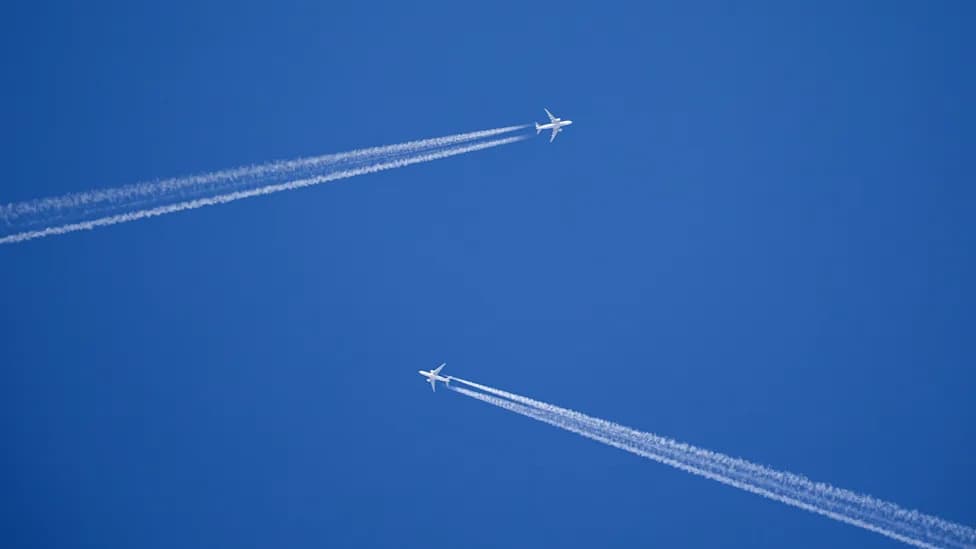
Photo Credit: iStock
The white streaks sometimes seen trailing aircraft are usually harmless contrails — clouds of ice crystals formed when hot, moist exhaust mixes with cold, humid air — not evidence of covert chemical spraying. While aviation does emit greenhouse gases and particulates, the visible lines themselves are well understood by atmospheric scientists.
What Are Contrails?
Contrails (short for condensation trails) form when jet exhaust encounters very cold, moisture-rich air at high altitude. The water vapor condenses and freezes into tiny ice crystals, creating a thin cloud that can persist or spread into cirrus-like formations depending on atmospheric conditions.
How the Chemtrails Myth Took Hold
The chemtrails conspiracy — the belief that aircraft deliberately spray chemicals for secret purposes — gained traction in part because of a widely circulated 1996 U.S. Air Force paper that discussed possible future uses of weather modification and mentioned releasing energy or chemicals into atmospheric processes. The paper described hypothetical scenarios but did not provide evidence of active large-scale chemical spraying.
What Scientists Say
"Contrails are a type of high-altitude ice cloud, or cirrus cloud," said Marc Stettler, a transport and environment professor at Imperial College London. "The conditions must be just right."
This explains why some flights leave visible trails while others do not: small differences in temperature and humidity determine contrail formation and persistence.
Climate Impact and Evidence
Contrails and aviation emissions do affect the climate. Stettler estimates contrails account for roughly half of aviation's total climate impact and about 1% of overall human-caused warming. During the COVID-19 pandemic, the sharp reduction in flights — and therefore contrails — contributed to a modest, short-term drop in global surface temperatures.
Mitigation and Alternatives
Researchers are investigating practical ways to reduce contrail-related warming without awaiting a full transformation of aviation technology. One promising approach is tactical rerouting: airlines could avoid the cold, humid layers where contrails form most readily, potentially cutting a meaningful share of aviation's climate impact.
Real Weather Modification and Its Risks
Weather-modification efforts such as cloud seeding are real and are being tested in several countries. China and the United Arab Emirates have deployed cloud-seeding to attempt to boost rainfall, while Israel ended a long-running program after finding limited benefits. The UK’s Advanced Research and Invention Agency has also funded field trials exploring ways to reflect more sunlight away from Earth.
Dr. Valérie Masson-Delmotte, head of the Climate Society Centre at France’s Institut Pierre Simon Laplace, cautioned that aerosol-based climate interventions "could deplete ozone and could disrupt climate patterns," with downstream effects on health, agriculture and energy systems.
Why Skepticism—and Focus—Matter
Conspiracy theories like chemtrails can distract from legitimate questions about aviation’s environmental footprint and the careful assessment required for any weather or climate intervention. As Karen Douglas, a social psychology professor at the University of Kent, observed, "A simple explanation is often not very appealing," and people sometimes look for larger hidden explanations when a straightforward scientific account exists.
Bottom line: Contrails are an atmospheric phenomenon with measurable climate effects, not proof of secret chemical programs. Addressing their climatic impact involves evidence-based policy, targeted research, and transparent public communication about risks and trade-offs.
Help us improve.