The Trump administration's July 2026 appointment of Matthew Wielicki to head the USGCRP raises concerns about the future of the National Climate Assessment. While NCAs have documented climate risks clearly, they have failed to provide decision-makers with clear, actionable options for adaptation and mitigation. The author argues the Assessment should become a searchable, updated library of candid case studies that compare costs, benefits, trade-offs, and outcomes to better guide business and government leaders.
The National Climate Assessment Is Failing — Appointing Matthew Wielicki Won't Fix It
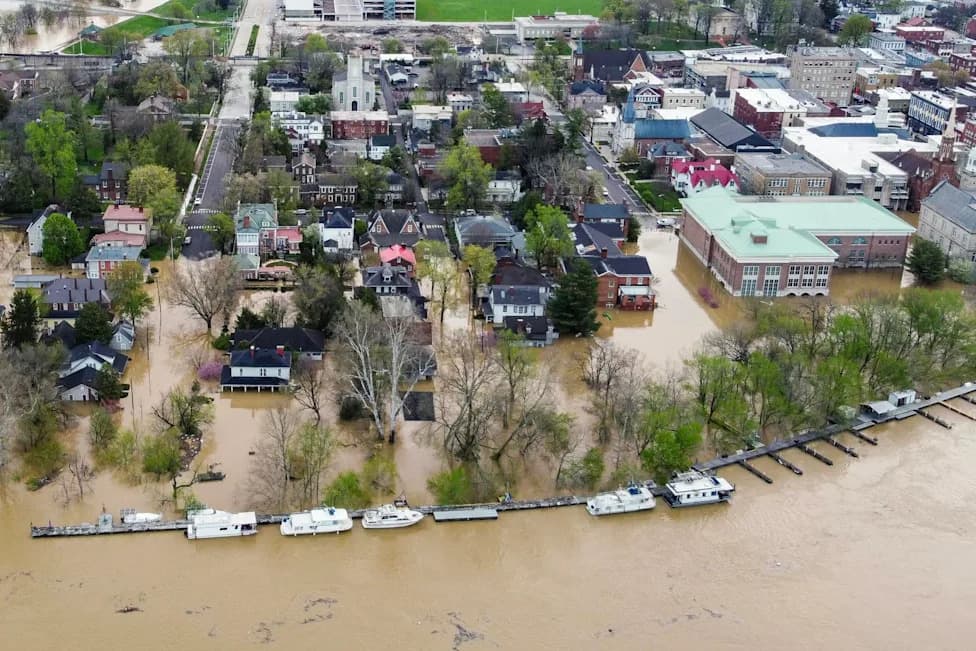
Days of heavy downpours flooded Frankfort, Ky., and other communities across the Midwest in spring 2025.Leandro Lozada/AFP via Getty Images
In early July 2026 the Trump administration quietly named Matthew Wielicki to lead the U.S. Global Change Research Program (USGCRP). Wielicki is best known as a podcaster who has publicly downplayed climate risks and, crucially, has not been a major participant in climate impacts research. His appointment places a climate skeptic at the helm of a congressionally mandated scientific program with responsibility for producing the National Climate Assessment (NCA).
What the National Climate Assessment Does — And What It Doesn't
By statute, the USGCRP must produce and deliver a National Climate Assessment to the president and Congress at least once every four years. The Assessment is intended to inform businesses, communities, and governments at all levels so they can make better choices in response to the mounting dangers of a changing climate.
Since the first NCA in 2000, these reports have done two things extremely well: they have plainly described the risks climate change poses to the United States, and they have shown that those risks will grow if greenhouse gas emissions are not controlled.
Why The Assessment Is Broken
Despite strong science and good intent, the Assessments have repeatedly fallen short of an essential part of their mandate. They document risks clearly but rarely provide decision-makers with a clear, usable accounting of the range of options for adapting to or reducing those risks. The reports often stop short of identifying which adaptation or mitigation strategies are most appropriate in specific places and under different climate scenarios. They also offer little guidance on how to make decisions under the inevitable uncertainties that climate change creates.
Imagine a doctor telling you you have a serious illness and then ushering you out of the office without explaining treatment options or how other patients fared. That is the Assessment’s dilemma: it catalogs risk with excellence but aids decision-making poorly.
Why Leadership Matters
Fixing the Assessment is fundamentally the responsibility of the USGCRP director. The remedy is not denial — evidence of climate harm is visible in extreme downpours, lethal heat waves, intense droughts, and worsening storms. The needed reform is to broaden the Assessment’s remit beyond documenting causes and consequences to providing actionable guidance on managing risks.
Appointing Wielicki — a former geochemistry instructor and vocal climate critic — to oversee the USGCRP is unlikely to strengthen the Assessment's ability to help decision-makers. In 2025 the administration dismantled parts of the USGCRP and commissioned a panel of skeptics to produce an alternative report that downplayed climate threats; a court later found that report had been produced improperly. Those moves have already undermined trust in federal climate science outputs.
What Decision-Makers Really Need
Business and government leaders need practical information: the costs, benefits, uncertainties, and trade-offs of different climate risk-management options. They need to know what happens if they act now, delay, or choose not to act.
A reformed National Climate Assessment could become a searchable, living library of concrete, relatable case studies documenting climate risk-management choices and outcomes. Useful cases would explain why New York City used scenario planning for sea-level rise and stronger storms; why Flagstaff, Arizona, pursued a ballot initiative to address flood and wildfire risks; how Burlington, Vermont, and Georgetown, Texas, fared after transitioning toward renewable electricity; and why some jurisdictions in South Florida continue to avoid limits on coastal development or managed retreat despite mounting scientific warnings.
How To Make Cases Useful
Three practical requirements would make case studies valuable:
- Candor: Be explicit about the strengths, limitations, and uncertainties of competing options, including maintaining the status quo.
- Transferability: Explain how lessons can be adapted to different places, governance contexts, and climate futures.
- Currency: Keep cases updated so users can learn from subsequent outcomes and policy adjustments.
Conclusion
Only by systematically documenting why actors chose to act — or not — and what followed can future decision-makers be better prepared when faced with similar choices. Strong, experienced leadership at the USGCRP is essential to transform the National Climate Assessment from a report that primarily documents risk into a practical tool that informs high-stakes decisions.
This article was adapted from a piece by Joe Árvai, USC Dornsife College of Letters, Arts and Sciences, originally published by The Conversation. The author has received funding from agencies including NASA, NOAA, and the National Science Foundation.
Help us improve.