A persistent North Atlantic "cold blob" south of Greenland is cooling because less warm water is being transported into the region, not because of increased surface heat loss. An international, data-driven study using records back to 1955 links this anomaly to a weakening Atlantic Meridional Overturning Circulation (AMOC). Models indicate the AMOC could approach a tipping point later this century, with consequences for European winters and global weather systems.
Alarming North Atlantic "Cold Blob" Near Greenland Suggests AMOC Is Approaching a Tipping Point

(Carlo Alberto Conti/Moment/Getty Images)
There is an unusual cooling anomaly in the North Atlantic, just south of Greenland: a persistent "cold blob" of ocean and air that is cooling even as the global average temperature continues to rise. A new international analysis of satellite observations, reanalysis datasets, and ocean heat content records dating back to 1955 finds this regional chill is driven by reduced heat transport from the ocean interior — not by increased surface heat loss.
YouTube Thumbnail
What the Study Did
The research team combined multiple observational records, including long-term ocean heat content data, to test two competing explanations: (1) reduced northward delivery of warm water by ocean currents, or (2) increased heat loss from the sea surface. Their analysis shows the cooling is rooted in changes to deep ocean currents and heat transport rather than surface fluxes.
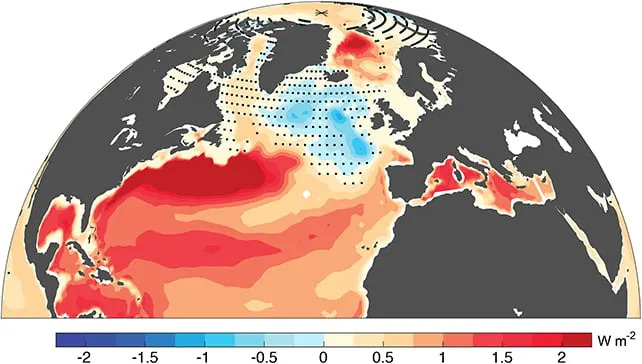
The 'cold blob' in the Atlantic Ocean hasn't followed the warming trend of the rest of the oceans. This map shows patterns of ocean warming and cooling in the full-depth water column for 1955–2024. (Rahmstorf et al.,Geophys. Res. Lett., 2026)
Key Findings
Reduced Ocean Heat Transport: The region's surface heat fluxes have actually declined, so the cold anomaly arises because less warm water is being advected into the area by the ocean interior.

Subscribe to ScienceAlert's free fact-checked newsletter
AMOC Link: The cold patch lies where the Atlantic Meridional Overturning Circulation (AMOC) returns water northward. Weaker northward flow means less tropical heat reaches the North Atlantic, producing the observed cooling.

YouTube Thumbnail
“Given the well-established existence of a tipping point of the AMOC, as well as recent studies finding a range of different 'early warning signals' of the ocean circulation approaching such a tipping point, the strong evidence for a weakening AMOC is a serious concern for society and policy,” the authors write.
Why This Matters
Multiple independent studies and climate-model ensembles (including CMIP6 simulations) indicate the AMOC is weakening and could approach a tipping point later this century in a subset of scenarios. If the AMOC were to shut down or collapse, climate models project colder, harsher winters for Europe and major reorganizations of global weather patterns, ecosystems, and food production systems.
Uncertainty and Next Steps
Direct AMOC measurements only extend to 2004, leaving a relatively short instrumental record. That limits certainty about the long-term trend, but the new observational evidence linking the cold blob to reduced ocean heat transport strengthens the case that the overturning circulation is changing. Scientists continue to use longer-term records and model ensembles to refine projections and to inform urgent policy and adaptation planning.
Publication: The study is published in Geophysical Research Letters.
Help us improve.