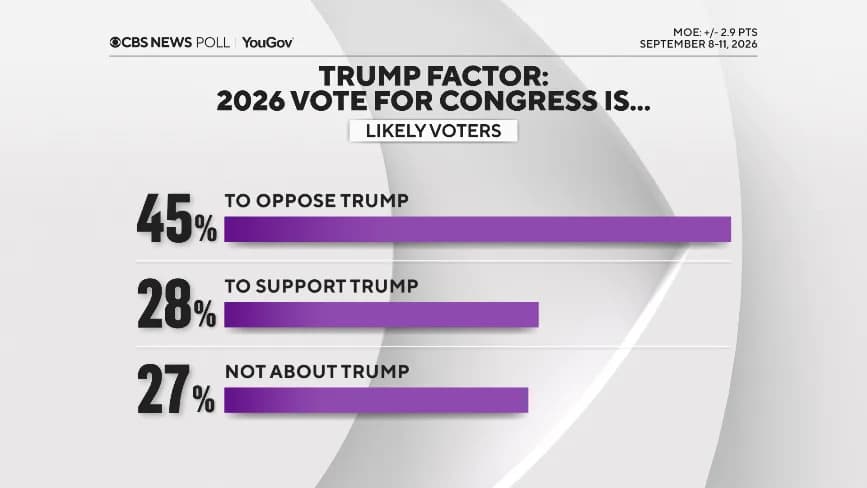
The New York Times/Siena poll released Monday shows Democrats leading the generic congressional ballot 50% to 39%, an 11-point margin up from five points in January. RealClearPolitics notes this gap is larger than most recent national polls. Republican strategist Karl Rove warned that redistricting could have mixed effects, but the Democratic edge suggests Republican incumbents in swing districts could be vulnerable. The survey also records President Trump at a 37% approval and 59% disapproval, with analysts citing unusually poor inflation-related polling for the president.
New NYT/Siena Poll: Democrats Lead Generic Congressional Ballot By 11 Points

House Minority Leader Hakeem Jeffries of N.Y., hands the gavel to speaker-elect Rep. Mike Johnson, R-La., at the Capitol in Washington, Wednesday, Oct. 25, 2023.
A New York Times/Siena poll released Monday shows Democrats leading the generic congressional ballot 50% to 39%, an 11-point advantage that has widened since January. The result signals potential trouble for Republican incumbents in competitive districts as parties prepare for the 2026 midterm map fight.
Details From The Survey
The poll asked voters: "If the 2026 general election for Congress were held today, which party’s candidate would you be more likely to vote for in your district?" Respondents favored the Democratic candidate by 50% to 39%. That margin has grown from a 5-point Democratic edge recorded by the same poll in January. RealClearPolitics, which aggregates polls, reports that this 11-point gap is larger than most recent national surveys.
Redistricting And Risk
Republican strategist Karl Rove cautioned that redistricting efforts could produce mixed results. On Fox News he suggested that splitting large Democratic cities into multiple districts may reduce Democratic margins in those areas but could leave Republicans vulnerable elsewhere.
“You could in essence take … like here in Texas, take big cities, which are typically Democrat, and split them up among several sort of suburban and rural Republicans and thereby reduce their margin and make [House Republicans] more vulnerable in an election year,” Rove said.
An 11-point Democratic advantage on the generic ballot implies that Republican-held seats in swing districts may be under significant pressure heading into 2026, even if redistricting changes the map locally.
President Trump’s Approval Ratings
The same New York Times/Siena poll recorded President Donald Trump with a 37% approval and 59% disapproval. That finding is consistent with other recent surveys showing presidential approval in the 30s. Aggregated approval on RealClearPolitics has fallen below 40% for the first time in Trump’s second term, a milestone that includes several right-leaning polls in the composite.
CNN chief data analyst Harry Enten summarized the broader picture on inflation-related polling, saying the numbers are the "worst polls ever for any president," highlighting how economic concerns are translating into poor ratings for the incumbent.
What To Watch Next
Polls can shift as events unfold, but this survey suggests Democrats currently hold a clear advantage on the generic ballot and that economic indicators—especially inflation—are weighing on presidential approval. Observers will be watching future national and district-level polls, redistricting outcomes, and early candidate positioning ahead of 2026.
Help us improve.