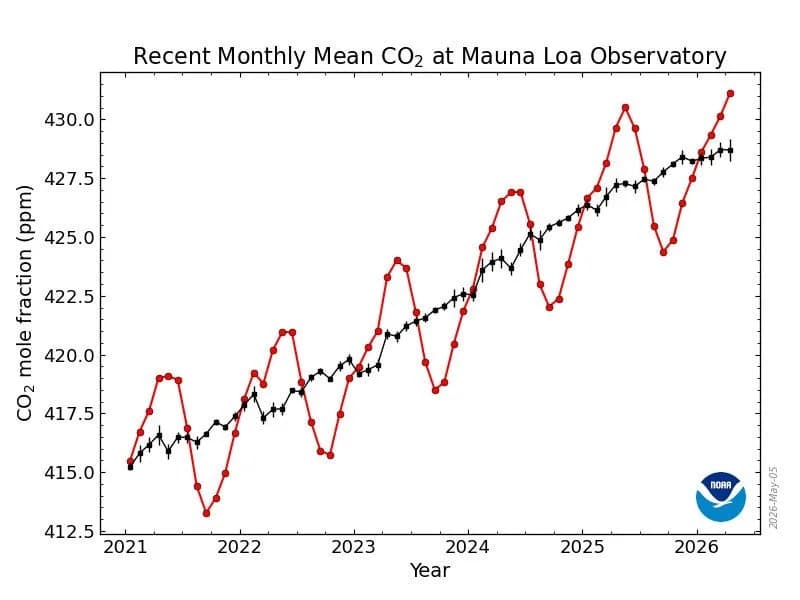
NOAA's Mauna Loa Observatory recorded an average atmospheric CO2 concentration of about 431 ppm in April, a new monthly high. April readings typically peak because winter plant decay releases carbon while regrowth later reabsorbs some of it, but NOAA's long-term records show a steady upward trend. The observatory — which has measured CO2 continuously since 1958 — faces potential funding cuts in NOAA's proposed FY2027 budget. Scientists point to both a recent rebound in U.S. emissions (partly tied to AI data-center demand) and expanding renewables as key factors shaping the near-term outlook.
Atmospheric CO2 Hits Record Monthly High — Mauna Loa Measures 431 ppm In April
NOAA
Measurements at the National Oceanic and Atmospheric Administration's Mauna Loa Observatory in Hawaii show atmospheric carbon dioxide reached a new monthly record in April, averaging about 431 parts per million (ppm).
What ppm means: Greenhouse gases such as carbon dioxide are reported as the number of molecules of a gas per one million molecules of air (ppm).
It’s just another sign that carbon dioxide continues to increase in our atmosphere as our planet continues to warm, Labe said. For many climate scientists, this is just 'here it is again, another record in the wrong direction.'
Climate scientist Zachary Labe of Climate Central described the new monthly high as "depressing" but not surprising given long-term trends. He noted that April typically produces the year's highest CO2 readings because decaying plant material after winter releases carbon; much of that carbon is later reabsorbed as vegetation regrows through spring and summer. Despite this seasonal cycle, NOAA's continuous records show a clear and concerning upward trend in average CO2 concentrations.
Why Mauna Loa matters: The Mauna Loa Observatory maintains the longest continuous direct record of atmospheric CO2 in the United States, with measurements beginning in 1958. At that time, April levels were under 320 ppm — illustrating how far concentrations have climbed in just a few decades.
Scientists extend the atmospheric record further back by analyzing tiny air bubbles trapped in ice cores, which show pre-industrial CO2 around 280 ppm or lower. Even during warm interglacial periods in Earth's past, atmospheric CO2 rarely exceeded roughly 300 ppm, underscoring how unusual current concentrations are on geologic timescales.
Policy and monitoring risks: The new record comes as the Mauna Loa program faces potential funding challenges. A NOAA budget proposal for fiscal year 2027 (which begins October 2026) recommends cuts to several climate-monitoring sites, including Mauna Loa, raising concerns about the continuity of this critical long-term dataset.
Emissions trends and outlook: U.S. emissions declined in 2023 and 2024, but preliminary analyses indicate a partial rebound in 2025, driven in part by increased electricity demand from artificial intelligence data centers. Still, Labe pointed to the rapid expansion of renewables such as solar and wind as reasons for cautious optimism about future emissions trajectories.
While a single monthly peak does not change the long-term picture, sustained increases like this month’s 431 ppm underline the urgency of emissions reductions and the value of ongoing, high-quality atmospheric monitoring.
Help us improve.