Doctoral candidate Rosh D'Arcy uses paleoclimate data to refute claims that the Holocene, Roman, or medieval eras were warmer than today. Records show modern global temperatures exceed Holocene values, with roughly 1.2 °C (2.2 °F) of warming in the last century. Regional warm spells in the past were not globally comparable, and much older periods such as the Cretaceous were hotter but occurred tens of millions of years ago. D'Arcy also lists practical steps people can take to reduce emissions.
Ph.D. Student Debunks Claim That Ancient Eras Were Hotter Than Today
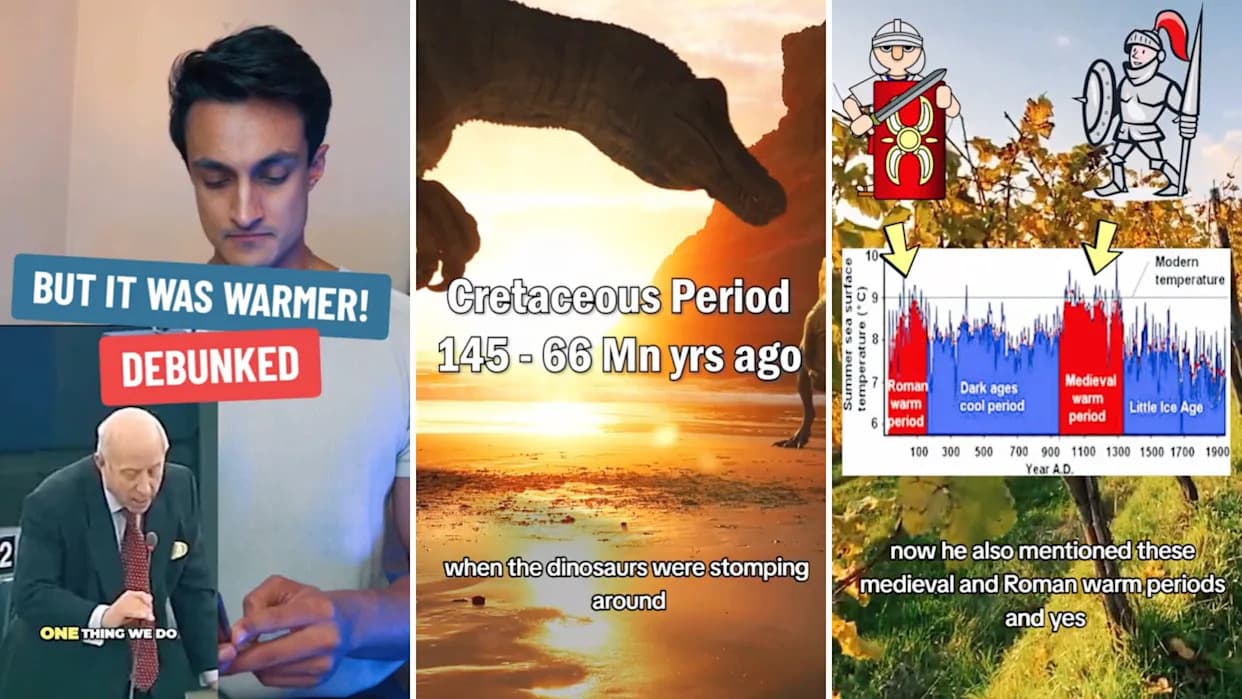
Photo Credit: TikTok
As global temperatures rise, misinformation about the scale and causes of climate change still circulates. A doctoral candidate in Earth and climate science, Rosh D'Arcy (@all_about_climate), has been posting short videos that use data and visual evidence to correct misleading claims.
In a recent TikTok, D'Arcy addressed the assertion that the Holocene, Roman, or medieval periods were warmer than the present. The Holocene epoch — the span of human civilization — began roughly 12,000 years ago. D'Arcy pointed to paleoclimate records showing that modern global temperatures are higher than any values recorded during the Holocene and displayed a temperature timeline with a clear spike at the end representing roughly 1.2 °C (about 2.2 °F) of warming over the past century.
He acknowledged that there were regional warm intervals during the Roman and medieval periods, but emphasized that these were not globally synchronous or anywhere near the magnitude of today’s warming on a planetary scale.
“If you look at the data for the Holocene, you can quite clearly see that modern temperatures are well above anything in the Holocene period — so this idea that it's been warmer in the Holocene is just wrong,” D'Arcy said.
D'Arcy contrasted modern warming with distant greenhouse climates. For example, during the Cretaceous period (about 66–145 million years ago) Earth was roughly 5–10 °C (9–18 °F) warmer than today — conditions that existed long before humans. The important distinction, he noted, is the rate and context of change: rapid transitions in Earth’s climate history (for example around mass-extinction events such as the Permian–Triassic interval) have had catastrophic consequences for ecosystems.
Practical Steps to Help Slow Warming
D'Arcy also offered practical, everyday actions individuals can take to reduce emissions and personal impact:
- Walk, bike, or use public transit instead of driving when possible.
- Reduce single-use plastics by switching to reusable water bottles and safer food containers.
- Improve home efficiency: electrify heating and cooking, upgrade insulation, and consider induction cooktops.
- Support policies and clean-energy solutions that reduce reliance on fossil fuels.
While individual choices help, D'Arcy stressed that systemic changes to energy systems and policy are critical to limit warming and avoid unlivable conditions for future generations.
Help us improve.