This study used data from 27,030 UK Biobank adults and validated findings in more than 10,000 U.S. teenagers to identify five reproducible sleep subtypes—two early-bird and three night-owl groups. Each subtype is associated with distinct health, behavior and brain-measure patterns: some show relatively few health problems, while others are linked to higher rates of depression, substance use and cardiovascular risk. The authors say recognizing this heterogeneity could help tailor sleep, work and mental-health strategies, while noting these are associations rather than causal findings.
Five Distinct Sleep Subtypes Linked To Different Health And Lifestyle Profiles
Study Ties 5 Subtypes of Sleep With Distinct Health And Lifestyle Patterns
New research shows that human sleep timing is more varied than the simple categories of "morning lark" and "night owl." By clustering sleep patterns and associated health measures, researchers identified five reproducible sleeper subtypes—two early-bird groups and three night-owl groups—each tied to distinct behavioral, mental-health and physical-risk profiles.
Study Overview
The team analyzed health records and self-reported sleep data from 27,030 adults in the UK Biobank (mid to late life) and validated their findings in a second cohort of more than 10,000 U.S. teenagers. The results, published in Nature Communications, describe consistent subtype patterns across age groups.
In today's digital and post-pandemic era, sleep patterns are more diverse than ever — understanding that diversity could help personalize approaches to sleep, work schedules and mental-health support. — Le Zhou, McGill University
The Five Subtypes
Subtype 1 (Night-Owl, High Risky Behavior / Cognitive Strengths): A late-timing group associated with risk-taking behaviors and difficulties in emotional regulation. Paradoxically, members showed faster reaction times and somewhat stronger cognitive performance on certain measures compared with early-bird groups.
Subscribe to ScienceAlert's free fact-checked newsletter
Subtype 2 (Night-Owl, Poorer Mental and Cardiovascular Outcomes): A night-owl profile linked to higher rates of depression, greater tobacco use, elevated cardiovascular risk, lower physical activity, and reduced white-matter integrity on brain imaging; people in this group were also more likely to be prescribed antidepressants.
Subtype 3 (Morningness, Healthier Profile): A morning-type group with relatively few health concerns. Individuals in this subtype tended not to smoke, rarely consumed alcohol, engaged less in risky behaviors, and—despite higher self-reported anxiety—had fewer emotional-regulation problems overall.
Subtype 4 (Early-Bird, Female-Skewed, Depressive Symptoms): A second early-morning chronotype that skewed female and was associated with depressive symptoms and higher rates of antidepressant prescriptions.
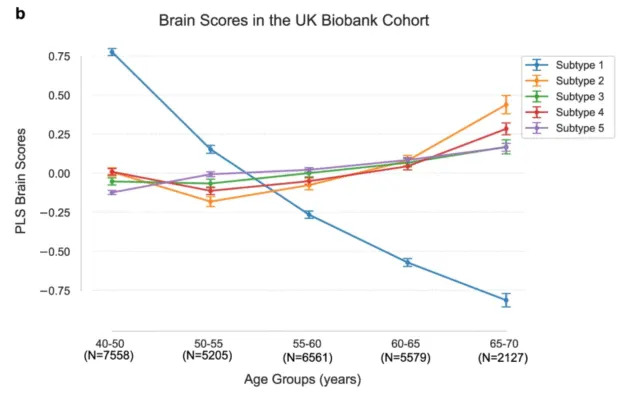
Age distributions for the UK Biobank cohort, including how strongly (higher brain scores) a specific age group fits each profile. (Zhou et al.,Nat. Commun., 2025)
Subtype 5 (Night-Owl, Male-Skewed, Substance Use): A late-timing group more common in males, tied to greater alcohol, tobacco and cannabis use, higher cardiovascular risk, and a higher incidence of prostate-related conditions.
Implications and Caveats
The study highlights that chronotype is not binary but includes multiple subgroups with different health correlates. These are associations, not proof of causation: the subtypes describe linked patterns of behavior, brain measures and health outcomes. The authors suggest that recognizing this diversity could inform more personalized recommendations for sleep timing, workplace schedules and mental-health interventions.
The research adds to growing evidence that internal sleep phasing interacts with many aspects of daily life, but further longitudinal and mechanistic studies are needed to understand causes and clinical applications.
Source: Study published in Nature Communications; analyses based on UK Biobank (n=27,030) and a U.S. teen cohort (n>10,000).
Help us improve.