Researchers at Aarhus University developed a ddPCR-based soil DNA test that uses the ITS2 genetic marker to identify plant species and estimate root biomass directly from soil. By creating reference curves from soils with known root amounts, they linked ddPCR signal strength to actual root mass. Tests on perennial ryegrass, hybrid ryegrass and cocksfoot showed the method recovers more root material—especially fine roots—than traditional washing and can apportion biomass in mixed samples, though closely related species and hybrids remain challenging.
DNA Breakthrough Reveals Hidden Life of Plant Roots — New Soil Test Measures Root Biomass and Species
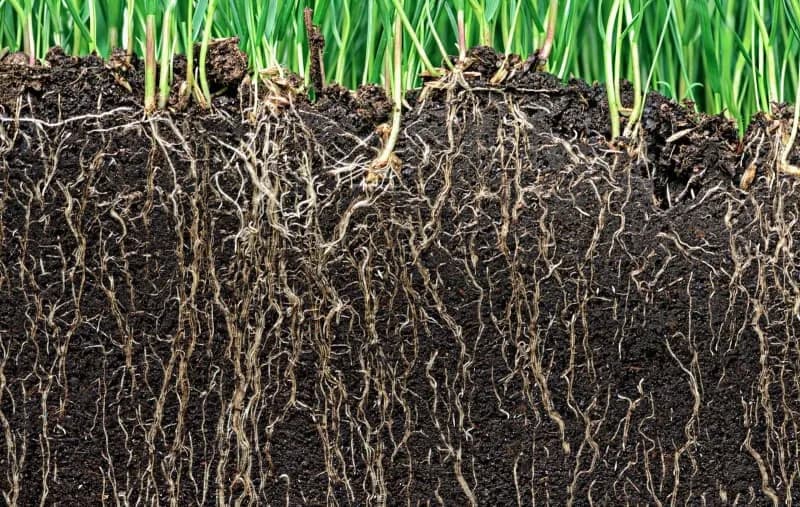
A new DNA method lets scientists measure plant roots underground, opening doors for climate research and smarter farming. (Shutterstock)
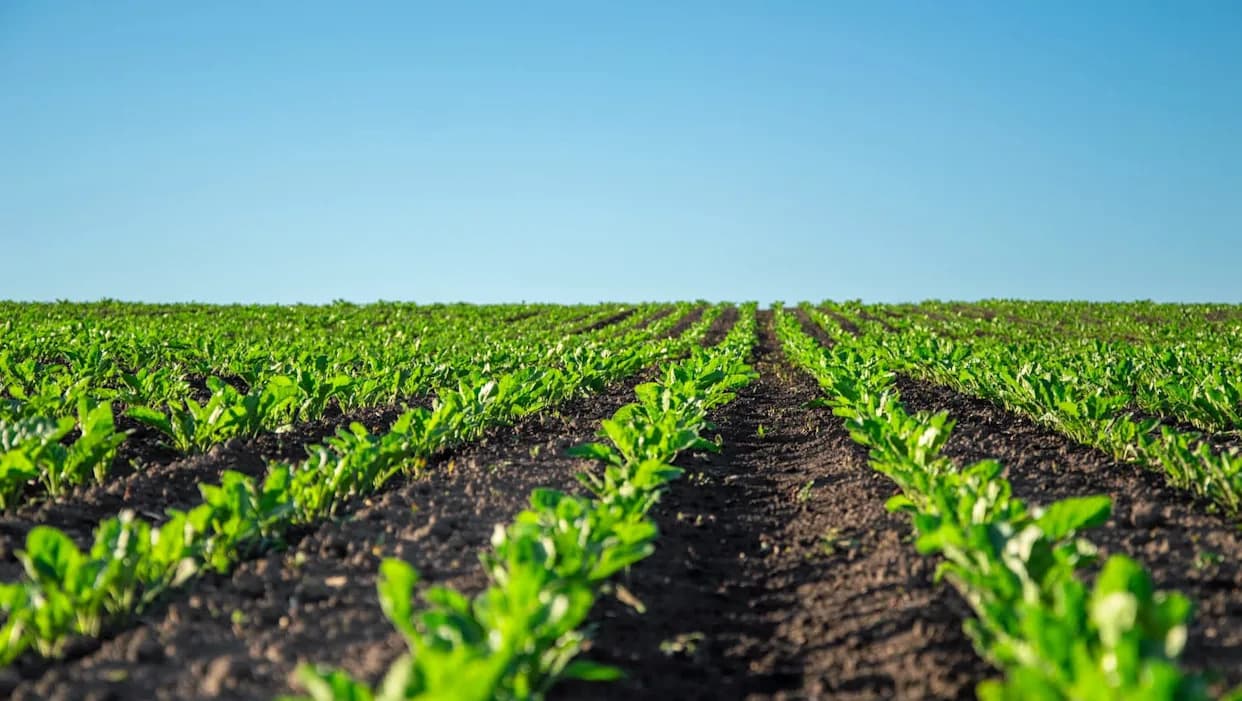
You walk through a field of wheat, ryegrass or clover and notice stems and leaves moving in the wind. What remains out of sight is where much of the vital activity takes place: below ground, roots spread, compete and quietly shape farming outcomes and the movement of carbon through soils.
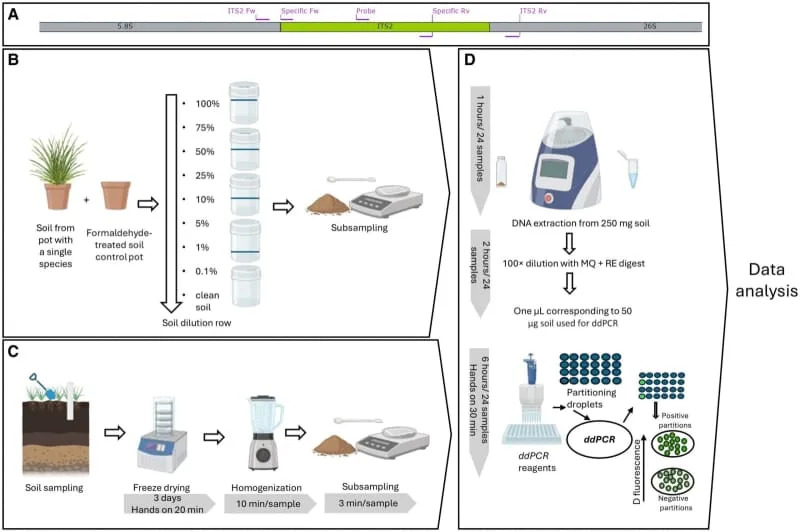
Outline of workflows and key concepts. (CREDIT: Plant Physiology)
Why Roots Matter — And Why They’re Hard to Study
Root systems anchor plants, take up water and nutrients, and sequester carbon in soil. Yet for decades researchers have struggled to measure roots precisely. Traditional approaches require digging, washing soil through sieves, untangling root mats by hand, drying and weighing the material — a slow process that commonly damages or loses the fine roots that do most of the nutrient uptake and carbon exchange.
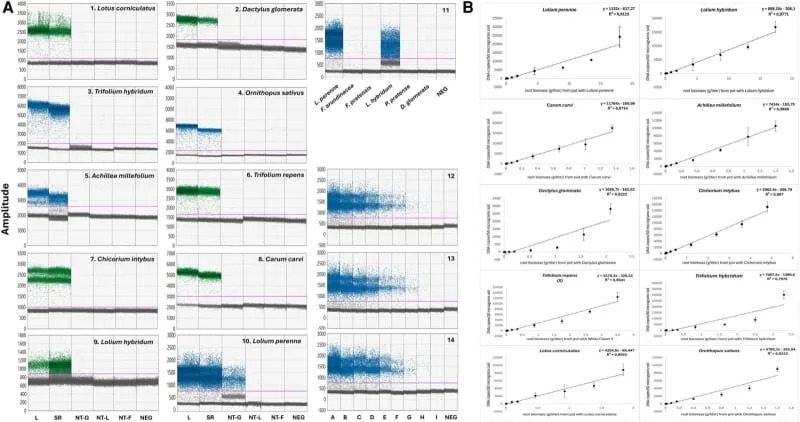
Validating probes and generating standard curves. (CREDIT: Plant Physiology)
A Genetic Solution: Reading Root DNA in Soil
Scientists at Aarhus University turned to genetics to overcome that barrier. Rather than pulling roots from soil, they extract DNA from soil samples and use droplet digital PCR (ddPCR) to detect plant DNA directly. ddPCR partitions a DNA extract into tens of thousands of micro-droplets and tests each droplet for target DNA sequences, improving sensitivity and quantification compared with conventional PCR.
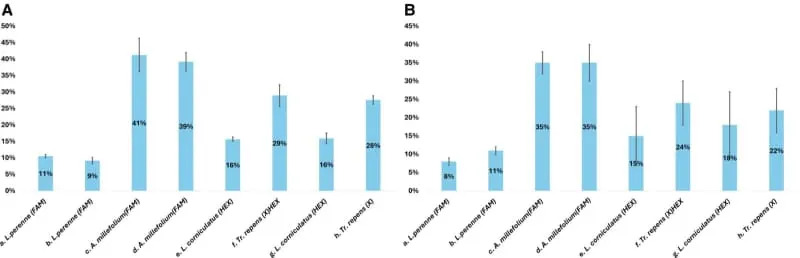
The histograms show the measured relative amounts of the target species. (CREDIT: Plant Physiology)
“It’s a bit like giving the soil a DNA test,” says Henrik Brinch-Pedersen, Professor in the Department of Agroecology at Aarhus University. “We can suddenly see the hidden distribution of species and biomass without digging up the whole field.”
ITS2: A Molecular Barcode For Roots
The team targets the ITS2 genetic marker, a short DNA region whose variants act like a species barcode. By designing species-specific probes for ITS2 and measuring signal strength with ddPCR, the researchers can both identify which species are present and estimate how much root material each contributes.
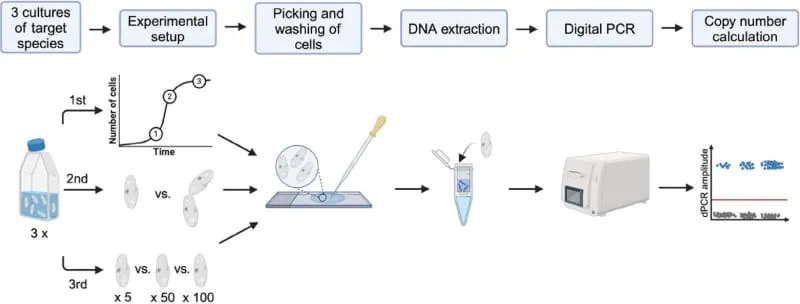
Experimental design of the study illustrating the individual copy number analyses. (CREDIT: Plant Physiology)
Quantifying Roots With Reference Curves
To make the method quantitative, the authors prepared soil samples with known amounts of root material, extracted DNA, and recorded ddPCR signal levels to build reference curves linking DNA signal to root biomass. They then validated the approach in semi-field trials using grasses such as perennial ryegrass, hybrid ryegrass and cocksfoot, comparing ddPCR results with traditional root washing and weighing.
Key Findings
- The DNA-based ddPCR method often detected more root material than washing methods, particularly recovering fine roots that are lost during washing.
- It could apportion biomass among species in mixed samples where roots are tightly intertwined, thanks to species-specific ITS2 probes.
- Specificity tests showed probes responded primarily to their intended targets in the tested species.
Limitations And Caveats
The technique is powerful but not perfect. Closely related species and hybrids can be difficult to separate when their ITS2 sequences are very similar. Each species requires development of a specific DNA probe, which takes time and laboratory validation. Other practical caveats include variation in DNA extraction efficiency across soil types, potential detection of relic (dead) DNA versus living roots, and changes in root tissue DNA concentration with plant age or health — all factors that can affect the DNA-to-biomass relationship and require calibration for different conditions.
Applications And Next Steps
Despite these limits, the method opens new possibilities. For farmers and plant breeders it offers a faster, more precise way to compare varieties and select crops with deeper or denser root systems that can improve drought resilience and nutrient uptake. For climate scientists, better root biomass estimates strengthen calculations of soil carbon storage — a key input for climate-smart farming strategies. Ecologists can use the approach to study belowground species interactions and biodiversity effects on soil health.
The study — led by Nurbanu Shynggyskyzy, Claus Krogh Madsen, Per L. Gregersen, Jim Rasmussen, Uffe Jørgensen and Henrik Brinch-Pedersen — is published online in the journal Plant Physiology. The research was reported originally in The Brighter Side of News.
Bottom line: ddPCR-based soil DNA testing using ITS2 probes is a major step toward seeing and quantifying what has long been hidden beneath our feet — the living architecture of roots that matters for farming, biodiversity and climate.
Help us improve.