Gallup’s global survey shows economic wellbeing is the top concern across sub‑Saharan Africa: nearly one in four residents cite the economy as their country’s main problem, with food, housing and jobs dominating worries. Seven of the 10 countries most worried about affording food or shelter are in the region, while only 6% named political or governance issues as their chief concern. The findings reflect persistent poverty in countries such as Madagascar and Malawi and policy‑driven cost‑of‑living pressures in Nigeria and Zambia. The IMF expects Africa’s growth to outpace Asia this year, but analysts warn major investment and pro‑poor policies are needed.
Economic Anxiety Tops Concerns in Sub‑Saharan Africa, Gallup Survey Finds
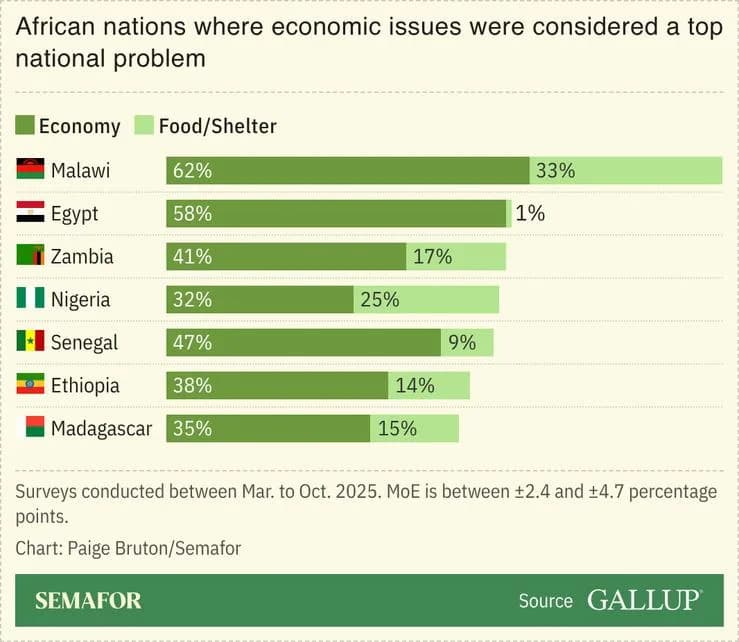
A chart showing African nations where economic issues were considered a top national problem.
A Gallup survey of 107 countries found that economic wellbeing — especially anxiety about affording food, housing and jobs — is the top concern across sub‑Saharan Africa, outweighing worries about politics, governance and security.
Nearly one in four residents in the region named the economy as their country’s single biggest national problem. Seven of the 10 countries where people expressed the greatest worry about paying for food or shelter are in sub‑Saharan Africa; the other three are Australia, Canada and Ireland. As Gallup notes, people judge a nation’s economic health by how well they feel they can live, not solely by measures such as GDP growth.
“People judge a nation’s economic health by how well they feel they are able to live, not by whether its GDP is growing,” the report said.
Employment and work‑related issues also featured more prominently in sub‑Saharan Africa than in the Asia‑Pacific and Europe, where political dissatisfaction was relatively more common. Even amid a wave of military coups and disputed election outcomes in parts of the continent in recent years, only 6% of respondents in sub‑Saharan Africa listed political and governance issues as their most important problem — a pattern Gallup describes as reflecting a hierarchy of needs.
Poverty, Policy and the Cost of Living
The survey’s findings align with long‑standing poverty challenges across the region. Madagascar and Malawi rank among the world’s 10 poorest countries by GDP per capita, and Nigeria has the largest absolute number of people living in poverty globally. Recent policy decisions have also intensified pressures: Nigeria’s fiscal reforms — including the removal of fuel and electricity subsidies — have helped stabilize macroeconomics in some respects but have also contributed to higher inflation and a sharp cost‑of‑living squeeze for many households. In Zambia, which defaulted on sovereign debt in 2020, more than six in 10 residents live below the poverty line.
Gendered Impact and Outlook
Gallup found that economic concerns are particularly acute for women: in Benin, Libya, Madagascar, Nigeria, Niger and Togo, women were at least 10 percentage points more likely than men to name the economy as the country’s main problem. Despite these pressures, the International Monetary Fund projects that Africa’s economic growth this year will outpace Asia’s for the first time. Economists caution, however, that sustaining and broadening that momentum will require substantial investment, improved governance, and policies that reduce poverty and protect vulnerable households.
Help us improve.