Thousands marched in Caracas in a government-organised “Gran Marcha” calling for the release of President Nicolas Maduro and his wife Cilia Flores, one month after the couple were reportedly seized in a violent operation on January 3. Maduro’s son described the operation as a lasting scar and accused a foreign military of desecrating Venezuelan soil. The demonstration — part of a reported global day of action — included public sector workers, students and relatives of political prisoners. Interim leader Delcy Rodriguez has freed hundreds of political prisoners and opened parts of the hydrocarbons sector to private investment, while an amnesty bill she promised has not yet reached parliament.
Thousands Rally In Caracas Demanding U.S. Release Of President Maduro And His Wife
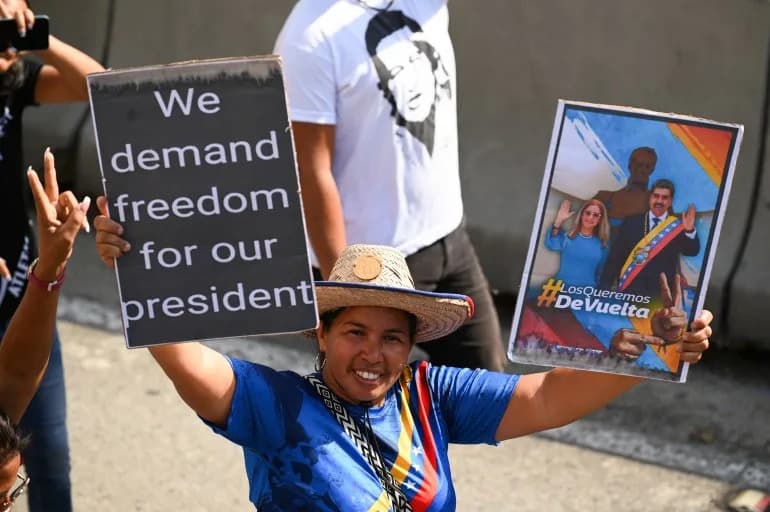
A demonstrator holds a placard during a rally to demand the US releases abducted Venezuelan President Nicolas Maduro and his wife, Cilia Flores, in Caracas, Venezuela [Maxwell Briceno/Reuters]
Thousands of people marched through Venezuela’s capital, Caracas, on Tuesday in a government-organised demonstration calling for the release of President Nicolas Maduro and his wife, Cilia Flores. The protest — dubbed the “Gran Marcha” (The Great March) — came exactly one month after the couple were reportedly seized in a violent nighttime operation on January 3, an act government spokespeople and supporters describe as an abduction by U.S. forces.
“Venezuela needs Nicolas!”chanted the crowds as demonstrators carried placards and wore T-shirts demanding the couple’s return from custody.
One banner read:
“The empire kidnapped them. We want them back.”
Nicolas Maduro Guerra, the detained president’s son and a National Assembly member, addressed the march from a stage, saying the January 3 operation “will remain marked like a scar on our face, forever.” He accused a foreign military of having “desecrated” Venezuelan soil during the operation.
The march was organised by the government and included many public-sector workers; it stretched several hundred metres and was accompanied by trucks playing loud music. Local news outlet Venezuela News described the Caracas event as part of a wider “global day of action,” with solidarity demonstrations abroad under slogans such as “Bring them back” and “Hands off Venezuela.”
Venezuela News said the international protests united voices “from diverse ideological trends,” who argued the detentions represent a breach of international law and a dangerous precedent for national sovereignty.
“We feel confused, sad, angry. There are a lot of emotions,” said Jose Perdomo, a 58-year-old municipal worker who joined the march in Caracas. “Sooner or later, they will have to free our president,” he added, while also expressing support for interim leader Delcy Rodriguez.
Since assuming the acting presidency, Rodriguez has sought to balance appeasing Maduro’s supporters with responding to international pressure. She has freed hundreds of political prisoners and taken steps to open parts of Venezuela’s nationalised hydrocarbons sector to private investment — moves the government frames as measures of reconciliation and reform.
U.S. President Donald Trump has said he is prepared to engage with Rodriguez if Caracas meets certain conditions, including on control and access to Venezuela’s oil resources, according to public statements.
Earlier on Tuesday, hundreds of university students and relatives of political prisoners marched in Caracas calling for prompt approval of an amnesty law Rodriguez has promised — legislation that has not yet been submitted to parliament.
Help us improve.