The Trump administration has stepped up scrutiny of Somalis living in the United States, even as Washington pursues a far deadlier—and quieter—military campaign in Somalia.
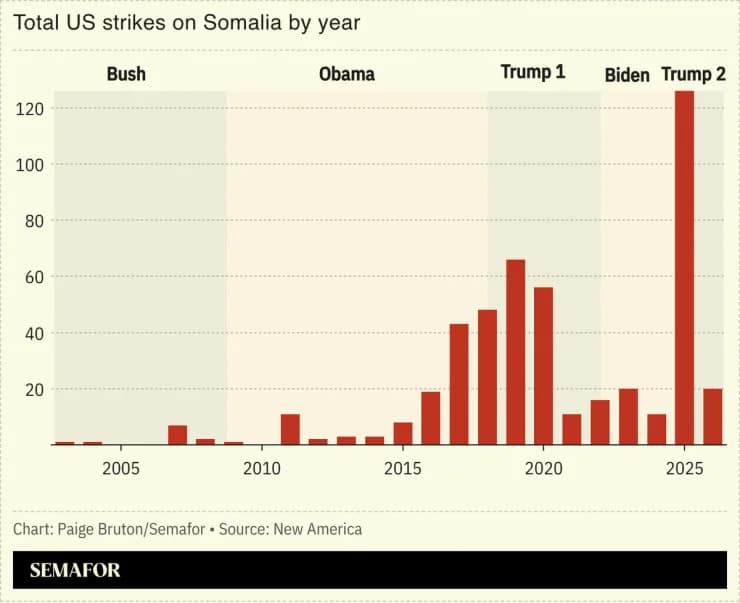
US airstrikes in Somalia have climbed sharply during President Donald Trump’s time in office as American forces target the al-Shabab and ISIS‑Somalia jihadist groups. A year into Trump’s second term, the number of strikes had reached 144, more than half the tally recorded during his first term, according to the nonprofit think tank New America.
At the same time, the Department of Homeland Security announced plans to end Temporary Protected Status for Somalis, potentially making thousands eligible for deportation by March. "Country conditions in Somalia have improved to the point that it no longer meets the law's requirement," the agency said.
Despite that assessment, the Pentagon continues to classify large swaths of Somalia as "areas of active hostilities," a designation officials say justifies sustaining the current pace of strikes. The security situation on the ground remains unstable: al-Shabab has successfully resisted recent government offensives, reclaiming key territories that Somalia’s forces had liberated during the 2022–2023 campaigns.
Militant Aims and U.S. Strategy
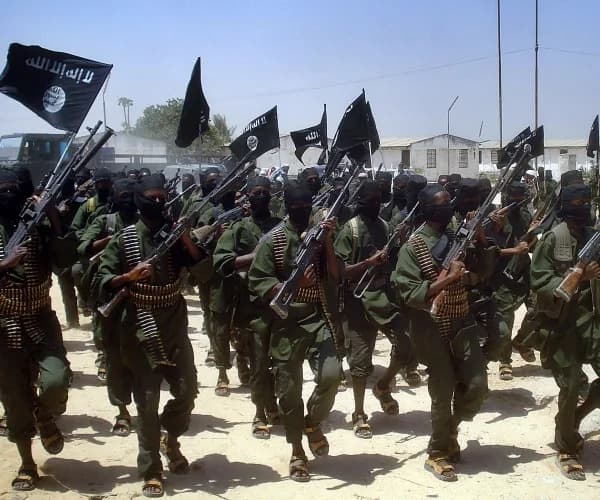
The al-Qaida‑linked al-Shabab seeks to topple Somalia’s government and impose a strict interpretation of Sharia law. Its smaller rival, ISIS‑Somalia, pursues a similar goal of entrenching the regional arm of ISIS’s proclaimed caliphate.
The White House’s approach to Africa emphasizes avoiding a prolonged American footprint or formal commitments. In practice, that posture has favored a strategy of "maximum pressure" from the air—using strikes as a lower‑risk alternative to deploying large numbers of ground troops and to avoid repeating high‑profile failures such as the 1993 "Black Hawk Down" episode.
Rules, Reporting and Accountability
In 2017, the Pentagon altered rules of engagement, lowering the threshold for drone strikes: approval authority was shifted away from the White House, the command level required to authorize strikes was reduced, and the standard for certifying civilian harm was relaxed. Those changes expanded operational flexibility but also raised concerns among rights groups and some lawmakers.
US Africa Command has temporarily stopped providing public casualty estimates while it finalizes related policy, a move that obscures the human cost of the campaign and limits families’ ability to obtain answers about civilian deaths. The reduced transparency also makes it harder for outside observers to evaluate whether the strikes are achieving strategic objectives, especially as al-Shabab demonstrates continuing territorial resilience.
Critics argue that the expansion of airpower—amid reduced reporting and lower authorization thresholds—creates a system in which the "precision" of strikes is primarily verifiable only by those who conduct them, with few avenues for redress for those affected.
Observers note the broader pattern: a push to minimize long‑term troop commitments abroad while relying more heavily on remote strike capabilities, coupled with declining transparency in both foreign counterterrorism operations and, some say, certain domestic enforcement practices.
The US has long framed al-Shabab as a major threat to regional stability, an assessment reinforced by analysts writing in outlets such as CTC Sentinel.