
3I/ATLAS, confirmed in July 2025 as the third known interstellar object, is making a close pass of the inner solar system. Traveling about 137,000 mph, it will come within roughly 170 million miles of Earth on Dec. 19 and poses no danger. The comet’s nucleus is estimated between about 1,400 feet and 3.5 miles across, and Hubble and Webb have collected observations. Skywatchers with small telescopes can spot 3I/ATLAS in pre-dawn skies—near Regulus in Leo—through spring 2026.
Interstellar Comet 3I/ATLAS Nears Earth — How Arizonans Can Spot the Rare Visitor

The interstellar comet 3I/ATLAS is nearing Earth and will on Dec. 19 come within about 170 million miles of our planet during its temporary visit to our solar system.
The enigmatic interstellar object 3I/ATLAS is speeding through the inner solar system and will make its closest approach to Earth in mid-December, giving both scientists and amateur skywatchers a rare chance to observe material that formed around another star.
What Is 3I/ATLAS?
First identified in July 2025, 3I/ATLAS was confirmed as the third known object originating beyond our solar system. When discovered, the object was traveling at roughly 137,000 miles per hour, a trajectory and speed that convinced astronomers it was ejected from another star system and has been drifting through interstellar space for potentially billions of years.
Origin, Size and Orbit
Observations indicate 3I/ATLAS approached from the general direction of the constellation Sagittarius, near the Milky Way's center. It passed inside the orbit of Mars and came as close as about 130 million miles to the Sun during its inbound leg. Unlike comets bound to the Sun, 3I/ATLAS follows a hyperbolic path that will carry it back into interstellar space after this brief visit.
Size estimates remain uncertain. The European Space Agency suggested a broad range—from a few hundred feet to a few miles across—while Hubble Space Telescope data constrained the solid, icy nucleus to roughly 1,400 feet to 3.5 miles in diameter.
When It Will Be Closest To Earth
NASA projects 3I/ATLAS will pass within about 170 million miles of Earth on Dec. 19. That distance is near twice the Earth–Sun separation and more than 700 times the distance between the Earth and the Moon, so the object poses no threat to our planet.
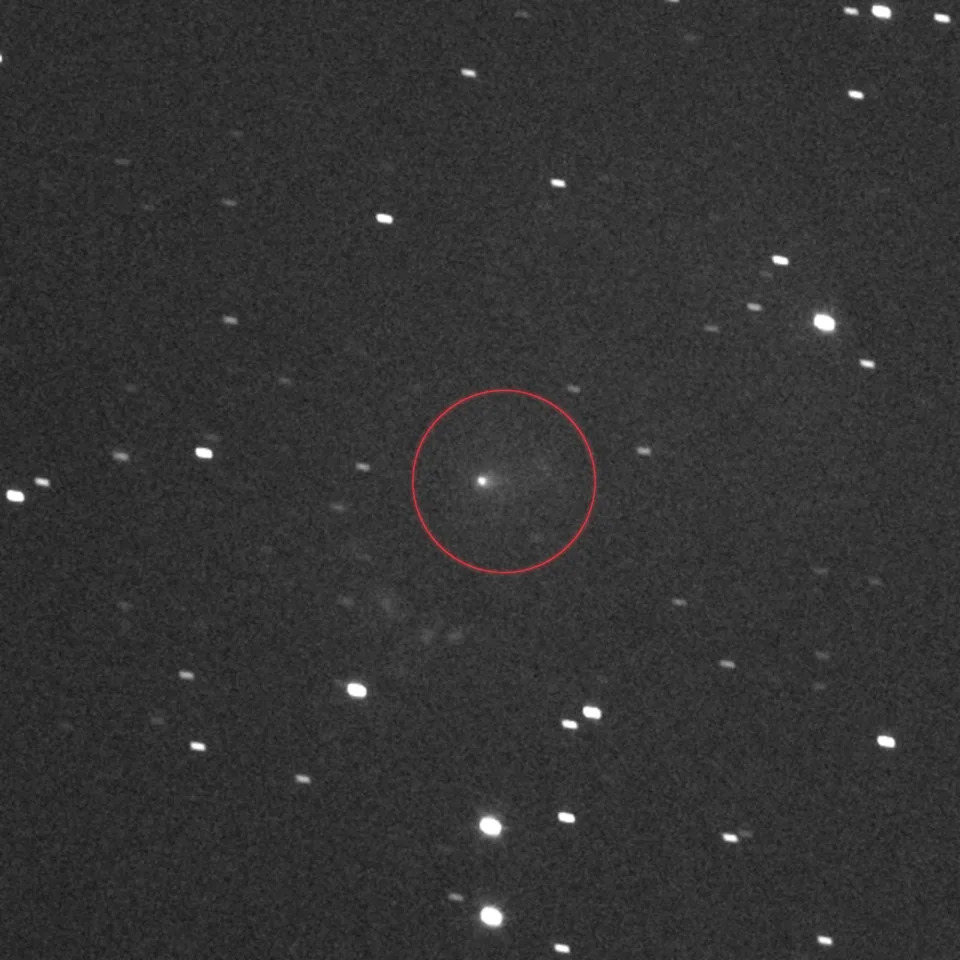
The interstellar comet 3I/ATLAS, circled in the center, as seen by the L’LORRI panchromatic, or black-and-white, imager on NASA’s Lucy spacecraft. This image was made by stacking a series of images taken on Sept. 16, as the comet was zooming toward Mars. Lucy was 240 million miles away from 3I/ATLAS at the time making its way to explore eight asteroids that share an orbit with Jupiter.
How Arizona Residents Can See It
Though 3I/ATLAS is too faint to see without help, observers with even a small telescope should be able to spot it in the pre-dawn sky from now through spring 2026. Around its closest approach, the comet will appear low in the eastern to northeast sky, positioned just under the bright star Regulus in the constellation Leo.
- When to look: Pre-dawn hours (before local sunrise), especially in the days around Dec. 19.
- Where to look: East–northeast horizon; use Regulus in Leo as a reference point.
- Equipment: A small telescope or binoculars and a steady mount will improve visibility. Modest magnification (20–100x) is useful depending on instrument and seeing conditions.
- Location tips: Travel to a dark-sky site away from city light pollution (northern and southern Arizona have many accessible dark-sky areas).
- Tools: Use NASA’s "Eyes on the Solar System" or sky-charting apps to track the comet’s predicted path in real time.
What Scientists Are Learning
A global network of ground- and space-based telescopes — including the Hubble Space Telescope and the James Webb Space Telescope — has been collecting imagery, spectra and other data to reveal the object's composition and history. Hubble’s most recent reported observation occurred on Nov. 30 when the comet was about 178 million miles from Earth. Because telescopes tracked the comet’s motion, background stars in some images appear as streaks while the comet remains sharp.
Addressing Speculation
The object’s interstellar origin has spawned speculation, including public suggestions that it might be artificial. Harvard astrophysicist Avi Loeb has noted the possibility in principle while also saying the object is "most likely a comet of natural origin." NASA officials have found no evidence of technosignatures; Acting Administrator Sean Duffy and science leaders have emphasized there is no threat and no confirmed sign of extraterrestrial technology.
Final Notes For Observers
This close passage is a rare scientific opportunity and an exciting moment for amateur astronomers. Plan a pre-dawn outing, check the local sky conditions, bring a red flashlight and star map, and consider contacting local astronomy clubs or observatories for group viewings and updated observing tips.
Reporter note: Observing conditions and exact coordinates change nightly. Consult NASA’s skywatching guide or reputable astronomy apps for current, location-specific details before heading out.


