The U.S. Court of Appeals has agreed to fast‑track the Chamber of Commerce’s appeal of the $100,000 surcharge on new H‑1B visas, allowing oral arguments in February so employers can learn whether they may participate in the March filing window. The fee, imposed in September, replaced typical petition costs of roughly $2,000–$5,000 and has prompted multiple lawsuits. Separately, DHS has finalized a rule to replace the random H‑1B lottery with a priority‑based allotment effective Feb. 27.
Appeals Court Fast-Tracks Chamber Challenge to $100,000 H‑1B Fee; Oral Arguments Set for February
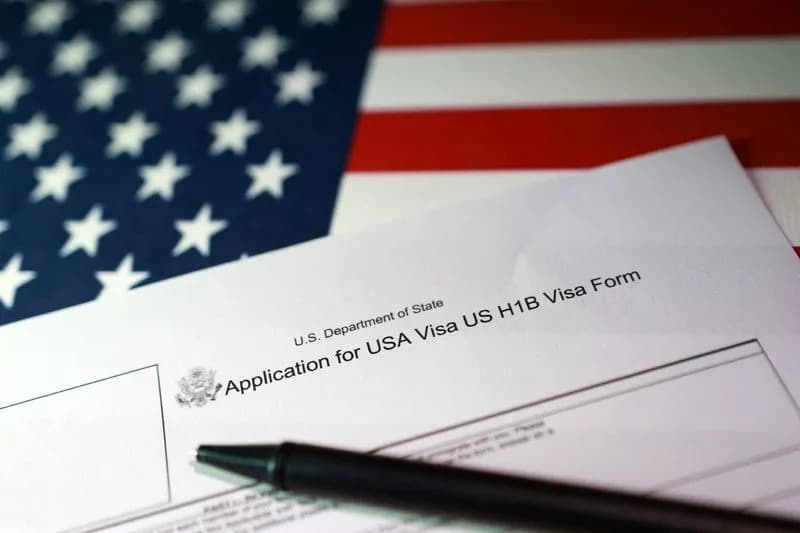
A U.S. flag and a U.S. H-1B Visa application form are seen in this illustration taken, September 22, 2025. REUTERS/Dado Ruvic/Illustration
Jan 5 (Reuters) — A U.S. appeals court on Monday approved an expedited schedule for an appeal by the U.S. Chamber of Commerce and other business and research groups challenging President Donald Trump’s $100,000 fee on new H‑1B visas for highly skilled foreign workers. The court’s timetable will allow oral arguments to proceed in February, ahead of the H‑1B application window that typically opens in March.
Why the Fast Track Matters
The Chamber argued that a swift decision is necessary so employers will know whether they can participate in the H‑1B process this year. In court filings the Chamber warned that employers’ ability to apply in the annual filing window "hinges on the outcome of this appeal; without relief by March, it will be too late." The Trump administration did not oppose the expedited schedule.
Background
The appeal seeks to overturn a Dec. 24 decision by a U.S. district judge who concluded the $100,000 surcharge fell within the president’s broad authority to regulate immigration. The surcharge, imposed in September, replaced the smaller petition fees employers typically paid — roughly $2,000 to $5,000 depending on the case.
The H‑1B program permits U.S. employers to hire foreign nationals trained in specialty fields. The program issues 65,000 regular visas annually plus 20,000 additional slots for workers with U.S. advanced degrees; authorizations commonly run three to six years. Technology companies are among the largest users of H‑1B visas.
Parallel Rulemaking And Other Litigation
Separately, the Department of Homeland Security has finalized a regulation that replaces the random lottery with an allotment system that prioritizes higher‑skilled and higher‑paid applicants. That rule is scheduled to take effect Feb. 27. The administration says the changes address alleged abuses of the program by some employers who favor lower‑paid foreign hires over U.S. workers.
In addition to the Chamber’s lawsuit, a group of Democratic‑led states and a coalition of employers, nonprofits and religious organizations have filed separate challenges to the fee.
Case And Counsel
The litigation is captioned Chamber of Commerce v. Department of Homeland Security, U.S. Court of Appeals for the District of Columbia Circuit, No. 25‑5473. Counsel listed in court filings include Paul Hughes of McDermott Will & Schulte and Daryl Joseffer of the U.S. Chamber Litigation Center for the Chamber; Lindsay Harrison of Jenner & Block for the Association of American Universities; and Tiberius Davis, Glenn Girdharry and Alexandra McTague of the U.S. Department of Justice for DHS.
Reporting by Dietrich Knauth in New York and Daniel Wiessner in Albany, New York.
Help us improve.