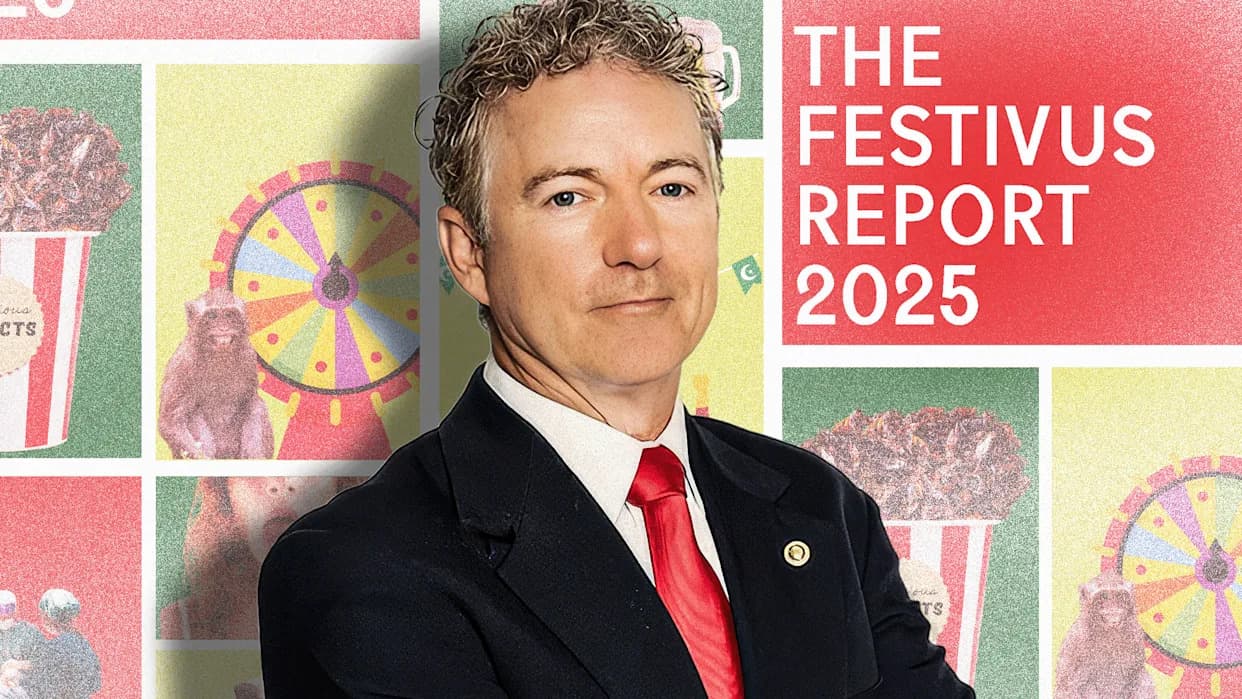
Sen. Rand Paul's Festivus Report 2025 compiles a list of federal programs and grants that the report characterizes as wasteful, totaling $1,639,135,969,608. It attributes $1.22 trillion of that total to interest on the national debt and highlights examples ranging from a $244,252 climate-cartoon grant in Islamabad to a $7.5 billion EV charger program described as largely unimplemented. The report revisits contentious funding linked to research connected with the Wuhan Institute of Virology and flags several controversial animal and human studies. Citing Penn Wharton Budget Model analysis, the report warns that persistent deficits and rising interest costs narrow the window for fiscal correction.
Rand Paul's Festivus Report 2025: $1.64 Trillion In Alleged Waste, $1.22T From Interest
Rand Paul's Annual Festivus Report Highlights $1.6 Trillion in Wasteful Spending
Sen. Rand Paul (R–Ky.) published The Festivus Report 2025, an annual roundup of federal spending he characterizes as wasteful. The report’s headline figure is $1,639,135,969,608, which Paul attributes in part to record interest costs on the national debt.
"This year, I'm spotlighting a jaw-dropping amount of government waste—the kind that makes you wonder if anyone in Washington has ever heard the word 'priorities.'" — The Festivus Report 2025
Selected Examples Highlighted In The Report
Small Grants With High Scrutiny: The report cites a $244,252 State Department grant to a group in Islamabad, Stand for Peace, to produce a children’s television program about climate action.
HHS And Campus Initiatives: It cites a $3.3 million award to Northwestern University to hire staff, create so-called "scientific neighborhoods," appoint "safe space ambassadors," and form committees intended to address systemic racism.
EV Charger Funding: Paul’s report says Congress provided $7.5 billion to the Department of Transportation for nationwide electric vehicle chargers, but asserts only 68 charging stations were operational at the time of reporting.
Return To Past Controversies: The Festivus Report revisits funding tied to the Wuhan Institute of Virology (WIV). The report asserts that U.S. funding flowed through groups such as EcoHealth Alliance and alleges USAID provided up to $54 million for coronavirus-related research projects. The report characterizes some of this work as risky; these assertions are presented as the author's summary of the report's claims.
Alleged Collaborations And Timeline Notes: The report also describes a 2021 collaboration the author says involved U.S. funding and researchers connected to WIV. The report states that this funding was discontinued in early 2025. (The report’s chronology and attribution of funding decisions are reported as described in the Festivus Report.)
Controversial Animal And Human Studies: The report highlights several federally funded experiments it calls ethically troubling, including an ongoing National Institute on Drug Abuse protocol involving beagles, a separate report of ferret studies described as binge-drinking experiments, and a Brown University study—reported as costing roughly $14 million—in which researchers trained monkeys to play a video game while collecting neural and eye-tracking data. The Festivus Report summarizes the Brown study wryly as concluding that "monkeys are very good at Plinko."
Personal Anecdote In The Original Article: The article that accompanies the Festivus Report recounts the author’s past work as a paid human subject in medical studies, noting that federally funded research has long included volunteer participants.
Fiscal Context And Warnings
Paul’s tally emphasizes that $1.22 trillion of the total reflects interest payments on the national debt. The report notes that the country’s total debt exceeds $38.4 trillion and points to analysis from the Penn Wharton Budget Model (PWBM) cited in the report, which estimates that under current policy the U.S. has a limited window to take corrective action before fiscal choices become far more painful.
Overall, the Festivus Report frames a mix of small grants, research projects, and long-term interest obligations as evidence that poor prioritization and persistent deficits compound over time. The report is a partisan audit designed to spotlight examples the author and Sen. Paul view as emblematic of broader fiscal waste.
What To Keep In Mind
This improved article preserves the report’s claims and notable examples while clarifying which statements come directly from the Festivus Report or the accompanying article. Some contested or complex topics—such as the origins of COVID-19 and the specifics of research funding—remain the subject of debate; here they are presented as reported allegations or assertions within the Festivus Report rather than uncontested facts.
Originally published on Reason.com; summaries here reflect the Festivus Report and the original article’s presentation.
Help us improve.