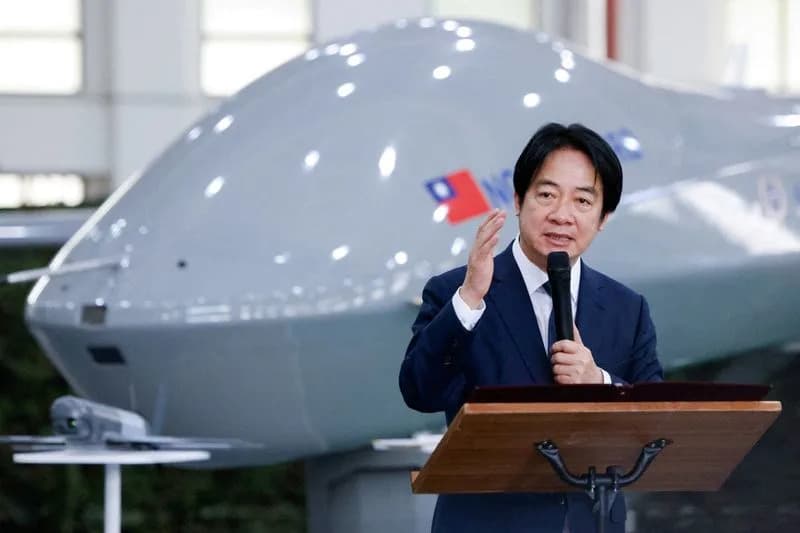
Taiwan President Lai Ching-te pledged in his New Year address to defend the island after Chinese drills that encircled Taiwan with missiles, fighter jets and naval vessels. He warned that parliamentary delays on the annual budget and a proposed $40 billion defence bill could undermine Taiwan’s deterrence. Beijing dismissed the speech as "lies," while Taipei plans to raise defence spending above 3% of GDP by 2026 and to 5% by 2030. Lai urged domestic unity amid a tense political climate and recent violence.
Lai Vows Firm Defence After Chinese Drills, Urges Unity Amid Budget Row

A man in Taiwan watches TV news coverage of the Chinese People's Liberation Army military drills this week, which Taipei called 'highly provocative' (CHENG Yu-chen)(CHENG Yu-chen/AFP/AFP)
Taiwanese President Lai Ching-te used his New Year’s address to vow he will defend the island’s sovereignty after a recent wave of Chinese military drills that encircled Taiwan’s main island.
Beijing this week fired missiles and deployed dozens of fighter jets, navy vessels and coastguard ships in manoeuvres Taipei called "highly provocative." China regards democratic Taiwan as part of its territory and has repeatedly threatened to use force to bring it under Chinese control.
"My stance has always been clear: to steadfastly defend national sovereignty, strengthen national defence and whole-of-society resilience, comprehensively establish effective deterrence capabilities, and build robust democratic defence mechanisms," Lai said in a televised address from the Presidential Office.
The show of force followed a major US arms package to Taipei and comments from Japan’s prime minister suggesting Tokyo could consider a military response if force were used against Taiwan. Lai said international support for Taiwan "has never wavered," arguing the island has become an indispensable and responsible actor in the international community.
Budget Fight and Defence Push
Lai warned that delays by opposition lawmakers in passing the government's annual budget and an additional $40 billion defence spending bill could raise doubts about "Taiwan's resolve" to defend itself. He urged lawmakers to act quickly, saying, "In the face of China's grave military ambitions, Taiwan has no time to wait, nor any time for internal strife."
The government plans to expand defence spending to more than 3% of GDP by 2026 and to 5% by 2030, while shifting procurement toward smaller, more mobile systems designed to enable asymmetric warfare against a larger adversary.
Beijing's Response And Domestic Context
Beijing dismissed Lai's speech as full of "lies," the state news agency Xinhua quoted Chen Binhua, a spokesman for the Taiwan Affairs Office, as saying. Chen accused Lai of promoting the "fallacy of 'Taiwan independence'" and of stoking cross-strait confrontation.
China's drills are the sixth major round of manoeuvres since 2022, when a visit to Taiwan by then-US House Speaker Nancy Pelosi provoked Beijing.
The speech came amid a turbulent period at home: a deadly stabbing on a Taipei metro that killed three people and an escalating political standoff in parliament. The Kuomintang (KMT) and Taiwan People's Party (TPP), which together control the legislature, have clashed with Lai's Democratic Progressive Party (DPP) after Premier Cho Jung-tai refused to sign opposition-backed amendments to a revenue-sharing bill, blocking them from taking effect. Opposition parties have accused the government of "defying the Constitution" and moved to launch impeachment proceedings.
Closing his address, Lai appealed for cross-party unity: "Only through unity, not division, can we avoid sending the wrong signals to China that it could invade Taiwan."
Help us improve.