
China has built the world’s largest theater-range missile force, combining high numbers with hardened bunkers and mobile launchers to threaten U.S. airfields, ports and bases across the Western Pacific. The U.S. retains advantages in targeting networks, submarine strike and alliance depth but faces shortages of long-range munitions and needs more varied missile defenses. The outcome of any conflict will depend on basing access, survivability and which side can fire, relocate and sustain strikes longest.
China’s Missile Surge Threatens Every U.S. Base In The Pacific — Response Window Is Closing

"The People’s Liberation Army Rocket Force… has built an increasing number of short-, medium-, and long-range missiles," Seth Jones of the Center for Strategic and International Studies told Fox News Digital.
For decades Beijing has built a vast land-based missile force intended to keep U.S. military power at a distance in any crisis over Taiwan. U.S. officials and analysts now warn those systems can threaten nearly every major airfield, port and installation across the Western Pacific. The contest between Washington and Beijing is increasingly shaped less by tanks or troop movements than by missile range, basing access and the ability to survive the opening salvos.
China’s Rocket Force: Numbers, Survivability, Tactics
The People’s Liberation Army Rocket Force has accumulated the world’s largest inventory of theater-range missiles, including short-, medium- and long-range systems deployed from hardened underground facilities and mobile launchers. China pairs numerical advantage with survivability measures such as deep bunkers, tunnel networks, decoys and shoot-and-scoot tactics designed to fire, relocate and strike again quickly.
“The People’s Liberation Army Rocket Force … has built an increasing number of short-, medium-, and long-range missiles,” said Seth Jones of the Center for Strategic and International Studies. “They have the capability to shoot those across the first and increasingly the second island chains.”
U.S. Strengths — And Critical Shortfalls
Despite China’s numerical edge, the United States retains important advantages. U.S. strike and defensive systems are integrated into a global surveillance and targeting network of satellites, undersea sensors, stealth drones and mature joint-command tools that Beijing cannot yet match. Submarines can launch cruise missiles from stealthy positions across the Western Pacific, offering strikes without exposed land-based launchers.
Nevertheless, planners acknowledge a near-term vulnerability: long-range munitions stockpiles. Analysts warn U.S. forces could exhaust current inventories of long-range weapons in roughly a week in a high-tempo contingency over Taiwan unless production and logistics are dramatically accelerated.
Rapid U.S. Reforms And Procurement
To close the gap, Washington is accelerating production of ground-launched strike systems. New Army acquisitions include Typhon launchers, expanded High Mobility Artillery Rocket System (HIMARS) batteries, Precision Strike Missiles and long-range hypersonic weapons with ranges above 2,500 kilometers. If plans proceed, the U.S. aims to field about 15,000 long-range anti-ship missiles by 2035, up from roughly 2,500 today.
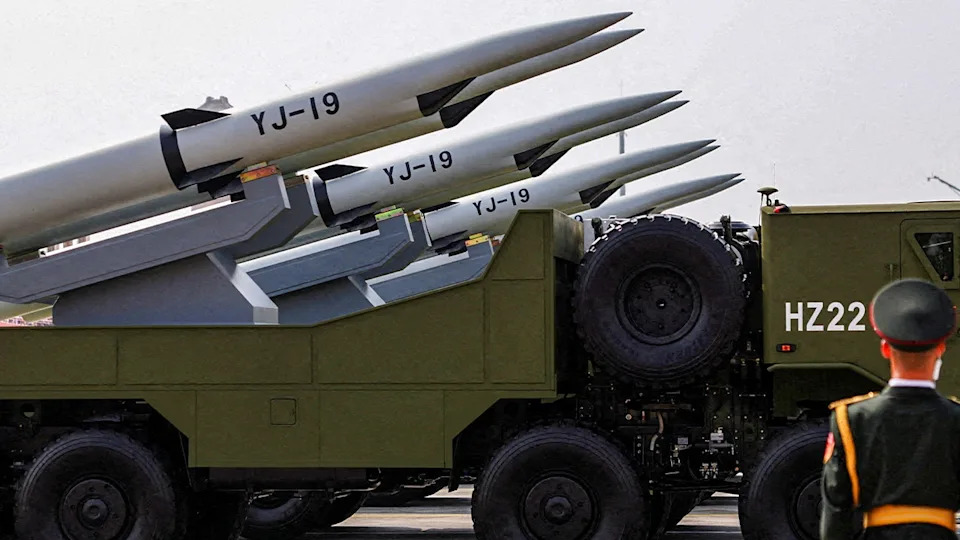
A member of the People's Liberation Army stands as the maritime operations group displays YJ-19 hypersonic anti-ship missiles during a military parade to mark the 80th anniversary of the end of World War Two, in Beijing, China, Sept. 3, 2025.
“We’re buying anti-ship missiles like there’s no tomorrow,” said Eric Heginbotham of MIT, summarizing the scale of procurement.
Integrated Defenses, Alliances And Command
American defense relies on layered missile defenses — Patriot batteries for critical bases, THAAD to intercept ballistic threats at higher altitude, and Aegis-equipped ships to engage missiles farther offshore. Analysts urge more variety and larger numbers of relatively inexpensive, proliferated interceptors to improve survivability.
Command integration is another differentiator. U.S. forces regularly train in multi-domain operations that link air, sea, land, cyber and space capabilities. By contrast, China still faces doctrinal and organizational challenges in joint operations and command structures, and some defense-industry inefficiencies complicate sustained wartime logistics.
Basing, Geography And Political Constraints
Geography matters: missiles are only as effective as the locations from which they can be launched. China enjoys depth inside the first island chain but faces power-projection limits beyond it. The United States, meanwhile, depends on regional basing and host-nation access, turning diplomacy into a component of combat power. Recent agreements with the Philippines and deeper cooperation with Japan and Australia aim to position U.S. launchers close enough to be effective without permanently stationing large ground forces.
The Tactical Reality: A Missile War
Any U.S.–China land conflict would likely be a high-tempo missile campaign rather than a maneuver war of massed armored columns. The decisive factors will be basing, survivability, accuracy and the ability to shoot, relocate and sustain fires under pressure. Both sides are investing in mobility, deception and hardened infrastructure, but the side that can sustain high-tempo launches longest and protect its launchers will shape the early course of conflict.
“Yes … you can defend Taiwan without striking bases inside China,” Heginbotham said. “But you are giving away a significant advantage.”
What Comes Next
For the United States the near-term tasks are clear: expand production of long-range munitions, diversify and proliferate missile defenses, secure regional basing and harden mobile launchers and logistics. For China the central test is whether its large missile inventory and continental depth can compensate for gaps in joint operations, command structure and real-world combat experience.
Ultimately, the contest will not be decided by numbers alone but by the ability to operate under fire, the political and diplomatic choices that permit regional basing, and the command integration needed to translate missiles into sustained, effective fires.


