
Israeli leaders plan to brief President Trump at Mar-a-Lago on Iran's suspected revival of ballistic missile production and repaired air-defence systems, which they regard as the most urgent threats. The briefing will present a range of options for U.S. involvement, from limited support to joint or U.S.-led strikes. The discussion comes amid continuing concerns about rebuilt nuclear enrichment sites, Tehran's interest in talks with Washington, and the fragile Israel–Hamas ceasefire.
Netanyahu to Present Trump With Options for New Strikes as Iran Rebuilds Missile Capabilities

President Donald Trump speaks with Israeli Prime Minister Benjamin Netanyahu at the Israeli parliament, the Knesset, on Oct. 13. (Chip Somodevilla / AFP - Getty Images)
Israeli leaders are preparing to brief President Donald Trump later this month at Mar-a-Lago about growing concerns that Iran is rebuilding its ballistic missile production capacity and repairing damaged air-defence systems, officials say. The briefing is expected to offer a menu of responses — from Israeli action alone to limited U.S. support or joint or U.S.-led strikes — as well as assess the risks to the wider region and U.S. interests.
Key Concerns
Israeli officials, according to a person with direct knowledge of the planning and four former U.S. officials briefed on the matter, view renewed missile production and restored air-defence systems as the most immediate threats. They also say Iran appears to be reconstituting nuclear enrichment sites hit by U.S. strikes in June, but that those efforts are viewed as somewhat less urgent than the missile program.
Planned Mar-a-Lago Briefing
Prime Minister Benjamin Netanyahu is expected to meet Mr. Trump at his Mar-a-Lago estate later this month. Israeli sources say Netanyahu will make the case that Iran's expanding missile capability could require swift action and will present options for U.S. participation, ranging from logistical or intelligence support to joint operations or a U.S.-led campaign.
White House response: White House spokesperson Anna Kelly defended the June strikes, saying the International Atomic Energy Agency and Iranian officials corroborated the U.S. assessment that 'Operation Midnight Hammer totally obliterated Iran's nuclear capabilities,' and reiterated that U.S. forces would act if Iran pursued a nuclear weapon.
Background: June Strikes and Israeli Operations
The U.S. strikes in June, dubbed 'Operation Midnight Hammer,' reportedly involved more than 100 aircraft, a submarine and seven B-2 bombers. U.S. officials have emphasized that extensive damage to buried nuclear facilities required U.S. use of 30,000-pound bunker-busting bombs. Israeli forces also struck Iranian ballistic missile sites earlier in the year, and Israeli attacks in April and October 2024 are reported to have damaged Iran's S-300 air-defence systems, lowering the threat to pilots and allowing later manned flights into Iranian airspace.
Options Previously Presented
Before the June strikes, Israeli officials presented Mr. Trump with four options on a coffee table in the Oval Office: Israel acting alone; Israel with limited U.S. support; a joint U.S.-Israel operation; or the U.S. acting alone. Mr. Trump approved a joint operation at that time. Israeli planners may present a similar range of options at the Mar-a-Lago meeting.
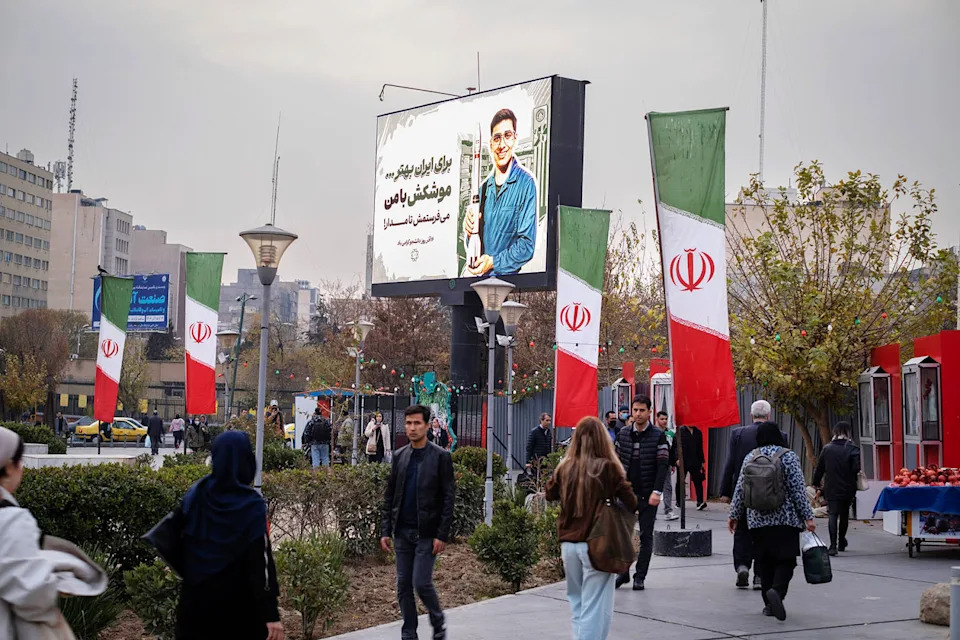
A sign in Tehran on Dec. 7 features an image of a university student holding a model of a satellite carrier, alongside Persian script that reads, ''For a better Iran, its missile is on me; I will send it into orbit.'' (Morteza Nikoubazl / NurPhoto via Getty Images)
Strategic and Political Context
Israeli requests for U.S. support come as Mr. Trump weighs other foreign-policy moves, including possible action in Venezuela, and while he publicly touts the June campaign against Iran's nuclear program and his role in a Gaza ceasefire. Tehran has signaled interest in resuming talks with Washington about limits on its nuclear activities, a development that could complicate Israeli efforts to secure U.S. approval for new strikes.
Israeli officials are also closely watching Iranian funding and arming of regional proxies. Some Israeli and former U.S. officials warn that, if left unchecked, Iran's missile production could increase dramatically — assessments cited by sources suggest a potential rise to as many as 3,000 missiles per month — which would both increase the immediate threat to Israel and complicate efforts to protect or strike Iran's nuclear sites.
Statements From Leaders
Mr. Trump has repeatedly asserted that the June strikes 'obliterated' Iran's nuclear capabilities and has warned Tehran against attempting to rebuild its missile or nuclear programs. He has also indicated possible willingness to resume diplomatic talks with Iran under some conditions.
The Israeli government declined to comment for this report. The Iranian Mission to the United Nations did not respond to requests for comment.
Note: This article summarizes reporting from sources with direct knowledge of Israeli planning and former U.S. officials who were briefed on the plans.


