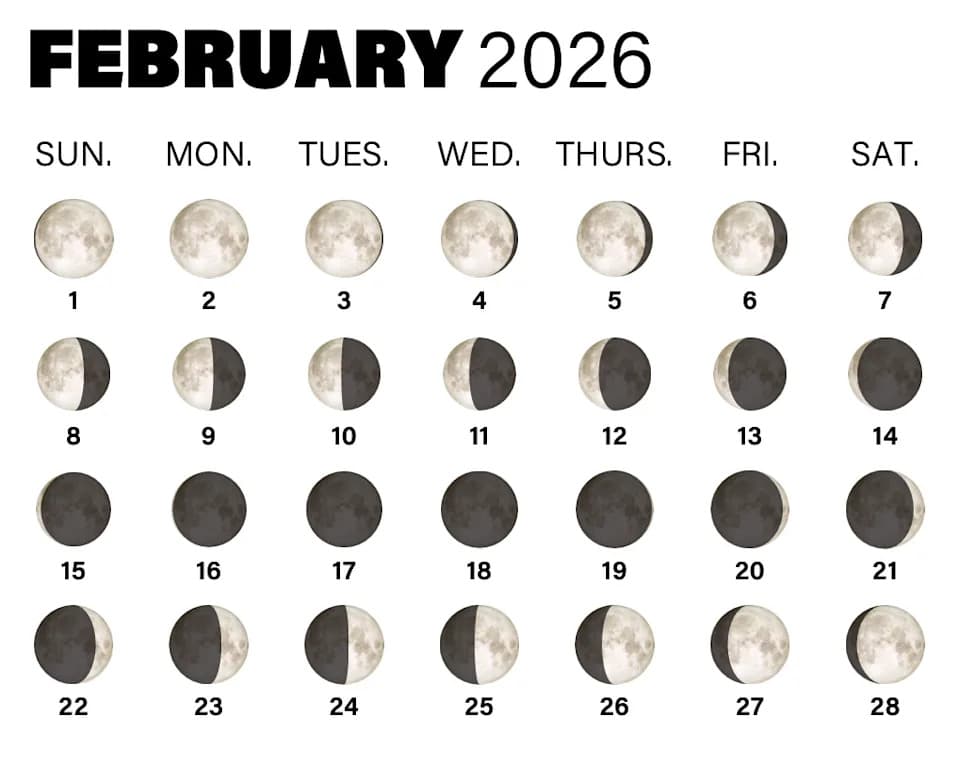
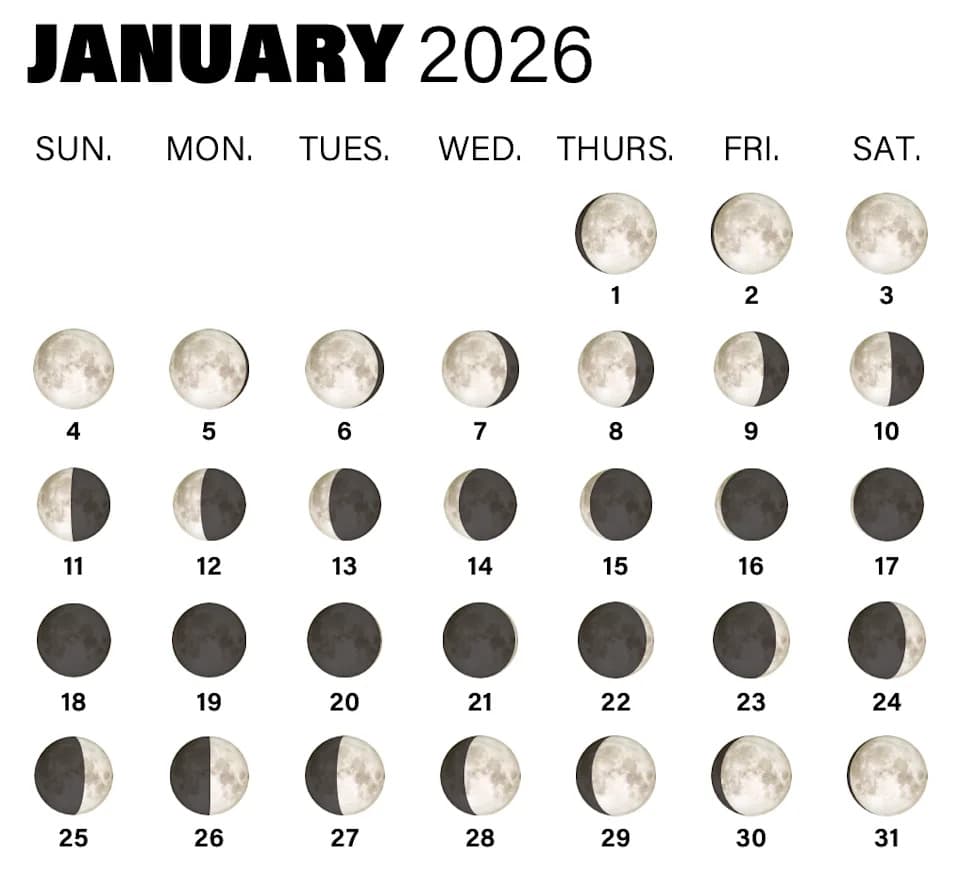
The Full Moon occurs when Earth sits between the Sun and the Moon, fully illuminating the Moon's near side. The Worm Moon peaks at 6:38 a.m. EST on March 3, 2026 and coincides with a total lunar eclipse. This guide lists every 2026 Full Moon with times (Eastern), explains terms like Super Moon and Blue Moon, and provides the full lunar phase calendar and sample local rise/set times for early February.
2026 Full Moon Calendar: Dates, Names, Eclipse Alerts & Viewing Tips
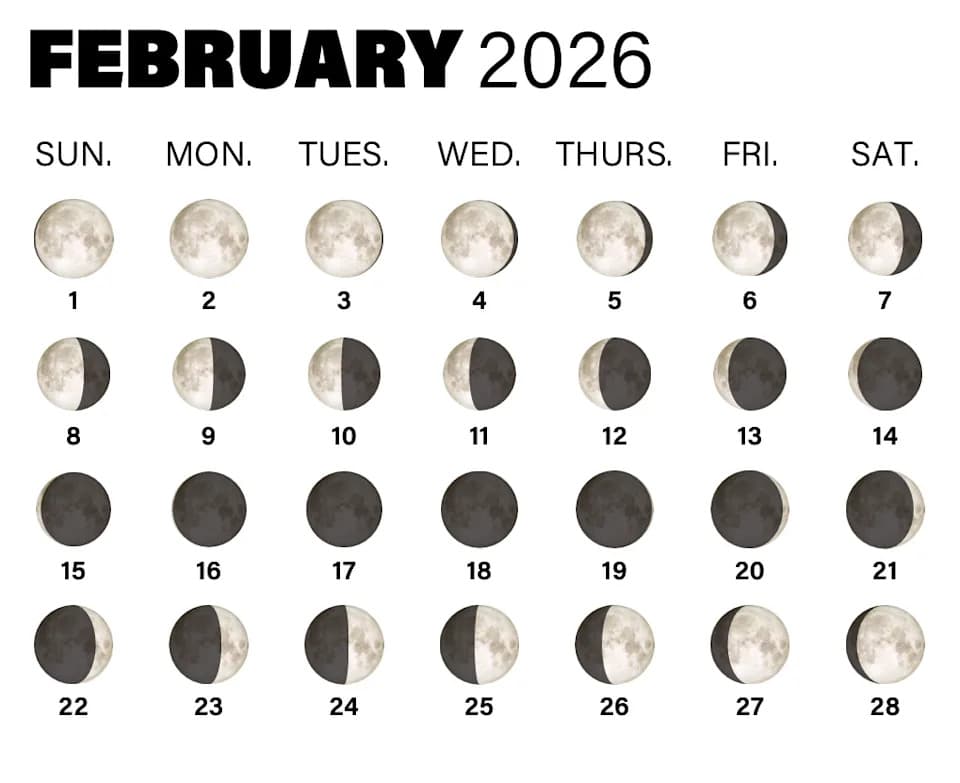
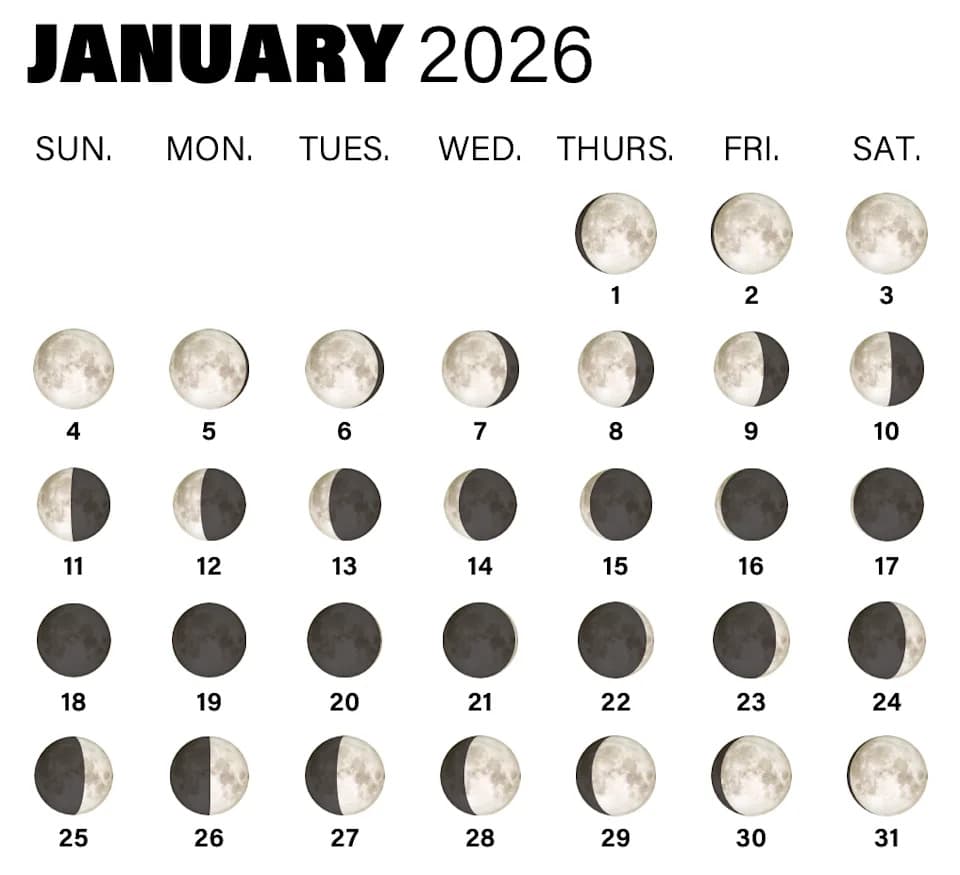
Note: Moon phases in the calendar vary in size due to the distance from Earth and are shown at 0h Universal Time. Credit: Astronomy: Roen Kelly
The Full Moon occurs when Earth lies nearly directly between the Sun and the Moon, lighting the lunar hemisphere that faces us. In 2026 several notable events include a total lunar eclipse during the Worm Moon and two eclipses later in the year. Below is a clear, user-friendly guide to every Full Moon in 2026, definitions of commonly used Moon terms, local rise/set examples, and the full lunar-phase calendar for the year.
Full Moons in 2026 (All times Eastern; * = Super Moon)
- Saturday, Jan. 3 - 5:03 a.m. - Wolf Moon*
- Sunday, Feb. 1 - 5:09 p.m. - Snow Moon
- Tuesday, March 3 - 6:38 a.m. - Worm Moon | Total lunar eclipse
- Wednesday, April 1 - 10:12 p.m. - Pink Moon
- Friday, May 1 - 1:23 p.m. - Flower Moon
- Sunday, May 31 - 4:45 a.m. - Blue Moon
- Monday, June 29 - 7:57 p.m. - Strawberry Moon
- Wednesday, July 29 - 10:36 a.m. - Buck Moon
- Friday, Aug. 28 - 12:19 a.m. - Sturgeon Moon | Partial lunar eclipse
- Saturday, Sept. 26 - 12:49 p.m. - Corn Moon
- Monday, Oct. 26 - 12:12 a.m. - Hunter's Moon
- Tuesday, Nov. 24 - 9:54 a.m. - Beaver Moon*
- Wednesday, Dec. 23 - 8:28 p.m. - Cold Moon*
Quick Viewing Notes
- The Worm Moon on March 3, 2026 peaks at 6:38 a.m. EST and coincides with a total lunar eclipse; viewers across the night side of Earth will see the eclipse at different stages depending on location.
- Super Moons (Jan. 3, Nov. 24, Dec. 23) occur when the Full Moon is near lunar perigee and can appear slightly larger and brighter than average.
- The Blue Moon on May 31 is the second Full Moon in May and is not actually blue under normal atmospheric conditions.
What Is a Full Moon?
A Full Moon is the instant when the Moon is opposite the Sun with Earth between them, making the Moon's near side fully illuminated as seen from Earth. Although that exact instant is brief, the Moon appears nearly full to casual observers for about three days centered on that moment.
Special Moon Terms
- Super Moon - A Full Moon near lunar perigee (closest approach to Earth), appearing slightly larger and brighter.
- Blue Moon - The second Full Moon in a calendar month containing two Full Moons; happens about every 2.7 years.
- Black Moon - An informal term; commonly defined either as the third of four New Moons in a season or the second New Moon in a calendar month.
- Harvest Moon - The Full Moon closest to the autumnal equinox, often providing extended evening moonlight valuable historically for harvest work.
How the Moon Affects Tides
The Moon's gravity pulls on Earth's oceans to create tidal bulges. When the Sun, Moon and Earth align at Full and New Moons, their combined gravity produces spring tides, which yield especially high high tides and especially low low tides.
Example Local Rise/Set Times (Reference: 40° N, 90° W)
Below are local times for sunrise, sunset, moonrise and moonset at the reference location 40° N, 90° W. Moon illumination percentages are given for 10:00 p.m. local time.
Thursday, February 5 — Sunrise: 7:04 A.M.; Sunset: 5:24 P.M.; Moonrise: 9:48 P.M.; Moonset: 8:53 A.M.; Moon Phase: Waning gibbous (81%)
Friday, February 6 — Sunrise: 7:03 A.M.; Sunset: 5:26 P.M.; Moonrise: 10:51 P.M.; Moonset: 9:14 A.M.; Moon Phase: Waning gibbous (72%)
Saturday, February 7 — Sunrise: 7:02 A.M.; Sunset: 5:27 P.M.; Moonrise: 11:55 P.M.; Moonset: 9:37 A.M.; Moon Phase: Waning gibbous (63%)
2026 Lunar Phases (New — First Quarter — Full — Last Quarter)
Jan. 3 — Jan. 10 — Jan. 18 — Jan. 25
Feb. 1 — Feb. 9 — Feb. 17 — Feb. 24
March 3 — March 11 — March 18 — March 25
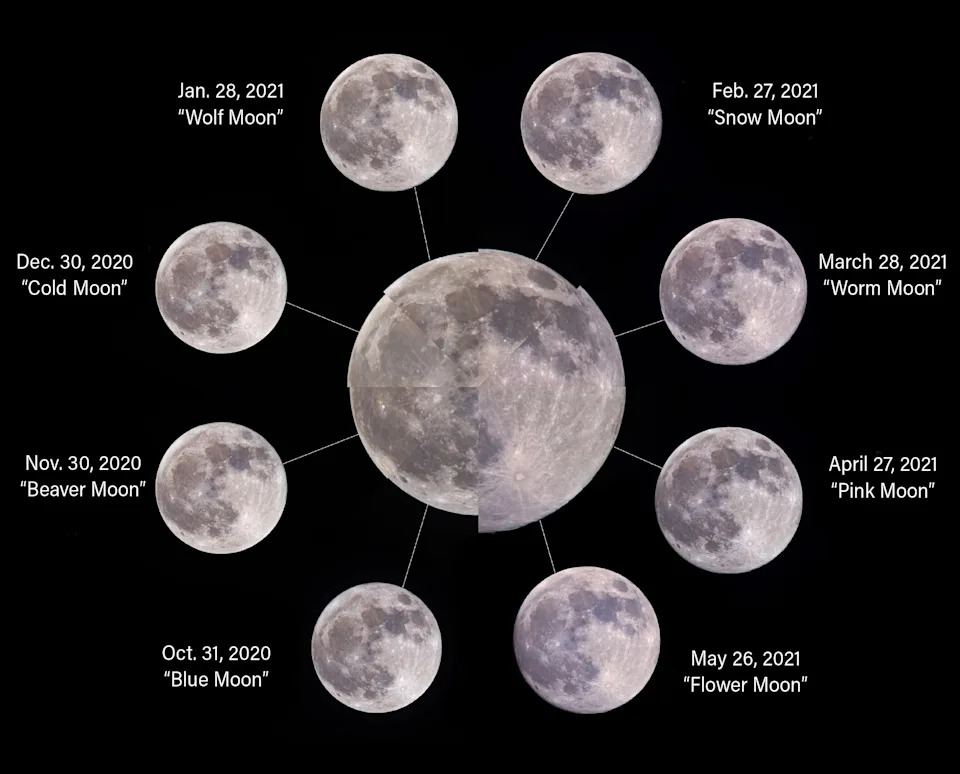
A composite of each month’s Full Moon in 2020 and 2021. Credit: Soumyadeep Mukherjee
April 1 — April 10 — April 17 — April 23
May 1 — May 9 — May 16 — May 23
May 31 — June 8 — June 14 — June 21
June 29 — July 7 — July 14 — July 21
July 29 — Aug. 5 — Aug. 12 — Aug. 19
Aug. 28 — Sept. 4 — Sept. 10 — Sept. 18
Sept. 26 — Oct. 3 — Oct. 10 — Oct. 18
Oct. 26 — Nov. 1 — Nov. 9 — Nov. 17
Nov. 24 — Dec. 1 — Dec. 8 — Dec. 17
Dec. 23 — Dec. 30
Quick Facts
- The synodic month (new Moon to new Moon or Full Moon to next Full Moon) is about 29.5 days.
- Full and New Moons cause spring tides due to alignment of solar and lunar gravity.
- Full Moons appear nearly full for roughly three days to the casual observer.
Images showing day-by-day lunar phases for February were part of the original article but are not included here. For weekly highlights and more observing tips, see the Sky This Week column referenced by the original publisher. This post is based on a calendar first published by Astronomy Magazine.
Help us improve.