
Quick summary: NASA probes first noted a human-related radio feature in near‑Earth space around 2012, and studies published in 2017 showed very low frequency (VLF) transmissions can alter the distribution of charged particles in the Van Allen belts. VLF emissions—historically used by military and long‑range services—can nudge electrons into the atmosphere, creating localized depletions in belt radiation. This human-made effect may help reduce some radiation risks and suggests potential (but unproven) ways to protect spacecraft.
Humans Built an Invisible Radio Shield Around Earth — How VLF Transmissions Reshape the Van Allen Belts

Whoops, Humans Made a Space Barrier Around EarthNASA
NASA probes discovered a surprising, human-related feature in near‑Earth space: a band of very low frequency (VLF) radio energy that can change where charged particles collect in the Van Allen radiation belts. First noticed around 2012 and shown in follow-up studies in 2017 to be causally linked to VLF transmissions, this phenomenon reveals that decades of radio signaling have left a measurable mark on the space environment around our planet.
What Scientists Found
The Van Allen belts are donut-shaped regions of energetic charged particles trapped by Earth's magnetic field. They affect everything from auroras to spacecraft electronics and human crews, so researchers study them closely. Probes sent to study these belts detected a persistent radio-wave feature that lined up with the belts' edge.
“A certain type of transmission, called very low frequency (VLF) radio communications, have become far more common now than in the 60s, and the team at NASA confirmed that they can influence how and where certain particles in space move about.”
How VLF Waves Interact With Particles
VLF waves occupy the lowest part of the radio spectrum and can penetrate the ionosphere well enough to interact with trapped electrons in the radiation belts. Through wave–particle interactions (for example, gyroresonant scattering), VLF transmissions can change particle pitch angles and energy, nudging some electrons into the atmosphere where they are lost from the belts. The result can be a localized depletion or shift in where radiation is concentrated.
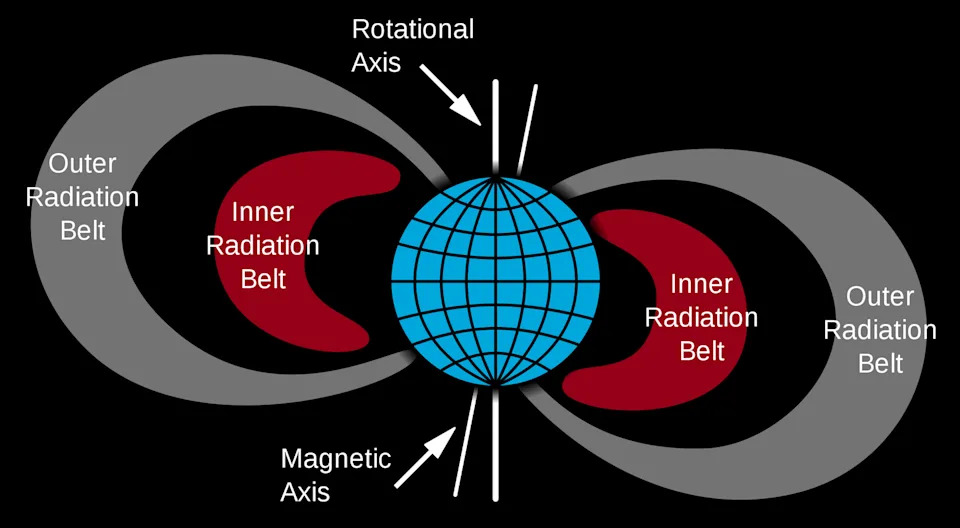
A cross section of Van Allen radiation belts.NASA/Public Domain
Why This Matters
Practical consequences include the potential to reduce certain radiation hazards in targeted regions and to influence how engineers plan spacecraft trajectories and shielding. However, the effect is energy‑ and location‑dependent: VLF does not simply erase the Van Allen belts, but can modify their structure at particular energies and geomagnetic latitudes.
Who Uses VLF—and Why It Reached Space
VLF bands have long been used for long‑range signaling, including naval and military communications, and for early telegraph‑style transmissions. Because these frequencies propagate efficiently through the lower atmosphere and into the ionosphere, persistent emissions over decades have produced measurable space‑weather effects without interfering with most civilian communications higher in the spectrum.
Opportunities and Limits
Some researchers suggest that deliberate use of VLF or similar techniques might one day be used to create safer corridors for spacecraft or to mitigate radiation temporarily. That idea remains speculative: intentional modification of near‑Earth space would require far more study to understand side effects, scale, and feasibility.
Bottom Line
This discovery shows that human technology can alter the near‑Earth space environment in subtle but important ways. While VLF transmissions have created a kind of invisible radio barrier that influences where energetic particles collect, the phenomenon is nuanced — promising for mitigation research but not an immediate fix for spaceflight radiation.


